
Markets
Jensen Huang GTC 2026 San Jose
(Nvidia/YouTube)

Nvidia keeps giving Wall Street everything it wants — without getting rewarded

Yet another case of good financial news from Nvidia failing to generate an enduring positive reaction.

At Nvidia’s GPU Technology Conference, CEO Jensen Huang stressed that the chip designer could be everything to everyone in AI.

And that, along with a mammoth revenue outlook, was everything that Wall Street wanted to hear.

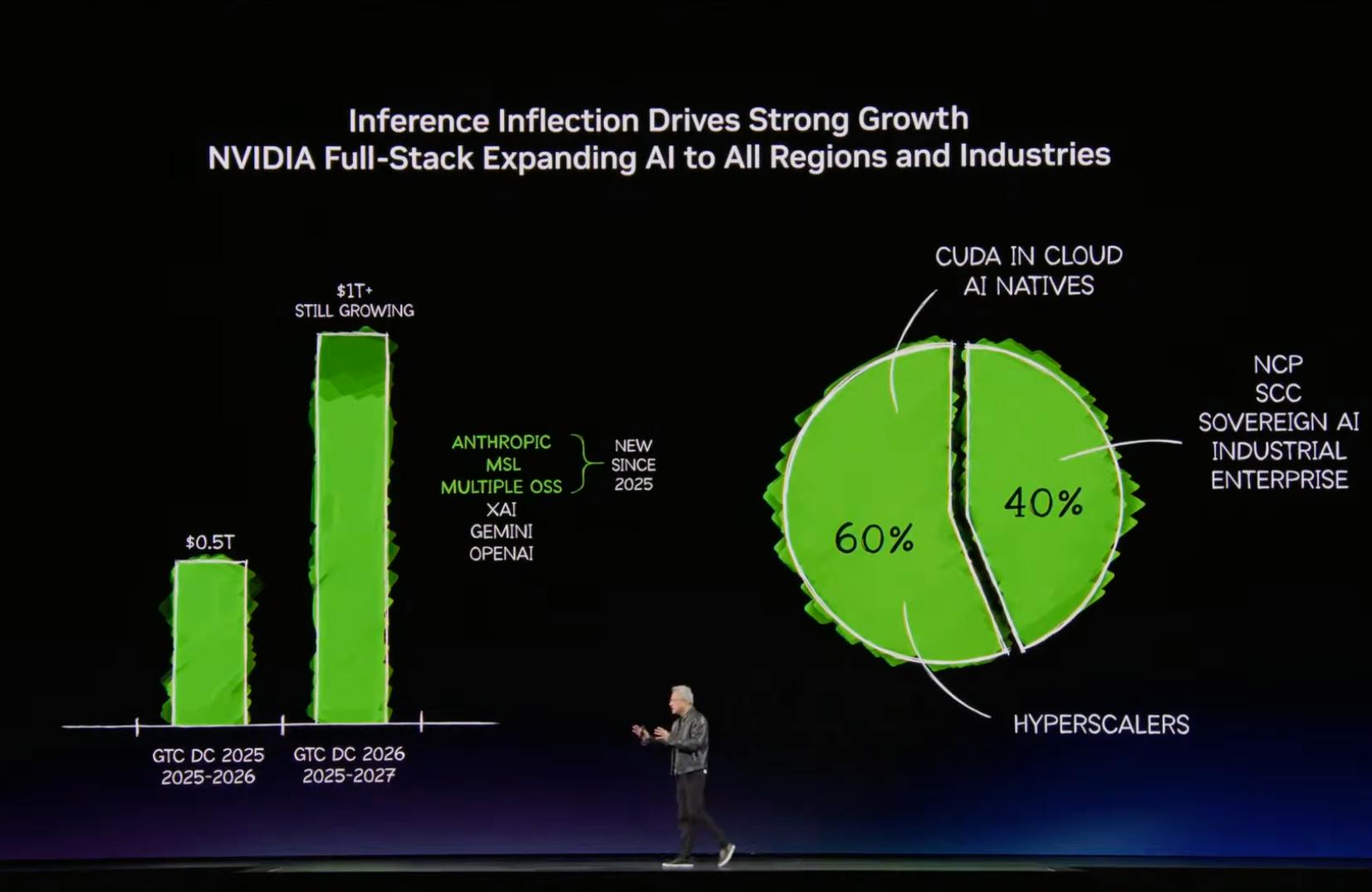
During his keynote, Huang repeatedly said that the chip designer is both vertically integrated (that is, offers all the solutions you need, not just GPUs) and also horizontally open (read: will integrate its offerings into whatever your technology stack happens to be). The headline, however, was his proclamation that AI chip sales would be at least $1 trillion through 2027.

Per analysts, Nvidia clarified that this $1 trillion guidance applies only to sales of Blackwell (which started shipping in its fiscal Q4 2025, roughly calendar Q4 2024) and Rubin chips, as well as associated networking equipment and CPUs, but not other products that were discussed at GTC. Therefore, the Street anticipates that overall data center sales are likely to come in well above that milestone figure.

Bottom line: no matter how you want to slice it, this number — and its implications for total revenues through calendar year 2027 — is an unmitigated thumbs-up relative to the consensus estimate.

But it’s yet another case of good financial news from Nvidia failing to generate an enduring positive reaction. Shares briefly spiked to session highs after Huang’s revenue guidance, but quickly lost all that advance and closed below where they were trading when the presentation started.

(That’s still better than the stock has done during most high-profile events recently.)

Here’s what analysts had to say about Huang’s keynote:

JPMorgan’s Harlan Sur, “overweight” rating, price target of $265:

“Net, while the market debate has shifted to AI spending cycle duration, we believe NVDA’s vertically integrated platform (now spanning seven chips, five rack systems, and the software stack to tie them together) is difficult to replicate, and the combination of accelerating inference demand, a structurally expanding TAM [total addressable market] via traditional workload acceleration, and a broadening customer base supports a more durable cycle than the market is currently underwriting.”

“NVDA’s Groq 3 LPU integration with Vera Rubin was the most architecturally significant product announcement — a disaggregated inference architecture that pairs Rubin GPUs (high throughput) with Groq LPUs (low latency decode) and positions NVDA to effectively service the low-latency inference market (where ASICs have traditionally held an advantage).”

Bernstein’s Stacy Rasgon, “outperform” rating, price target of $300:

“NVIDIA’s full platform approach appears increasingly difficult to disrupt as they relentlessly build out their software and hardware stacks across multiple offerings including GPUs, CPUs, DPUs, (now) LPUs, networking, and storage, and continue to drive token costs down by orders of magnitude with every generation which should allow them to capitalize as inference computing exponentiates; frankly we increasingly wonder how anyone else can compete with this.”

“NVIDIA’s roadmap looks really solid, their capability gap continues to widen, new offerings ought to help cement their position in inference just as they dominate training, and the order book suggests further upside to numbers, with the stock (in our opinion) almost absurdly valued given their positioning.”

Bank of America’s Vivek Arya, “buy” rating, price target of $300:

“1 gigawatt of data center now represents ~$40 billion of capex, with NVDA addressing $20-30 billion depending on networking content. Overall, we see continued NVDA leadership in AI backed by its broadening full-stack end-to-end pipeline, extreme co-design with customers, and supply assurance.”

Wedbush Securities’ Dan Ives, “outperform” rating, price target of $300:

“GTC 2026 was another opportunity for Jensen & Co. to further separate from the field in the AI arms race and they delivered, further reinforcing that Nvidia sits alone at the top of the AI mountain with the entire tech world watching below.”

“Inference has emerged as a dominant demand driver, with the GB200 NVL72 delivering up to 50x performance per watt and 35x lower cost per token compared to Hopper, making it the clear architecture of choice for enterprises scaling agentic AI workloads. With agentic systems now generating tokens at an exponential rate and the Groq licensing agreement set to unlock new levels of low-latency inference performance, the GB200 NVL72 sits at the center of the most important infrastructure buildout in the history of technology and NVDA’s inference leadership is only widening.”

Morgan Stanley’s Joseph Moore, “overweight” rating, price target of $260:

“We note that NVIDIA has consistently put up more upside to quarterly guidance than either of these competitors, and while just how strong 2027 is remains to be seen, we believe that NVIDIAs forecast leaves the most room for upside in the base case. Market share in this environment has more to do with supply chain, and we increasingly see potential for bottlenecks in other parts of the supply chain may actually bring preference to NVIDIA given a non supply limitation on GPU/XPU.

That’s especially relevant when the stock is trading at ~17x EPS [earnings-per-share] numbers that are likely to have material upside, discounting a falloff in earnings not yet in evidence. It’s certainly true that a semiconductor company’s views about demand 24 months into the future should be taken with a healthy dose of skepticism, but given bottlenecks in AI around land, power, and space, Nvidia’s customers are making planning decisions and commitments that far into the future, so it makes sense Nvidia is getting that visibility as well.”

More Markets

See all Markets

US airlines pop on report Spirit preparing to shut down as government rescue deal fails to gain support

US airlines are spiking on Friday following a Wall Street Journal report that low-budget carrier Spirit Airlines is preparing to shut down. According to CBS News, the airline could cease operations as early as Saturday, barring an intervention.

In late April, President Trump said he would “love somebody to buy Spirit.” The administration weighed a $500 million rescue package, though it received significant blowback from members of Congress and ultimately didn’t receive support from Spirit’s creditors.

On Friday, Trump told reporters that the administration has given Spirit a “final proposal.”

Shares of Spirit’s rivals surged on the report, with budget carriers like Frontier Airlines and JetBlue climbing by double digits. The big four — Delta Air Lines, United Airlines, American Airlines, and Southwest Airlines — rose by low single digits. Alaska Air and Allegiant also saw a bump.

markets

Estée Lauder gets a glow-up after earnings beat, guidance hike

Estée Lauder shares are soaring after the beauty giant released Q3 earnings results that topped expectations and raised its full-year outlook, while also expanding its restructuring plan.

The key numbers:

  • Revenue of $3.71 billion (compared to analysts’ estimate of $3.69 billion).

  • Adjusted earnings per share of $0.91 (estimate: $0.65).

Estée Lauder also lifted its full-year earnings outlook to a range of $2.35 to $2.45 per share, up from $2.05 to $2.25 previously.

The bottom line is getting flattered by job cuts, with management increasing that target to as many as 10,000 roles, up from a prior range of 5,800 to 7,000, as part of a broader effort to streamline operations and shift toward faster-growing sales channels.

The rally comes after a tough stretch for the stock, which is down more than 20% year to date, with the results inspiring hope that its turnaround efforts will bear fruit.

CEO Stéphane de La Faverie said fiscal 2026 is “promising to be the pivotal year we intended,” with the company expecting to restore organic sales growth and expand margins for the first time in four years.

Amid these positive signals, Estée Lauder flagged risks from tariffs, geopolitical tensions, and potential disruptions tied to the Middle East.

markets

Moderna beats Q1 estimates and reaffirms full-year guidance

Moderna rose in premarket trading after it reported earnings results that beat Wall Street expectations and reaffirmed its full-year guidance.

For the first three months of 2026, the company reported:

  • An adjusted loss per share of $3.40, less than the $4.45 loss per share analysts polled by FactSet had expected.

  • Revenue of $352 million, more than the $236 million the Street was anticipating. About 80% of that came from outside the US, the company said.

For the full year in 2026, the company still expects:

  • Revenue to grow 10%. Currently, analysts are penciling in $2 billion in 2026 sales, which is about a 5% increase.

Moderna was tapped by the US government to quickly develop a vaccine for COVID-19 in 2020, a product that has seen its sales plummet, but remains the company’s main source of revenue.

Now, the company sees growth on the horizon this year, after the European Commission approved its combination vaccine for the flu and COVID-19 for adults ‌50 years and older. Indeed, Moderna said a growing share of its revenue is coming from international markets.

The company has had a harder time getting approval from the US Food and Drug Administration, though the agency said in February that it would reconsider its stand-alone flu vaccine.

markets

Chevron posts mixed Q1 results, as sales miss offsets big earnings beat

Chevron is modestly lower after posting mixed Q1 results, as investors wonder whether elevated oil prices and crack spreads will continue to buoy earnings in the quarters to come.

The key numbers:

  • Q1 revenue of $48.6 billion (compared to analyst estimates of $50.6 billion).

  • Adjusted earnings per share of $1.41 (estimate: $0.90).

  • Production of 3.86 million barrels of oil equivalent per day (estimate: 3.8 million).

The upside surprise in Chevron’s upstream (production) business more than offset underwhelming results in its downstream (refined) division.

Friday’s dip comes with Chevron outperforming most of the Energy Select Sector SPDR Fund as of 10:36 a.m. ET, with tumbling West Texas Intermediate futures weighing on energy stocks.

Chevron said earnings would have been better if not for “unfavorable timing effects” totaling about $2.9 billion, which included mark-to-market losses on derivatives and inventory accounting impacts, weighing on reported earnings.

“Despite heightened geopolitical volatility and related supply disruptions, Chevron delivered solid first-quarter performance,” CEO Mike Wirth said, citing strong US operations and production growth following the integration of Hess.

Ahead of these results, Chevron had also cautioned that supply may take time to respond to higher prices. Wirth also said in a CBS interview that restoring production is “not like turning on a faucet,” noting it can take “weeks and months, in some cases years” to bring disrupted fields and infrastructure back online.

The results also come as Wirth met with President Trump and other energy executives this Tuesday to discuss potential steps to stabilize oil markets in the event that shipments through the Strait of Hormuz remain limited.

Latest Stories

Sherwood Media, LLC produces fresh and unique perspectives on topical financial news and is a fully owned subsidiary of Robinhood Markets, Inc., and any views expressed here do not necessarily reflect the views of any other Robinhood affiliate, including Robinhood Markets, Inc., Robinhood Financial LLC, Robinhood Securities, LLC, Robinhood Crypto, LLC, Robinhood Derivatives, LLC, or Robinhood Money, LLC. Futures and event contracts are offered through Robinhood Derivatives, LLC.

