
Markets
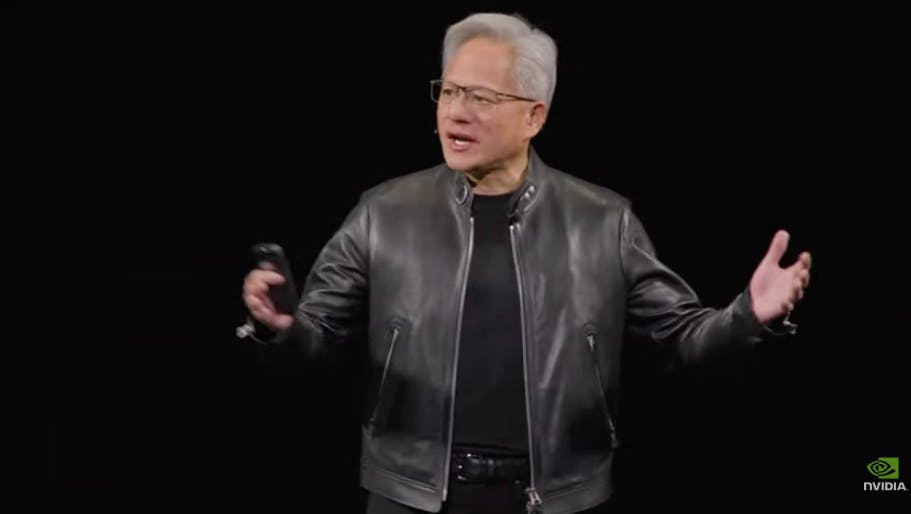
Jensen Huang at 2026 GTC in San Jose
(Nvidia/YouTube)

What Wall Street’s looking for from Nvidia’s Q1 results

Further upside to its $1 trillion revenue guidance, more customer success, and shareholder returns.

Editor’s note: A version of this post appeared in the May 20 edition of EntryPoint, a markets newsletter from Sherwood featuring data on how Robinhood traders are navigating the daily twists and turns and the key trends that define the price action. Sign up here.

The only thing that can steal the spotlight from 30-year Treasury yields hitting a 19-year high is the world’s most valuable company releasing quarterly results.

Here are the numbers Wall Street is keying in on when Nvidia reports its Q1 figures after the close on Wednesday, as well as expectations for Q2 guidance:

And here’s how the options market is positioned ahead of the mAIn event:

It’s not a pure read on sentiment or even intent, but there’s certainly a lot of wood to chop overhead, with elevated open interest at every round number between here and $250. For what it’s worth, open interest in calls at $240 and $250 was flying higher last Thursday, when Nvidia booked a fresh all-time high, which probably points to bullish outright (or at the very least) spread positions being established ahead of earnings.

Beyond the numbers, here’s what analysts will want to hear more on from the chip designer:


$1 trillion… and counting?

The revenue target that CEO Jensen Huang unveiled in March for Blackwell and Rubin chips as well as networking equipment through 2027 seemed massive at the time. 

But more than two months later, Morgan Stanley analyst Joseph Moore thinks his peers still haven’t adequately updated their forecasts to account for these potential sales — and that there’s more where that came from.

His math suggests that this $1 trillion target would be hit via $845 billion of data center sales during this calendar year and the next. 

“Despite that [target] consensus estimates for total datacenter revenue over that period is just $785 billion,” Moore wrote, arguing that there’s upside to those numbers from Groq, stand-alone CPUs, and Inference Context Memory Storage.

“Given how recently Nvidia has launched Groq and standalone CPUs this is an area where we may hear more about the potential revenue contribution in the near-term and how Nvidia sees their solutions for competing offerings,” he added.

CPUs in particular will be in focus thanks to the computing demands of AI agents, which have seemingly tilted the ratio of CPUs to GPUs needed to run models substantially toward the former.

How are its customers doing?

A company’s fate is inextricably tied to its customers.

“We believe the stock’s multiple can re-rate if we see evidence of: (1) improving profitability metrics at hyperscalers that supports sustained spending growth; (2) proliferation of agentic AI signaling broader enterprise adoption; (3) more visibility into deployments at non-traditional customers,” Goldman Sachs analyst James Schneider wrote. 

Henry Ford famously wanted his employees to be able to afford the cars they made. Similarly, the longevity of the AI boom depends on cloud providers and more downstream end users receiving a solid ROI from this spending, rather than returns being concentrated in chip and AI infrastructure companies.

“We believe the Street is underestimating the cloud growth/AI deal flow conversion for Microsoft/Azure and Amazon/AWS over the next year... and the software layer with recent positive data points from Palantir, Datadog, and Innodata is now showing the tidal wave of use case driven demand is on the horizon,” Wedbush Securities analyst Dan Ives wrote.

Getting an OK from boomers

Investors have put a lot of money into Nvidia; Bank of America’s Vivek Arya reckons they’d shell out even more if the chip designer returned the favor. 

We’ve discussed how Nvidia may have become “too big to excite” as it’s matured. Well, attracting more love from the boomer cohort — since the desire for income-generating investments generally increases with age — might be one way to remedy this enthusiasm gap.

“The historical pivot towards free cash flow returns at Apple and Microsoft is well known,” Arya wrote. “While it certainly was not the only reason for their enhanced P/E multiples, it likely created a class of sticky shareholders, including possible attraction of dividend growth and income growth funds.”

Nvidia plans on dividends and buybacks running at about 50% of its free cash flow. In mid-March, CFO Colette Kress told investors to “stay tuned” for announcements on enhanced shareholder returns. But, she added, those would probably have to wait until the second half of ’26, as management was focusing on its investments in the first half.

There’s always the possibility of being positively surprised, but it’s now May, and Nvidia has splashed a ton of dough on financial investments rather than capex. Just in 2026, the company has reached agreements with CoreWeave, Lumentum, Coherent, Nebius, Marvell Technology, Corning, and IREN as Nvidia flexes its financial might to support the AI ecosystem and, in most cases, secure future supply for what management expects will be a long-lived series of data center build-outs.

Bof Nvidia FCF estimates

More Markets

See all Markets
markets

Micron jumps on looming Samsung strike

Micron shares are climbing early Wednesday, breaking a sharp multi-day semiconductor pullback. The rally comes amid the potential for a critical supply-side disruption at one of its largest global competitors, Samsung Electronics, as well as building investor enthusiasm ahead of Nvidia’s highly anticipated earnings report.

As demand for AI compute accelerates, Micron is increasingly viewed as a top-tier beneficiary due to its role in the critical high-bandwidth memory (HBM) market. The operational catalyst sparking Micron’s rally is a massive looming labor dispute in South Korea. According to Reuters, roughly 48,000 Samsung workers are set to begin an 18-day strike Thursday after negotiations broke down.

As global HBM production is effectively controlled by Micron, Samsung Electronics, and SK Hynix, any manufacturing hiccup at Samsung shifts pricing leverage to Micron. This backdrop comes as South Korea’s broader chip ecosystem is benefiting from the global infrastructure boom, pushing the country to the seventh-largest stock market in the world.

Micron has been expanding its own AI memory footprint. In March, the company completed its acquisition of PSMC’s Tongluo P5 site, a strategic integration designed to scale its domestic HBM production capacity and meet accelerating hyperscaler demand.

markets

Target sinks on expense concerns despite Q1 earnings beat

Target shares are sinking in volatile early Wednesday trading, erasing its premarket gains as investor anxiety over rising corporate overhead and tightening profit margins appeared to overawe strong Q1 earnings results that beat Wall Street estimates.

Key numbers:

  • Revenue of $25.44 billion (estimate: $24.11 billion).

  • Adjusted earnings per share of $1.71 (estimate: $1.43).

  • Same-store sales growth of 5.6% (estimate: 1.85%).

Target's headline numbers signaled clear, if partial, comeback story with 6.7% net sales growth, breaking a year-long slump. The company also raised its full-year sales growth forecast to 4.0% compared with 2025, double its previous forecast of 2% growth. The company now projects annual EPS to land at the high end of its $7.50 to $8.50 range, beating the $8.10 consensus estimate from Wall Street.

However, Target’s operational expenses climbed to 21.9% of its total revenue last quarter, up from last year, with the company citing "higher compensation costs" and "higher marketing expense" to explain the jump . These rising costs were only partially offset by the boost from Target's strong sales growth.

"While we have momentum, we’re also being cautious about the near-term operating environment," said Michael Fiddelke, CEO of Target. "With consumers weighing multiple headwinds and tailwinds, and recent dips in consumer sentiment, we continue to place a premium on flexibility, not wanting to swing too hard too quickly, despite the early signs of momentum we’re seeing."

This is the first earnings report under newly appointed CEO Michael Fiddelke, who officially took the helm in February and who’s focused on enhancing operational efficiency amid a prolonged retail sales slump.

Target yesterday announced that it tapped former Walmart exec Jeff England as chief supply chain officer to optimize inventory and delivery, part of a wider $6 billion turnaround. The retailer is also overhauling its beauty, baby, and apparel categories through exclusive Parke and “Pokémon” partnerships, though margins remain sensitive to inventory markdowns and labor costs.

markets

Roblox jumps after announcing $3 billion share buyback plan

Roblox rallied in postmarket trading on Tuesday after unveiling its first-ever share repurchase program.

The somewhat controversial, but certainly popular, gaming company has put forth a plan for $3 billion in future stock buybacks, with the intention to back up to $1 billion over the next 12 months. The stock subsequently jumped 4% after-hours.

On Tuesday, Naveen Chopra, chief financial officer of Roblox, said:

“Investing in continued growth will always be our highest priority, but the strength of our balance sheet and free cash flow generation allows us to support industry leading innovation while simultaneously reducing dilution.”

As of Q1 2026, Roblox had $6.2 billion in total cash, cash equivalents, and investments (for a net $5.2 billion after subtracting its $1.0 billion in debt). The company posted a consolidated net loss of $248 million in Q1.

While management has the cash on hand for a $3 billion buyback, the stock been taking hits recently — falling 28% over the past month (and 45% since the beginning of the year) as the company adjusts its safety standards. In April, the video game company slashed its full-year guidance due to age verification hurdles, which have slowed growth.

markets

Cava rallies after Q1 results impress and management hikes full-year guidance

Cava jumped 8% after the bell on Tuesday after the fast-casual Mediterranean restaurant chain was able to bring in more customers and drive up more revenue than expected in the first quarter, with management signaling that this momentum is poised to continue.

Here are the numbers:

  • Q1 revenue of $434.4 million (compared to analyst estimates of $418.2 million).

  • Q1 adjusted EBITDA of $61.7 million (estimate: $57.3 million).

  • Full-year guidance for same-restaurant sales growth of 4.5% to 6.5%, up from its prior guidance of 3% to 5% and above estimates for 4.95%.

The company also posted traffic growth of 6.8% — blowing away salad competitor Sweetgreen’s traffic decrease of 11.2% in the first quarter.

“We’re creating a bit of a bridge in a K-shaped economy and becoming very accessible for the low-income cohorts,” CFO Tricia Tolivar told Restaurant Dive. “When we look at our restaurant stratified based on median household income, we’re seeing tremendous strength in the lower-income cohorts.”

The performance of these fast-casual establishments (or slop bowl chains) has been a way to keep an eye on our increasingly unequal economy. Interestingly, as especially younger consumers seem to be pulling back, at some of these restaurants, Cava continues to perform well.

Latest Stories

Sherwood Media, LLC and Chartr Limited produce fresh and unique perspectives on topical financial news and are fully owned subsidiaries of Robinhood Markets, Inc., and any views expressed here do not necessarily reflect the views of any other Robinhood affiliate, including Robinhood Markets, Inc., Robinhood Financial LLC, Robinhood Securities, LLC, Robinhood Crypto, LLC, Robinhood Money, LLC, Robinhood U.K. Ltd, Robinhood Derivatives, LLC, Robinhood Gold, LLC, Robinhood Asset Management, LLC, Robinhood Credit, Inc., Robinhood Ventures DE, LLC and, where applicable, its managed investment vehicles.

