
Markets
Complex Simplicity
Getty Images

OpenAI doesn’t have the cash to pay Oracle $300 billion — raising it will test the very limits of private markets

The ChatGPT maker plans to burn though $115 billion by 2029. No company in history has ever lit that much money on fire intentionally, let alone tried funding such a splurge through private markets alone.

There’s a playbook in Silicon Valley: raise some money; build something people want; raise a lot more money; burn it in the pursuit of growth. The core of this strategy is to swap money for time by acquiring talent, companies, infrastructure, and technologies, all in the pursuit of leapfrogging your competition in the burgeoning field you’re disrupting.

Then, if you’re successful in ascending to the top: kick back, up your prices, and rake in the billions.

From Uber to Amazon, Tesla to Facebook, this game plan has worked time and time again. Jokes on late-night talk shows about companies losing money year after year, or paying a billion dollars for then boutique apps like Instagram, have become unfunny fast, as Big Tech has swallowed advertising, apparel, and everything in between.

But no company has ever burned as much money as OpenAI is planning to.

In the last few weeks, major deals with Broadcom and Oracle have thrown into sharp relief just how insane OpenAI’s ambitions are. The Oracle deal alone is worth $300 billion over five years starting in 2027. OpenAI does not have that kind of cash.

In fact, four of the tech world’s big “cash incinerators” — Uber, Tesla, Snap, and Netflix — together burned a pathetic ~$42 billion during their respective heavily cash-burning periods.
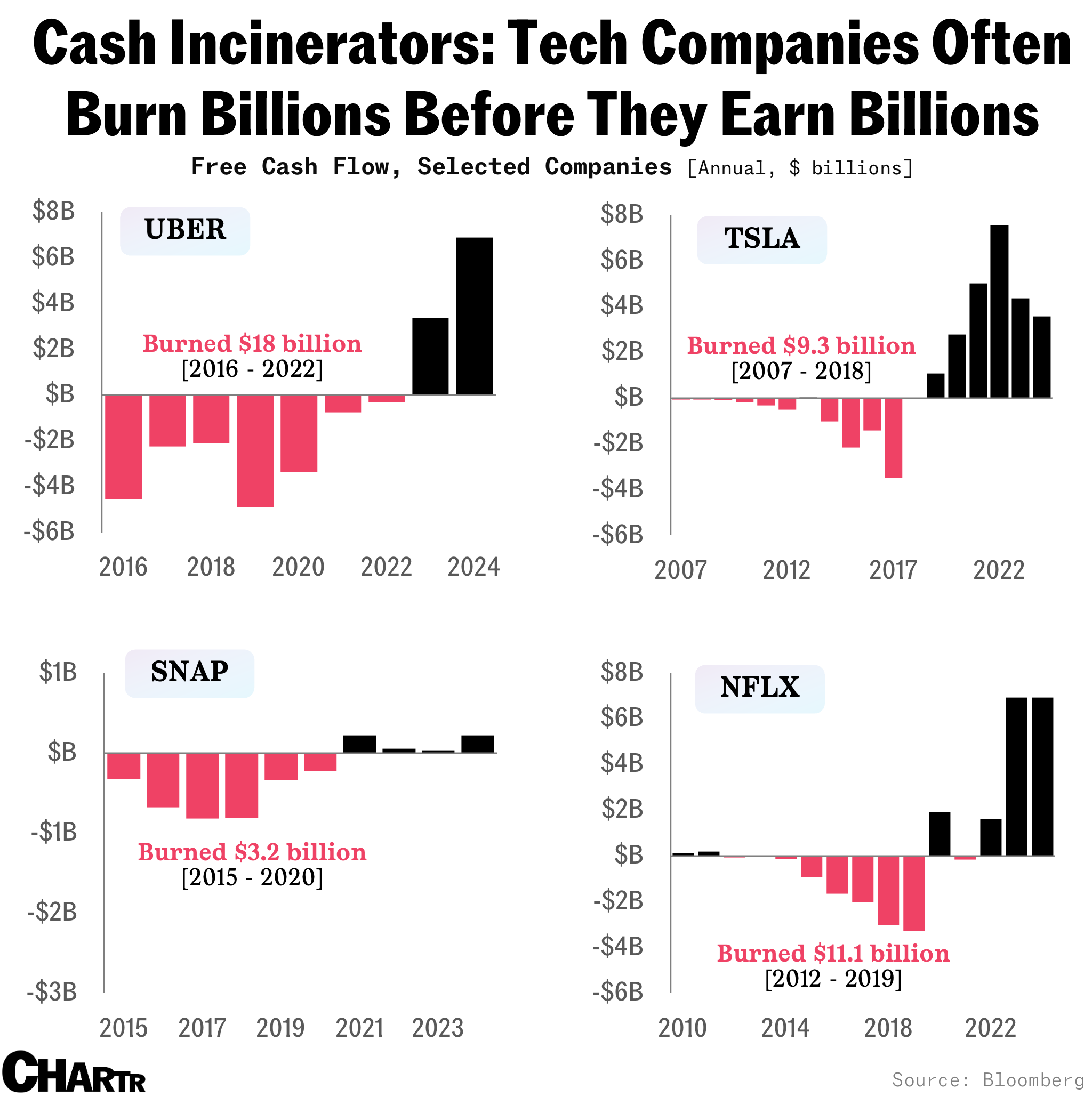
Lossmaking big tech burning cash
Sherwood News

Per The Information, OpenAI is planning on burning $115 billion through 2029. Given that the company raised “only” $40 billion earlier this year — and $64 billion in its lifetime to date, per Pitchbook data — it’s fair to assume that OpenAI will have to dip into the capital markets again to raise another $50 billion to $75 billion to fund its spending splurge.

And OpenAIs funding needs might not stop there — after that monstrous 2029 spending figure is reached, the company could still be on the hook for hundreds of billions of dollars as part of the freshly inked deal with Oracle, which runs for five years and only starts in 2027.

We’re going to need a bigger cap table

Just a few years ago, the idea of raising that amount on the deeply liquid public markets would have been remarkable; the biggest IPO ever was 2014’s Alibaba, which raised $25 billion — a figure that might not cover even a single year of OpenAI’s peak cash burn. Doing it in private markets would have been near unthinkable. Doing it as a complicated entity controlled by a “not-for-profit” entity? Insane.

Last week, the company revealed it had made progress on that last point. The Financial Times reported that OpenAI and Microsoft had signed a “non-binding memorandum of understanding” marking “a significant step forward in the start-up’s effort to convert to a more investor-friendly, for-profit structure.” That could unlock a potential IPO, giving institutional and retail investors the ability to invest directly in the company.

But in August, CEO Sam Altman said that an IPO was not a priority, suggesting there’s a very good chance that OpenAI continues to fund its runway via the private scene.

If the company pulls it off — raises all that money and finds a way to make the unit economics of its chatbot work along the way — it will raise a major question: is the stock market doing its primary job? If the most capital-hungry business of all time doesn’t need to raise on the public markets, we may need to rethink our textbook definitions of the stock market. The capital-allocating conduit that’s been the bedrock of American capitalism for more than a century is increasingly about price discovery, liquidity, and risk transfer, and less about capital formation.

What’s most remarkable, though, is that this might be quite an easy feat for OpenAI. Given the pervasive AI mania that we find ourselves experiencing in 2025, it’s hard to imagine that the world’s leading consumer-facing AI company will struggle to find investors for its cap table in the private markets, even at a nosebleed valuation of $500 billion and even with evidence that AI adoption might be cooling.

Related reading: Where did all the stocks go?

More Markets

See all Markets

US airlines pop on report Spirit preparing to shut down as government rescue deal fails to gain support

US airlines are spiking on Friday morning following a Wall Street Journal report that low-budget carrier Spirit Airlines is preparing to shut down.

In late April, President Trump said he would “love somebody to buy Spirit.” The administration weighed a $500 million rescue package, though it received significant blowback from members of Congress and ultimately didn’t receive support from Spirit’s creditors.

Shares of Spirit’s rivals surged on the report, with budget carriers like Frontier Airlines and JetBlue climbing by double digits. The big four — Delta Air Lines, United Airlines, American Airlines, and Southwest Airlines — rose by low single digits. Alaska Air and Allegiant also saw a bump.

markets

Estée Lauder gets a glow-up after earnings beat, guidance hike

Estée Lauder shares are soaring after the beauty giant released Q3 earnings results that topped expectations and raised its full-year outlook, while also expanding its restructuring plan.

The key numbers:

  • Revenue of $3.71 billion (compared to analysts’ estimate of $3.69 billion).

  • Adjusted earnings per share of $0.91 (estimate: $0.65).

Estée Lauder also lifted its full-year earnings outlook to a range of $2.35 to $2.45 per share, up from $2.05 to $2.25 previously.

The bottom line is getting flattered by job cuts, with management increasing that target to as many as 10,000 roles, up from a prior range of 5,800 to 7,000, as part of a broader effort to streamline operations and shift toward faster-growing sales channels.

The rally comes after a tough stretch for the stock, which is down more than 20% year to date, with the results inspiring hope that its turnaround efforts will bear fruit.

CEO Stéphane de La Faverie said fiscal 2026 is “promising to be the pivotal year we intended,” with the company expecting to restore organic sales growth and expand margins for the first time in four years.

Amid these positive signals, Estée Lauder flagged risks from tariffs, geopolitical tensions, and potential disruptions tied to the Middle East.

markets

Moderna beats Q1 estimates and reaffirms full-year guidance

Moderna rose in premarket trading after it reported earnings results that beat Wall Street expectations and reaffirmed its full-year guidance.

For the first three months of 2026, the company reported:

  • An adjusted loss per share of $3.40, less than the $4.45 loss per share analysts polled by FactSet had expected.

  • Revenue of $352 million, more than the $236 million the Street was anticipating. About 80% of that came from outside the US, the company said.

For the full year in 2026, the company still expects:

  • Revenue to grow 10%. Currently, analysts are penciling in $2 billion in 2026 sales, which is about a 5% increase.

Moderna was tapped by the US government to quickly develop a vaccine for COVID-19 in 2020, a product that has seen its sales plummet, but remains the company’s main source of revenue.

Now, the company sees growth on the horizon this year, after the European Commission approved its combination vaccine for the flu and COVID-19 for adults ‌50 years and older. Indeed, Moderna said a growing share of its revenue is coming from international markets.

The company has had a harder time getting approval from the US Food and Drug Administration, though the agency said in February that it would reconsider its stand-alone flu vaccine.

markets

Chevron posts mixed Q1 results, as sales miss offsets big earnings beat

Chevron is modestly lower after posting mixed Q1 results, as investors wonder whether elevated oil prices and crack spreads will continue to buoy earnings in the quarters to come.

The key numbers:

  • Q1 revenue of $48.6 billion (compared to analyst estimates of $50.6 billion).

  • Adjusted earnings per share of $1.41 (estimate: $0.90).

  • Production of 3.86 million barrels of oil equivalent per day (estimate: 3.8 million).

The upside surprise in Chevron’s upstream (production) business more than offset underwhelming results in its downstream (refined) division.

Friday’s dip comes with Chevron outperforming most of the Energy Select Sector SPDR Fund as of 10:36 a.m. ET, with tumbling West Texas Intermediate futures weighing on energy stocks.

Chevron said earnings would have been better if not for “unfavorable timing effects” totaling about $2.9 billion, which included mark-to-market losses on derivatives and inventory accounting impacts, weighing on reported earnings.

“Despite heightened geopolitical volatility and related supply disruptions, Chevron delivered solid first-quarter performance,” CEO Mike Wirth said, citing strong US operations and production growth following the integration of Hess.

Ahead of these results, Chevron had also cautioned that supply may take time to respond to higher prices. Wirth also said in a CBS interview that restoring production is “not like turning on a faucet,” noting it can take “weeks and months, in some cases years” to bring disrupted fields and infrastructure back online.

The results also come as Wirth met with President Trump and other energy executives this Tuesday to discuss potential steps to stabilize oil markets in the event that shipments through the Strait of Hormuz remain limited.

Latest Stories

Sherwood Media, LLC produces fresh and unique perspectives on topical financial news and is a fully owned subsidiary of Robinhood Markets, Inc., and any views expressed here do not necessarily reflect the views of any other Robinhood affiliate, including Robinhood Markets, Inc., Robinhood Financial LLC, Robinhood Securities, LLC, Robinhood Crypto, LLC, Robinhood Derivatives, LLC, or Robinhood Money, LLC. Futures and event contracts are offered through Robinhood Derivatives, LLC.

