Markets
Elon Musk In Krakow, Poland
Elon Musk, owner of Tesla and X, formerly Twitter (Beata Zawrzel/Getty Images)

Retail investors are getting smoked because they keep buying the dip in Tesla

This Tesla buying streak is the biggest in at least a decade, as investors pour into the Magnificent 7.

Luke Kawa

It turns out continuing to pile into the S&P 500’s biggest loser of the year is not a winning strategy.

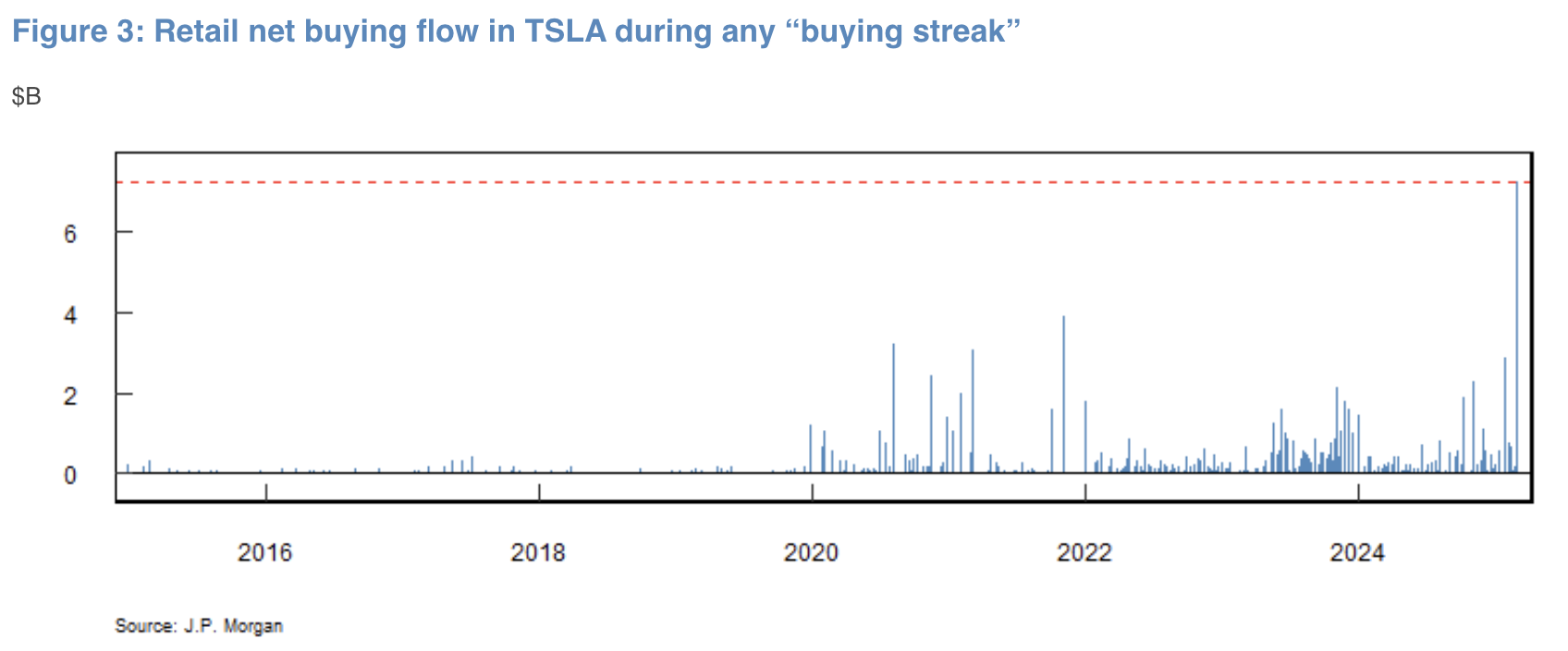
Retail traders have been accumulating Tesla for 12 straight days to the tune of $7.3 billion in net purchases, per JPMorgan, “the highest magnitude among all past ‘buying streaks’ in over a decade.”
JPM Tesla buying

Shares of the Elon Musk-led auto company are down 17.1% over this period, which has included selling by Tesla insiders, analysts cutting delivery targets as early-year sales figures disappoint, progress by rivals on autonomous driving as well as EV charging, and deteriorating public perception of the brand.

According to JPM quantitative strategist Emma Wu, nearly 75% of the $8.3 billion that retail traders have put to work in single stocks over the past week has gone to the members of the Magnificent 7, led by Tesla and Nvidia. This group has generally faced heavy selling pressure amid a breakdown in momentum stocks, particularly those levered to AI.

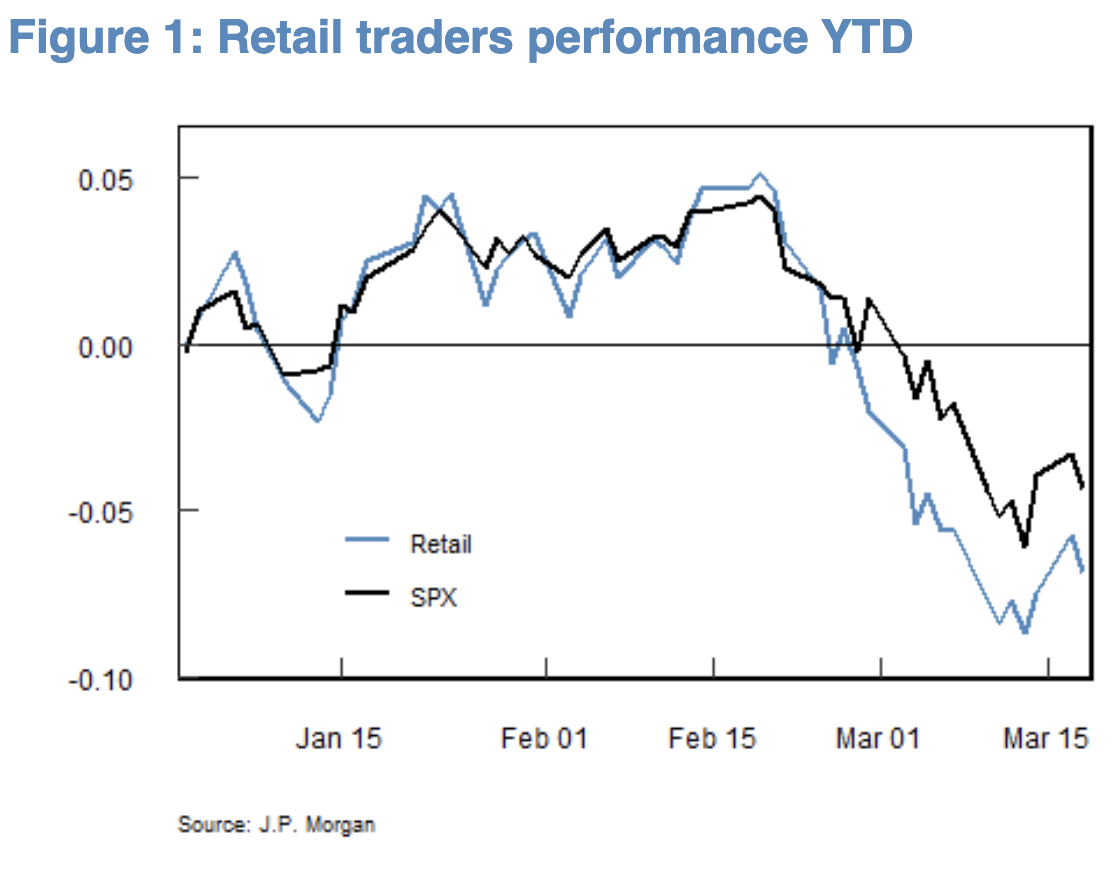
“We estimate retail investors’ performance is down by 7% year-to-date (vs. -3.3% loss in S&P),” she wrote. “Most of the drawdown came from March as they increased their holdings in Tech.”
JPMretail performance

Heavy retail buying when stocks go down has been the rule, not the exception, she observed:

“They broke the $2-billion threshold for the past four days in a row. It’s worth noting that this level that is more easily reached in a ‘down’ year than in an ‘up’ year: it was rarely seen in 2023/24 (4 times in total), when S&P produced double-digit returns, but occurred 10 times in 2022, concentrated in Feb during the Russia-Ukraine war, and has already happened 16 times this year. The correlation between S&P returns and subsequent retail net imbalance was up to 60% in 2022 and this year, vs. ~20% in 2023/24. This suggests their ‘buy-the-dip’ mentality from another perspective.”

Not only is Tesla the worst-performing S&P 500 constituent year-to-date (down 41.6%), but it’s also posted the largest drop since the S&P 500’s February 19 record close (down 34.6%).

More Markets

See all Markets
markets

Applied Optoelectronics jumps after hyperscaler more than doubles its recent order

Applied Optoelectronics is soaring on Monday after a hyperscaler upped demand for its components, which help servers in data centers relay information.

After the close on Thursday, the optics and networking company announced that a key customer ordered an additional $71 million worth of 800-gigabit single-mode data center transceivers. Per the press release, orders from this buyer now total $124 million since mid-March, with this commitment doubling AAOI’s backlog for this customer.

The stock is up more than 5% in premarket trading; other names in the industry like Coherent, Lumentum, and POET Technologies are also trading well in the green.

Shares of AAOI ended Thursday up 20% before this news dropped, with the industry having displayed strong momentum as of late to reaffirm its status as one of the few areas of the AI trade that investors have loved in 2026.

“We anticipate completing delivery of the initial order in the third quarter, with this new order by end of this year,” said Dr. Thompson Lin, founder, chairman, and CEO of Applied Optoelectronics. “We also recently shipped the first 10,000 units of an 800G single-mode transceiver order to another hyperscale datacenter customer.”

markets

OpenAI’s leadership reportedly disagrees about when to raise money and how to spend it

Money can’t buy C-Suite harmony.

Fresh off booking $122 billion at a valuation of $852 billion, OpenAI’s top brass reportedly have a difference of opinion on how quickly the ChatGPT maker should pursue its highest-profile fundraising — an IPO — as well as how much computing power it should be buying.

The Information reports that CFO Sarah Friar has “told some colleagues earlier this year that she didn’t believe the company would be ready to go public in 2026, because of the procedural and organizational work needed and the risks from its spending commitments,” citing a person who spoke with her.

CEO Sam Altman wants to go public as soon as Q4, in line with previous press on the matter, with some inside the firm looking to beat fellow chatbot company Anthropic to the punch.

While there may not be too much daylight between going public in Q4 and not being ready to go public until 2027, the strategic divide between Altman and Friar apparently runs even deeper.

Altman has made gigantic commitments of $600 billion in compute spend through 2030. But Friar has reportedly “said she wasn’t sure yet whether OpenAI would need to pour so much money into obtaining AI servers in the coming years or whether its revenue growth, which has been slowing, would support the commitments.”

These frictions have reportedly led to Altman icing out his CFO. Citing people who have worked closely with the pair, the outlet reports that Altman has “excluded [Friar] from some conversations related to the company’s financial plans.”

Well, I can tell you that when my bosses and I have had disagreements (about things like pay, responsibilities, or the appropriateness of miniature poodles in the office)... they tend to win.

Of course, drama between Altman and some of the AI company’s top talent or leadership core is nothing new. This reported episode is considerably less spicy compared to him briefly getting bounced from the company in 2023 or the exodus of employees (including Dario Amodei!) who would go on to found Anthropic in 2021.

markets
Luke Kawa

US job growth crushes estimates in March, with the unemployment rate unexpectedly dipping to 4.3%

US hiring surged in March, with job growth of 178,000 well ahead of estimates while the unemployment rate unexpectedly edged down to 4.3%.

Economists had anticipated non-farm payrolls growth of 65,000 for the month with the unemployment rate holding steady at 4.4%

Event contracts had presumed that job growth would come in between 70,000 and 80,000, a sunnier view than Wall Street.

Prediction markets had anticipated roughly 70% odds that the unemployment rate would hold steady at 4.4%, with a much higher implied likelihood of an increase versus a decrease.

(Event contracts are offered through Robinhood Derivatives, LLC — probabilities referenced or sourced from KalshiEx LLC or ForecastEx LLC.)

S&P 500 equity futures, which were modestly negative ahead of the report in thin holiday trading, were little changed in the immediate aftermath of this release. Treasury yields jumped, with the 10-year yield rising to 4.35% from 4.31%.

The inflationary impact of the higher crude prices in the wake of US-Israeli attacks on Iran and the subsequent challenges shipping oil through the Strait of Hormuz has been the dominant macroeconomic development of the past month, rather than US labor market data.

Before the conflict began, roughly 60 basis points of easing by the Federal Reserve was priced in for 2026. Heading into this release, that’s slimmed to just 5 basis points as US gas prices jumped above $4 per gallon.

The Federal Reserve’s “dot plot” from the March meeting still suggests that officials think it will be appropriate to lower the policy rate this year if the economy unfolds in line with their expectations.

The February jobs report had been a big disappointment, with jobs unexpectedly contracting and the unemployment rate edging higher. With this release, the February figures were revised to show an even larger decline of 133,000.

Strikes which had weighed on employment in health care during February, a critical source of US employment growth in recent years, seemingly reversed. The industry accounted for more than half of net job growth for March.

markets

AI server cluster maker Penguin Solutions takes flight

Small-cap AI server cluster maker Penguin Solutions surged Thursday after posting better-than-expected Q2 revenue and profit numbers Wednesday after the close, along with an increase in full-year sales and profit guidance.

The company, which was known as Smart Global Holdings until July 2024, has positioned itself as a provider of “end-to-end AI infrastructure solutions.”

Its Advanced Computing division designs and sells computers, cabling, and cooling systems, the server racks and clusters of racks AI data centers need. Its other main division sells flash and DRAM memory products.

It’s a pretty small company, with a fully diluted market cap of just over $1 billion and roughly 2,900 employees, according to FactSet.

The stock is volatile. Penguin dove during last year’s tariff tantrum that followed “Liberation Day” in April. Then it turned tail and doubled through early October amid a surge of call options activity, which tends to reflect retail interest. From the October peak, it then plunged by about 50%, before Thursday’s renaissance.

For what it’s worth, call options activity in Penguin is pretty busy today, too — relatively speaking — with roughly 2,625 traded as of 1:15 p.m. ET. That’s the most since early January, when the company last reported quarterly numbers. The average volume over the previous 25 trading sessions is about 325 calls a day, FactSet data shows.

The company, which was known as Smart Global Holdings until July 2024, has positioned itself as a provider of “end-to-end AI infrastructure solutions.”

Its Advanced Computing division designs and sells computers, cabling, and cooling systems, the server racks and clusters of racks AI data centers need. Its other main division sells flash and DRAM memory products.

It’s a pretty small company, with a fully diluted market cap of just over $1 billion and roughly 2,900 employees, according to FactSet.

The stock is volatile. Penguin dove during last year’s tariff tantrum that followed “Liberation Day” in April. Then it turned tail and doubled through early October amid a surge of call options activity, which tends to reflect retail interest. From the October peak, it then plunged by about 50%, before Thursday’s renaissance.

For what it’s worth, call options activity in Penguin is pretty busy today, too — relatively speaking — with roughly 2,625 traded as of 1:15 p.m. ET. That’s the most since early January, when the company last reported quarterly numbers. The average volume over the previous 25 trading sessions is about 325 calls a day, FactSet data shows.

Latest Stories

Sherwood Media, LLC produces fresh and unique perspectives on topical financial news and is a fully owned subsidiary of Robinhood Markets, Inc., and any views expressed here do not necessarily reflect the views of any other Robinhood affiliate, including Robinhood Markets, Inc., Robinhood Financial LLC, Robinhood Securities, LLC, Robinhood Crypto, LLC, Robinhood Derivatives, LLC, or Robinhood Money, LLC. Futures and event contracts are offered through Robinhood Derivatives, LLC.