
Markets
Former President Trump And VP Nominee Sen. JD Vance Hold Rally In St. Cloud, Minnesota
Vice President Vance and President Trump (Stephen Maturen/Getty Images)

Stocks crater as the trade war investors doubted would ever happen is here now

Tariffs go from negotiating tactic to policy real quick.

A relentless breakdown in momentum stocks plus tariff threats that finally became real are a toxic combination for the US stock market.

The S&P 500 suffered its biggest loss of the year on Monday after President Donald Trump said 25% tariffs on imports from Mexico and Canada, as well as a doubling of levies on Chinese imports to 20%, will go into effect tomorrow.

A basket of stocks highlighted by Goldman Sachs as particularly vulnerable to tariffs tumbled 3%, which eliminates all their gains since the US election. It’s the worst one-day loss for the group since the Federal Reserve warned in its December meeting about upside risks to inflation following Trump’s election victory.

General Motors, perhaps the company most impacted by these levies, fell nearly 3% intraday following the affirmation of these tariffs shortly before 3 p.m. ET, deepening its daily loss.

Among investors, there was little consensus as to whether or not these tariffs would be enacted, per this survey from 22V Research at the end of last week:
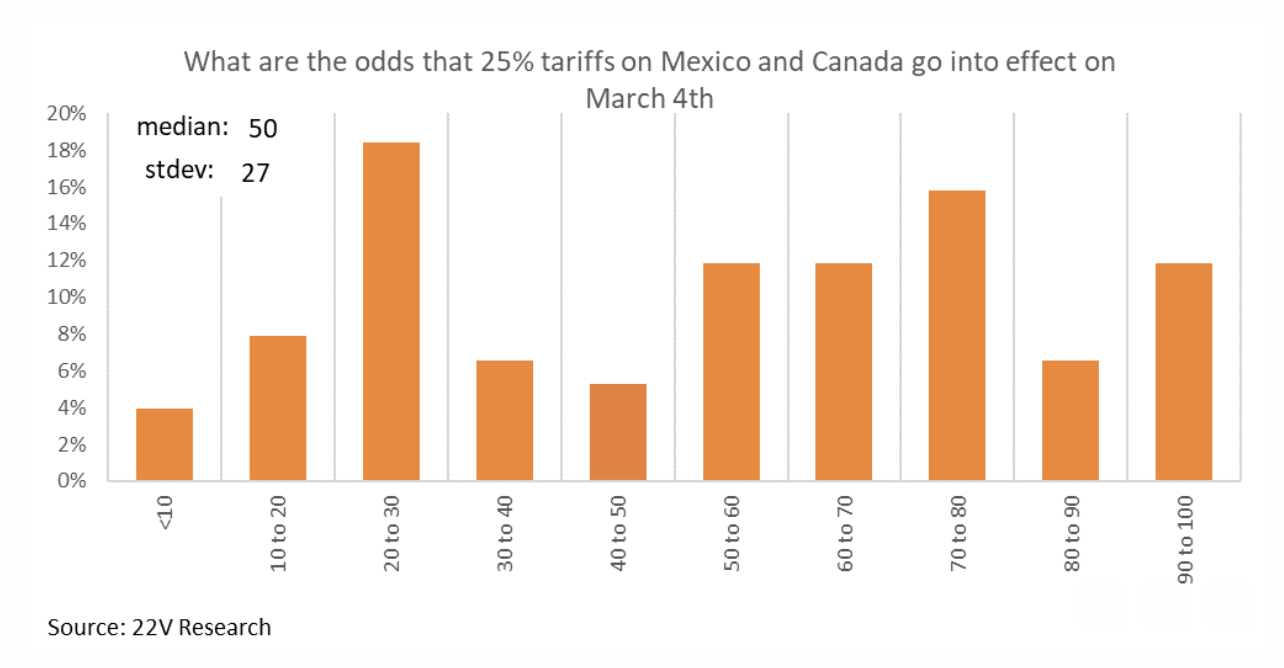
Tariff consensus
Source: 22V Research

By and large, markets had not been reacting too much to the chatter over trade barriers. Tariff-sensitive stocks had been (and still are!) handily outperforming shares of companies deemed insulated from levies since the November 5 election. As such, there’s plenty of scope for this theme to assert a larger role in driving price action going forward.

The assumptions investors had made as to why disruptive trade measures wouldn’t be high on the list of policy priorities for Trump 2.0 are quickly being revisited.

Trump 1.0 was carrots first, sticks second. Trump 2.0, however...

“The sequencing is a challenge as the administration is beginning with the hits to growth and confidence, rather than cementing a higher floor first, the opposite of the approach in the first Trump administration which began with tax cuts and deregulation,” wrote Peter Williams, strategist at 22V Research.

More Markets

See all Markets
markets

T1 Energy spikes on record call volumes after Roth analyst calls short report a buying opportunity

Shares of T1 Energy are electric Wednesday afternoon, soaring more than 20% on record call volumes.

The stock had fallen over 13% at its lows on Tuesday after short-only fund Fuzzy Panda Research published a report calling the solar and battery storage company a "China Hustle," rather than a legitimate AI infrastructure investment, also alleging that the company has booked tax credits it won’t receive.

Retail traders have often used the dip that’s followed the announcement of a short report to load up on a company’s shares (see: Poet Technologies in April).

Roth Capital Partners analyst Philip Shen responded to the report by calling T1 "a model for what the Trump administration may want in a domestic manufacturer that is transferring advanced technology and capacity to the US,” suggesting that the selloff was a buying opportunity.

Earlier this week, T1 got an even more prominent vote of confidence when a 13f filing from Situational Awareness showed the hedge fund run by wunderkid Leopold Aschenbrenner held a 3.6% stake in the company at the end of Q1.

Airlines and cruise stocks surge as oil prices plunge

Travel stocks are surging on Wednesday, with West Texas Intermediate crude futures down 5% as of 12 p.m. ET, largely on commodity traders’ hopes of a resolution to the US war with Iran.

The decline comes despite the US Energy Information Administration reporting a record plunge in US crude inventories last week. As the country expands its oil exports to reduce the impact of the war in Iran, inventories have fallen by 7.9 million barrels, according to the EIA, indicating a significant drop in domestic supply wiggle room ahead of the summer driving season. Per Reuters, analysts had expected a drop of 2.9 million.

Bloomberg noted that US oil exports have been crucial in keeping global petroleum prices in check, as supply remains historically constrained due to the effective closure of the Straight of Hormuz. Typically, such a sharper-than-expected drop in inventories would cause oil futures to rise.

Today, however, that is not the case and oil’s pain is travel stocks’ gain, with US airlines and cruise lines surging higher on Wednesday. Delta Air Lines, United Airlines, American Airlines, Southwest Airlines, and JetBlue were all up by at least 6%, while Carnival and Norwegian were up about 7%.

Royal Caribbean pared earlier losses from Mexico’s rejection of a large planned water park, but was still down about 1%.

Latest Stories

Sherwood Media, LLC and Chartr Limited produce fresh and unique perspectives on topical financial news and are fully owned subsidiaries of Robinhood Markets, Inc., and any views expressed here do not necessarily reflect the views of any other Robinhood affiliate, including Robinhood Markets, Inc., Robinhood Financial LLC, Robinhood Securities, LLC, Robinhood Crypto, LLC, Robinhood Money, LLC, Robinhood U.K. Ltd, Robinhood Derivatives, LLC, Robinhood Gold, LLC, Robinhood Asset Management, LLC, Robinhood Credit, Inc., Robinhood Ventures DE, LLC and, where applicable, its managed investment vehicles.

