Markets
21 December 2020, Lower Saxony, Hanover: Nana the polar bear eats slices of peppers hanging from a Christmas tree at Hannover Adventure Zoo.
(Moritz Frankenberg/Getty Images)
Market Wrap

Stocks slump ahead of Fed meeting

Tech was the only sector to post gains today.

Stocks skidded on Monday, with the S&P 500 and Nasdaq 100 trading lower, while the Russell 2000 was essentially flat. Tech was the only sector to end the day in the green.

While traders are confidently pricing in a quarter-point rate cut during the Fed’s meeting this week, uncertainty over how the central bank will handle easing in 2026 looms. Despite a rebound over the weekend, bitcoin dropped ahead of the Fed decision. According to Timothy Misir, head of research at Blockhead Research Network, bitcoin is “politically and macro-sensitive this week,” and the Fed’s decision and Chair Jerome Powell’s subsequent speech are the “obvious market pivots.”

Stocks that moved higher:

Stocks that moved lower:

More Markets

See all Markets
markets

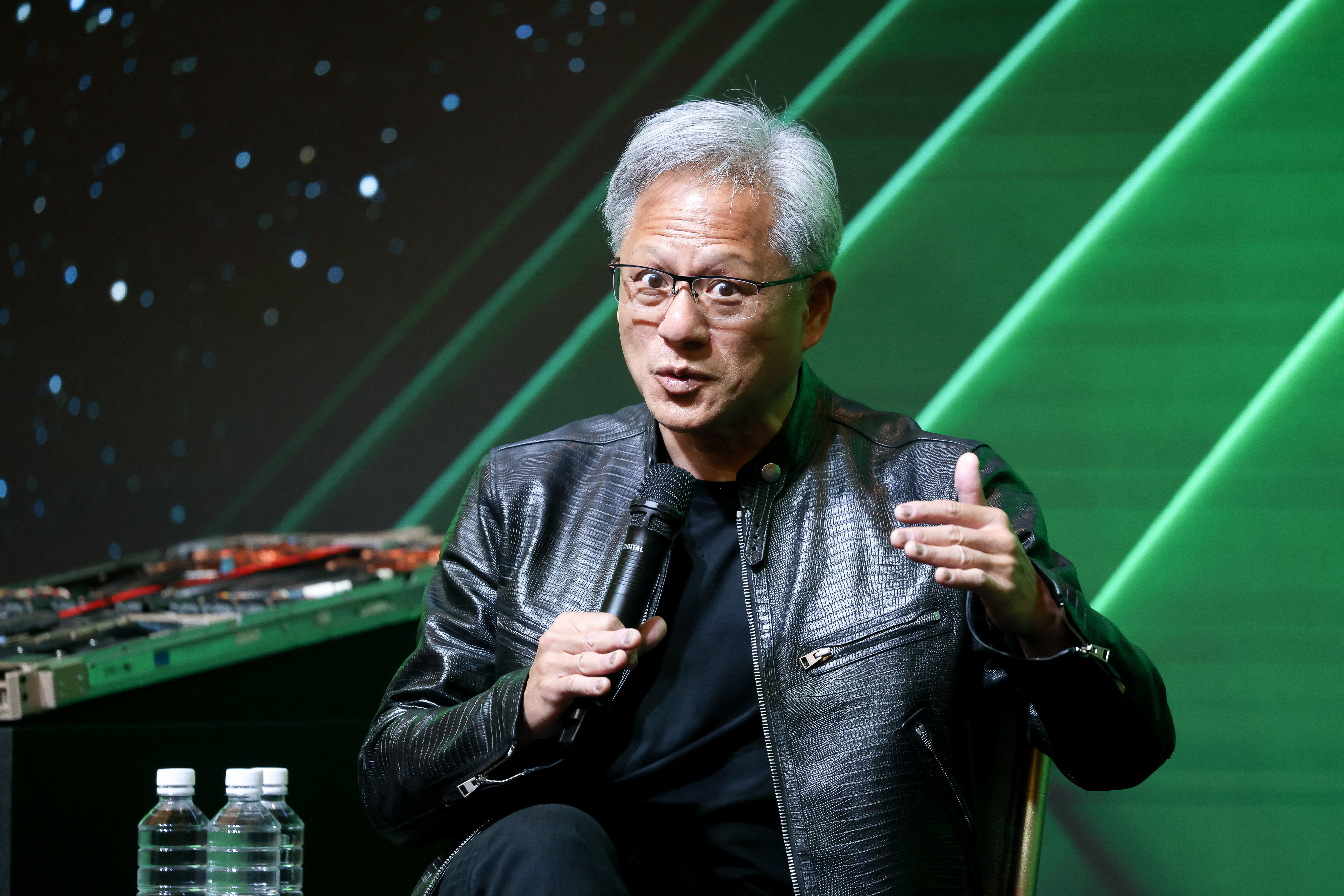
President Trump says that Nvidia can begin to sell its H200 chips to China, with 25% of proceeds going to US government

US President Donald Trump confirmed after the close on Monday that Nvidia will be allowed to ship its H200 chips to China, sending shares of the chip designer up more than 1% in the after-hours session.

Per the president, 25% of the proceeds will go to the US government. That’s a step up from the 15% that Nvidia and AMD had agreed to provide the government in exchange for receiving export licenses to sell their H20 and MI308 chips to China.

Earlier in the day, Semafor reported that the Department of Commerce would soon give the go-ahead to export these powerful chips produced by Nvidia to China, which has been a core priority of the chip juggernaut, citing a source with “knowledge of the plan.” Bloomberg reported on November 21 that such a move was being considered.

The chip designer’s stock surged on the news, while Advanced Micro Devices also caught a bid.

H200s are the most advanced chips from the Hopper line, which was Nvidia’s leading offering prior to Blackwell.

The Chinese government has blocked the import of less powerful chips such as the H20, while China hawks in Washington, DC, have been hesitant to allow the export of the defining technology of the AI era to a rival emerging superpower, introducing a bill in the Senate last week to limit China’s access to chips.

Nevertheless, China’s tech industry has managed to produce models from DeepSeek and Alibaba that compete globally.

Shipments of these chips are “reviving a key data-center revenue stream and potentially restoring $10-$15 billion annually,” wrote Bloomberg Intelligence analysts Kunjan Sobhani and Oscar Hernandez Tejada. “The H200 — offering 5-7x faster performance, 50% more memory, and over 2x the average selling price of the H20 — would likely become the highest-end GPU that Chinese buyers can legally procure, reopening a significant high-margin channel.”

H200s are the most advanced chips from the Hopper line, which was Nvidia’s leading offering prior to Blackwell.

The Chinese government has blocked the import of less powerful chips such as the H20, while China hawks in Washington, DC, have been hesitant to allow the export of the defining technology of the AI era to a rival emerging superpower, introducing a bill in the Senate last week to limit China’s access to chips.

Nevertheless, China’s tech industry has managed to produce models from DeepSeek and Alibaba that compete globally.

Shipments of these chips are “reviving a key data-center revenue stream and potentially restoring $10-$15 billion annually,” wrote Bloomberg Intelligence analysts Kunjan Sobhani and Oscar Hernandez Tejada. “The H200 — offering 5-7x faster performance, 50% more memory, and over 2x the average selling price of the H20 — would likely become the highest-end GPU that Chinese buyers can legally procure, reopening a significant high-margin channel.”

markets

SpaceX valuation chatter lifts satellite stocks

Satellite stocks rose early Monday, riding a wave of excitement about recent reports that Tesla CEO Elon Musk’s satellite startup, SpaceX, is shooting for an $800 billion valuation as it launches a secondary share sale.

EchoStar and Rocket Lab rose, partly in response to the report.

William Blair analyst Louie DiPalma wrote that the valuation news has positive implications for owners of satellite spectrum rights.

If the reported valuation is ultimately achieved, it would be a mark-to-market moment suggesting that traditional satellite spectrum rights are worth more than the market had previously assumed.

That likely explains some of EchoStar’s outperformance on the day. As a legacy provider of satellite-based television services — such as Dish Network — it is a large owner of that spectrum, and has recently been an opportunistic seller of those assets, including to AT&T and SpaceX.

But the market doesn’t seem to like the implications for AST SpaceMobile, which has been trying to build up its portfolio of spectrum rights to compete as a seller of space-based services directly to consumers.

Higher spectrum right prices mean AST will have to cough up more cash as it competes with a Musk-controlled, $800 billion satellite gorilla.

William Blair analyst Louie DiPalma wrote that the valuation news has positive implications for owners of satellite spectrum rights.

If the reported valuation is ultimately achieved, it would be a mark-to-market moment suggesting that traditional satellite spectrum rights are worth more than the market had previously assumed.

That likely explains some of EchoStar’s outperformance on the day. As a legacy provider of satellite-based television services — such as Dish Network — it is a large owner of that spectrum, and has recently been an opportunistic seller of those assets, including to AT&T and SpaceX.

But the market doesn’t seem to like the implications for AST SpaceMobile, which has been trying to build up its portfolio of spectrum rights to compete as a seller of space-based services directly to consumers.

Higher spectrum right prices mean AST will have to cough up more cash as it competes with a Musk-controlled, $800 billion satellite gorilla.

markets

Marvell sinks after Benchmark cuts company, saying that it lost its Amazon custom chip design business

Over the past two trading days, Marvell Technology has faced vexing questions about its relationship with its top two custom chip hyperscaler customers.

Shares are tumbling, down 9% as of 10:21 a.m. ET.

Late last week, The Information reported that Microsoft, its second-biggest custom chip buyer, was in talks to shift that business from Marvell to Broadcom.

Now, Benchmark analyst Cody Acree thinks that Marvell’s largest custom chip customer, Amazon, has done the same, writing that “we now have a high degree of conviction that the company has lost both Amazon’s Trainium3 and 4 designs to its Taiwanese competitor, Alchip.”

Acree downgraded Marvell to “hold” from “buy,” recommending that investors take profit after its post-earnings bounce.

(Harlan Sur at JPMorgan, for what it’s worth, does not believe this is the case, pointing to Marvell’s acquisition of Celestial AI as providing key technology that aligns the company with Amazon’s future chip design needs.)

During the conference call that followed earnings, Sur asked Marvell CEO Matt Murphy about its role with Amazon chips going forward.

“What I would say, which is incorporated into our numbers, is that our product transition from where we are today with our lead XPU customer to the next one is baked into all the numbers I gave you. And yes, I got the backlog, and I got the orders, and we got great visibility there,” Murphy said.

Murphy’s answer was not quite definitive, according to Acree, who thinks that Marvell’s revenue forecast is being “driven by expected continued Trainium2 volumes and a Kuiper low-earth orbit engagement and not the successful transition to Trainium3 designs that many on the sell-side have concluded.”

markets

Structure Therapeutics posts mid-stage weight-loss pill data in line with Eli Lilly rival

Structure Therapeutics soared in early trading after it reported mid-stage results for its weight-loss pill that were roughly in line with Eli Lilly’s competing product.

The San Francisco-based biotech reported that patients lost roughly 11.3% of their body weight on a lower dose of the pill, aleniglipron, in a mid-stage study. That puts it roughly in line with Lilly’s competing pill, orforglipron, and slightly below Novo Nordisk’s oral Wegovy.

Both Lilly and Novo’s pills are awaiting regulatory approval and are expected to go to market next year. While the weight-loss numbers were encouraging, Structure’s pill did report higher rates of side effects like nausea and vomiting.

Investors have been closely watching drugmakers’ once-daily pills, which could replace the weekly injections currently on the market. While pills tend to be less effective than shots, they are less expensive to manufacture than prefilled injection pens and are more inviting to squeamish patients.

Warner Brothers To Put Itself Up For Sale

Paramount launches hostile takeover bid for Warner Bros. Discovery at $30 per share, trying to upend Netflix deal

Paramount is taking its Warner Bros. Discovery purchase effort straight to shareholders.

Latest Stories

Sherwood Media, LLC produces fresh and unique perspectives on topical financial news and is a fully owned subsidiary of Robinhood Markets, Inc., and any views expressed here do not necessarily reflect the views of any other Robinhood affiliate, including Robinhood Markets, Inc., Robinhood Financial LLC, Robinhood Securities, LLC, Robinhood Crypto, LLC, or Robinhood Money, LLC.