

Tesla Q1 earnings and revenue beat Wall Street’s estimates
Tesla reported earnings after the bell Wednesday.
Tesla reported quarterly earnings that beat analysts’ expectations, which they’d been lowering over the past year as the company’s core automotive business has struggled and its upcoming innovations have been pushed further into the future.
Shares were up 4.4% in after-hours trading following the report before giving up a big chunk of those gains.
The company reported revenue of $22.4 billion (versus a $22.1 billion FactSet analyst consensus estimate) and adjusted earnings per share of $0.41 (compared with Wall Street’s $0.35).
Meanwhile, its free cash flow was $1.4 billion, much better than the $1.5 billion loss the Street expected, as the company contends with lower regulatory credit revenue, ongoing pricing pressure, and burgeoning capital expenditure.
Tesla now expects its 2026 capex to be $25 billion, up from the $20 billion it suggested last quarter.
Analysts have been hoping that growth in the company’s energy generation and storage business would continue to offset its weakening automotive business. Energy segment revenue rose to $2.4 billion (lower than FactSet’s $3.2 billion) while the automotive segment grew to $16.2 billion (compared with the consensus expectation of $14.9 billion).
On the earnings call, investors will be looking beyond near-term financials and toward the moon shot AI and autonomous projects on which Tesla is staking its future. That includes expanding into new markets and removing safety monitors from existing ones. So far, Robotaxi is running in San Francisco, Austin, and on a much smaller scale in Dallas and Houston, and safety monitors still attend a vast majority of its rides. Investors will also be looking for any incremental news on Optimus robot and AI chip progress.
Of course, Tesla’s automotive business remains its main source of revenue and the major mechanism with which it finances those forward-looking ambitions.
In the earnings release, Tesla said that “over time, we expect our hardware-related profits to be accompanied by an acceleration of AI, software and fleet-based profits,” but didn’t give an actual timeline.
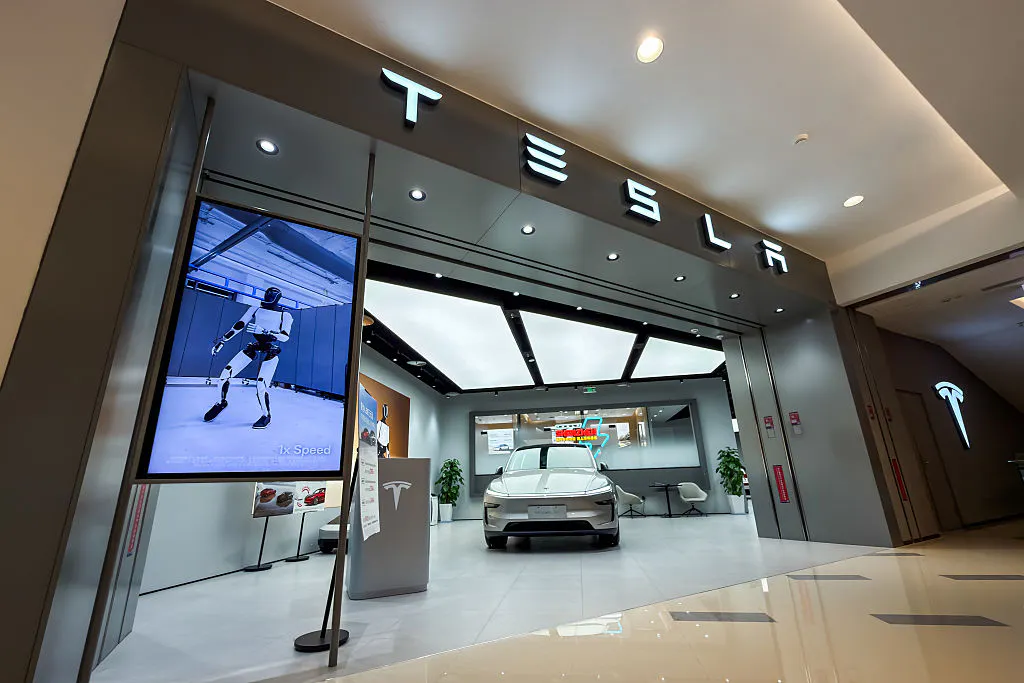
More pointedly, the company noted that it would begin working on its large-scale Optimus factory this quarter, which is “designed for 1 million robots a year” at its location in Fremont, California. Tesla said it’s also working on a second-generation production line at its Texas Gigafactory, which would have “long-term annual production capacity of 10 million robots.”
Of course, CEO Elon Musk had once said the company would churn out a quarter million Cybertrucks per year, only to find tepid demand. Still, an AI robot is presumably more attractive than an “apocalypse-proof” truck.
Prior to the earnings report, Tesla’s stock was down 14% year to date.




