
Markets
Bear Roar
(Marcos del Mazo/Getty Images)
BEAR NECESSITIES

The insanity over the Starbucks “Bearista” cups tells you everything you need to know about the US economy and markets

Upper-income consumers and megacap tech companies are both a) doing well and b) supply constrained.

Luke Kawa

The lack of bear cups is almost too much to bear.

A $30 ursine coffee cup offered by Starbucks seems to be too popular. Customers are literally fighting to get their hands on one, and the company has already apologized for not having enough supplies to go around.

We can probably safely infer that anyone willing to spend $30 on an admittedly very adorable bear cup probably isn’t pinching pennies to make ends meet. A bear cup is a bear necessity, but not a bare necessity. I have a deep envy of anyone for whom access to a bear cup is what inspired you to make your William Wallace-esque last stand.

Starbucks customers are generally more affluent than average. That means they’re part of a cohort that Bank of America has recently flagged as enjoying better pay growth than lower-income Americans, and, accordingly, showing more robust growth in spending.

Turning to financial markets...

Nvidia’s doing well! CEO Jensen Huang recently boasted of more than $500 billion in orders for its flagship chips through 2026.

Microsoft’s doing well, too! Its Azure cloud business is on fire and has a massive backlog.

But the thinking is that they could be doing even better if not for pesky supply constraints, which in this case do relate to something that is a bare necessity: power.

The most charitable interpretation of Jensen Huang’s remarks this week on how tight the AI race is between the US and China is that the CEO is trying to hold the government’s feet to the fire on the urgency of boosting energy supplies to meet the power demands of the AI boom.

For his part, Microsoft CEO Satya Nadella recently said his biggest problem right now is “not a supply issue of chips; it’s actually the fact that I don’t have warm shelves to plug into.”

The top of the heap, among households and businesses, have little to complain about but supply issues. Those supply issues are still hurting lower-income Americans, too — coffee prices are near all-time highs, and electricity prices have surged — but not in ways that seem to be bad enough to tip the aggregate “economy” in a negative way.

Lower-income earners are supply-of-income constrained, and even major US companies that fall outside the so-called Magnificent 7 cohort appear to be less well-off this year on the earnings front than analysts expected at the beginning of April, as this chart from Apollo Chief Economist Torsten Slok shows:
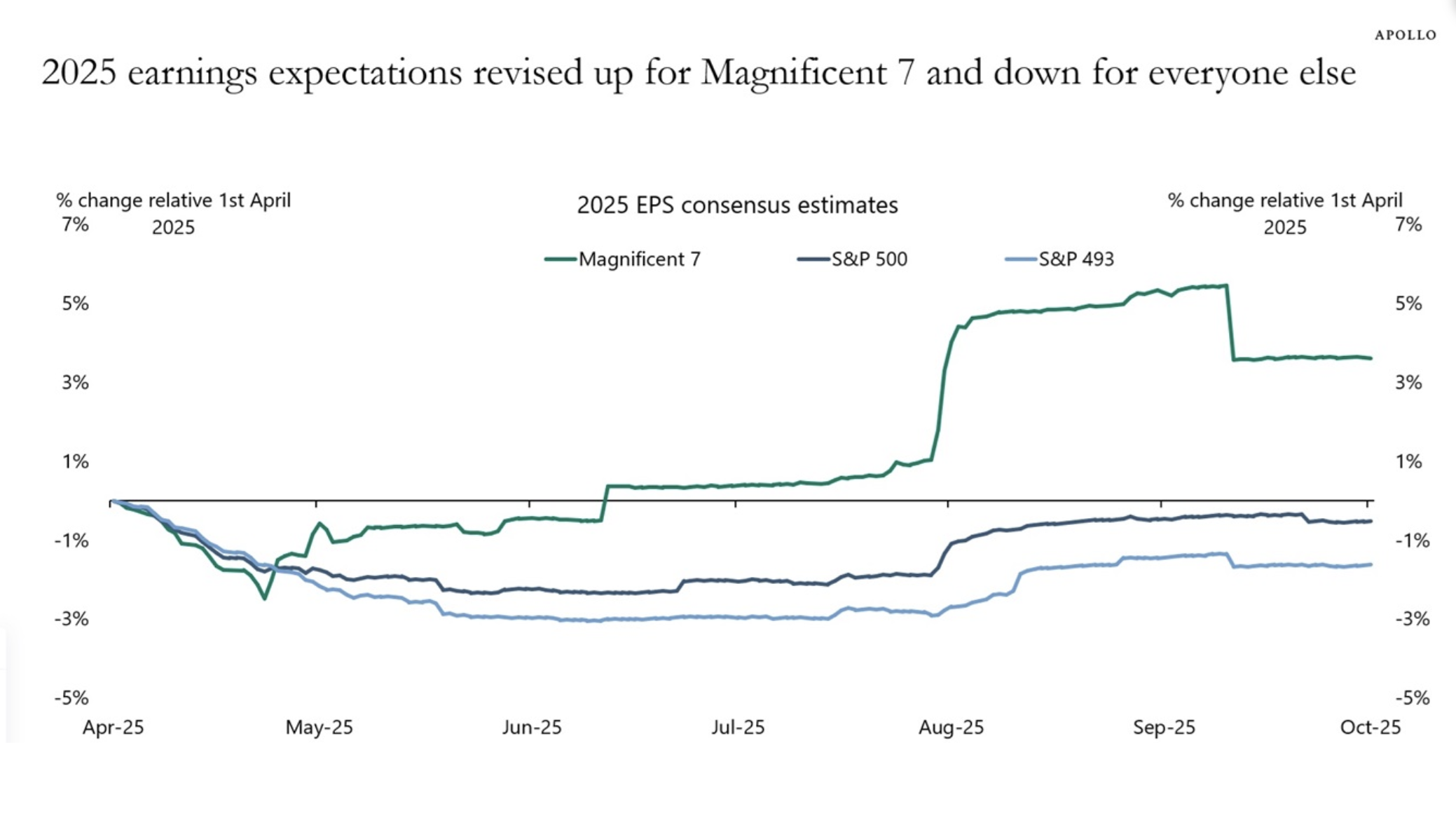
2025 EPS estimates Apollo

More Markets

See all Markets
markets

Figma spikes after raising full-year sales outlook as the software company leverages AI for growth

Figma jumped postmarket Thursday after posting impressive sales in Q1, surpassing Wall Street expectations and raising its full-year guidance. The key numbers:

  • Q1 revenue of $333.4 million (compared to analyst estimates of $316 million).

  • Q2 sales guidance of $348 million to $350 million (estimate: $329.7 million).

  • Full-year revenue between $1.422 billion and $1.428 billion (up from previous guidance of $1.37 billion).

The digital design software firm is the latest company to diminish investor fears about AI-induced disruption by making the technology work for them. Like Atlassian or Datadog, Figma said it was able to use AI to its advantage, bringing more customers on board and getting them to spend more.

In the press release, Praveer Melwani, Figma CFO, said:

As AI gets better, Figma is accelerating and customer usage and workflows on our platform are deepening. Our platform and AI products drove faster growth for both new customer acquisition and expansion within existing accounts.

Revenue grew 46% year over year in Q1 2026, an acceleration from growth of 40% in Q4 2025.

markets

Infleqtion reports Q1 adjusted loss, offers modest boost to full-year sales guidance

Infleqtion is falling in postmarket trading after reporting a Q1 adjusted loss from operations of $13.2 million and sales of $9.5 million.

Management modestly upgraded its sales guidance to “at least” $40 million for 2026, adding that language to enhance the target provided in early April. Revenues of $40 million would mark an increase of roughly 23% compared to the $32.5 million generated in 2025, and an acceleration from growth of 12% last year.

The company utilizes neutral-atom technology to make quantum sensors used in clocks and antennas in addition to computers.

“Q1 reinforced our confidence that quantum is gaining momentum as the market shifts toward deployable systems, real applications, and measurable customer value,” said CEO Matt Kinsella. “Across computing, sensing, and software, we are seeing expanding customer activity especially in national security, space, and hybrid quantum-AI applications.”

Shares are roughly flat since February 13, which is just before the company went public via a SPAC, after being down 35% near the end of March, and then up nearly 30% in mid-April.

The quantum computing space benefited from the return of speculative appetite in April after the US and Iran agreed to a ceasefire. The cohort was later bolstered after Nvidia unveiled a suite of open models designed to leverage AI to improve calibration and error correction for quantum computers.

markets

Applied Materials rallies after better-than-expected Q2 results, strong sales guidance

Shares of Applied Materials are gaining in postmarket trading after the company reported robust Q2 results and a sales outlook that indicate building momentum.

  • Net sales: $7.9 billion (compared to analyst estimates of $7.7 billion and guidance for $7.65 billion, plus or minus $500 million).

  • Adjusted earnings per share: $2.86 (estimate: $2.68, guidance: $2.68, plus or minus $0.20).

For Q3, the company anticipates net sales of $8.95 billion (plus or minus $500 million; estimate: $8.15 billion) with adjusted EPS of $3.36 (plus or minus $0.20; estimate: $2.88).

“The growth in AI that Applied has been investing for is now in full force,” CFO Brice Hill said in the press release.

Management has consistently indicated that it expects demand to pick up in the second half of this year, but its first-half results have already blown away expectations by a wide margin. All this appetite for semiconductors to support AI compute is fantastic news for companies like Applied Materials that make the equipment to produce these specialized chips.

Shares of Applied Materials closed near a record high ahead of this report, up more than 70% year to date.

markets

Snap falls after Meta rolls out new “Instants” feature

Here today, gone tomorrow is a winning idea — according to Wall Street.

Shares of Snap are down nearly 5% Thursday afternoon after Meta announced Instants, a new feature and companion app that allows users to share spontaneous, unfiltered photos that disappearing after viewing. Remind you of anything?

Snap has fallen roughly 34% this year, while Facebook and Instagram parent company Meta has dipped 5% over the same time frame. Last week, Snap reported earnings that showed the social media company losing out on ad sales.

Latest Stories

Sherwood Media, LLC and Chartr Limited produce fresh and unique perspectives on topical financial news and are fully owned subsidiaries of Robinhood Markets, Inc., and any views expressed here do not necessarily reflect the views of any other Robinhood affiliate, including Robinhood Markets, Inc., Robinhood Financial LLC, Robinhood Securities, LLC, Robinhood Crypto, LLC, Robinhood Money, LLC, Robinhood U.K. Ltd, Robinhood Derivatives, LLC, Robinhood Gold, LLC, Robinhood Asset Management, LLC, Robinhood Credit, Inc., Robinhood Ventures DE, LLC and, where applicable, its managed investment vehicles.

