
Markets
Novo Nordisk share price chart
Sherwood News

What’s eating Novo Nordisk?

The Ozempic maker’s market cap has more than halved since this time last year.

Last July, Novo Nordisk, the drugmaker that brought us Ozempic and Wegovy, was sitting pretty as Europe’s most valuable company — and, with a margin of more than $200 billion between it and storied luxury house LVMH, it wasn’t even really close. A lot can change in a year.

Weighed down

Since peaking just shy of $660 billion last summer, Novo has been shedding market cap almost nonstop. Yesterday, shares ended up posting their steepest single-day drop in the Danish behemoth’s history, sliding 23% after the company slashed its sales and profit outlook for the year ahead. Now, Novo’s new CEO, a veteran insider who was announced with the slimmed-down outlook yesterday, will have his work cut out to stop the bleeding.
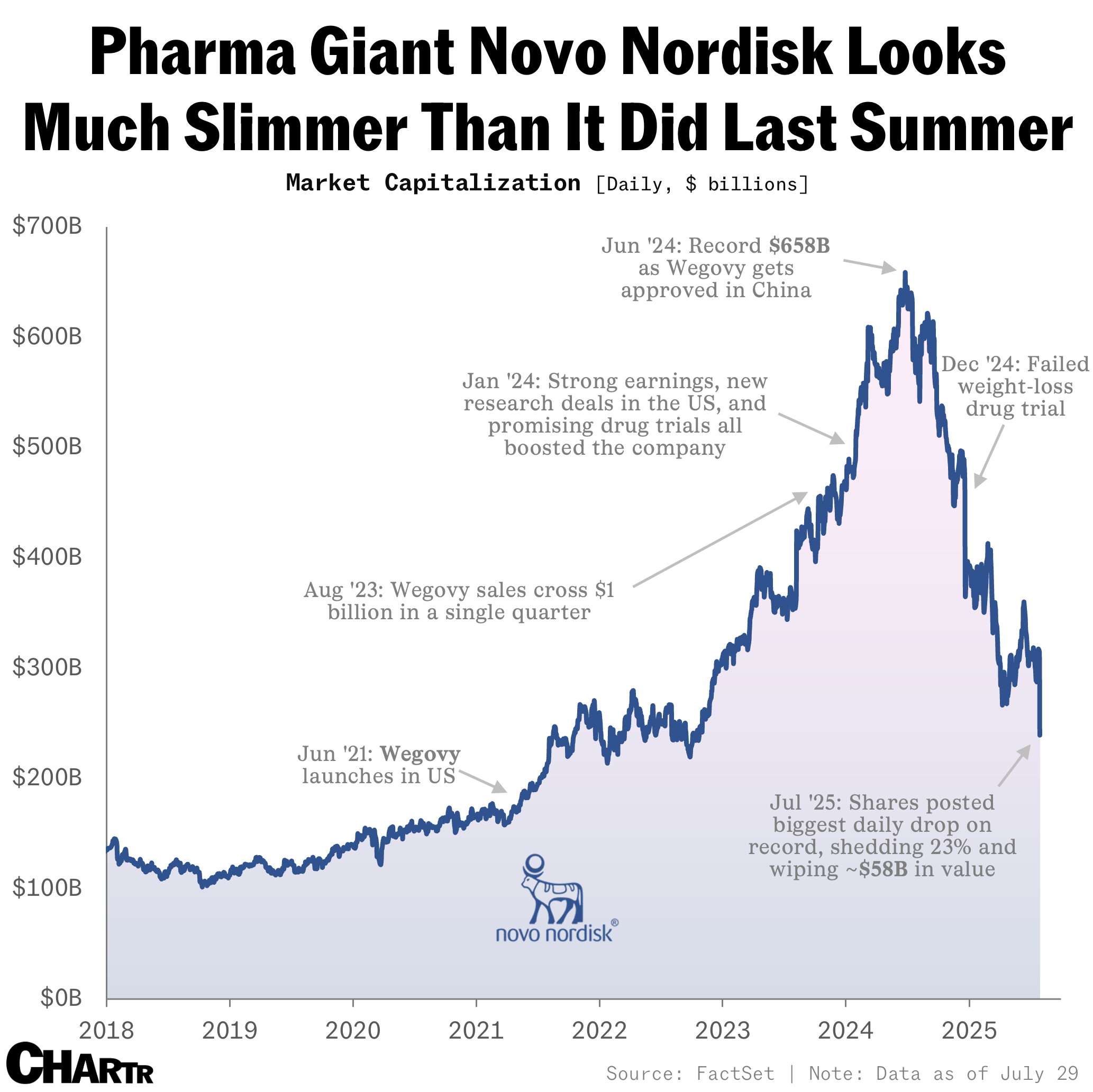
Novo Nordisk share price chart
Sherwood News

If 2024 was the year that GLP-1s “took over,” Ozempic (launched in the US in 2017) was very much leading the charge, having amassed enough cultural weight to serve as the poster child for the new wave of obesity treatments.

Since then, however, offerings from Eli Lilly, as well as stiff competition from compounders like Hims & Hers and Noom, have started to muscle in on Novo’s leading Ozempic and Wegovy drugs. Notably, Lilly’s Mounjaro and Zepbound have proven to be more effective for weight loss with fewer side effects, according to reporting from the Financial Times.

Nouveau problems

Much is made of first-mover advantage in business, but Novo might just be the latest in a long list of cautionary tales — MySpace, BlackBerry, Yahoo Search, Zoom, Peloton — that proves being early isn’t always enough. With new GLP-1 effort CagriSema disappointing across trials in December and March, it’s not just Novo that’s feeling the pain; the company’s slumping sales are hurting Denmark’s national export figures, too.

Go Deeper: How the Novo Nordisk-Hims & Hers partnership epically flopped in just two months | Is Ozempic old news?

More Markets

See all Markets
markets

Figma spikes after raising full-year sales outlook as the software company leverages AI for growth

Figma jumped postmarket Thursday after posting impressive sales in Q1, surpassing Wall Street expectations and raising its full-year guidance. The key numbers:

  • Q1 revenue of $333.4 million (compared to analyst estimates of $316 million).

  • Q2 sales guidance of $348 million to $350 million (estimate: $329.7 million).

  • Full-year revenue between $1.422 billion and $1.428 billion (up from previous guidance of $1.37 billion).

The digital design software firm is the latest company to diminish investor fears about AI-induced disruption by making the technology work for them. Like Atlassian or Datadog, Figma said it was able to use AI to its advantage, bringing more customers on board and getting them to spend more.

In the press release, Praveer Melwani, Figma CFO, said:

As AI gets better, Figma is accelerating and customer usage and workflows on our platform are deepening. Our platform and AI products drove faster growth for both new customer acquisition and expansion within existing accounts.

Revenue grew 46% year over year in Q1 2026, an acceleration from growth of 40% in Q4 2025.

markets

Infleqtion reports Q1 adjusted loss, offers modest boost to full-year sales guidance

Infleqtion is falling in postmarket trading after reporting a Q1 adjusted loss from operations of $13.2 million and sales of $9.5 million.

Management modestly upgraded its sales guidance to “at least” $40 million for 2026, adding that language to enhance the target provided in early April. Revenues of $40 million would mark an increase of roughly 23% compared to the $32.5 million generated in 2025, and an acceleration from growth of 12% last year.

The company utilizes neutral-atom technology to make quantum sensors used in clocks and antennas in addition to computers.

“Q1 reinforced our confidence that quantum is gaining momentum as the market shifts toward deployable systems, real applications, and measurable customer value,” said CEO Matt Kinsella. “Across computing, sensing, and software, we are seeing expanding customer activity especially in national security, space, and hybrid quantum-AI applications.”

Shares are roughly flat since February 13, which is just before the company went public via a SPAC, after being down 35% near the end of March, and then up nearly 30% in mid-April.

The quantum computing space benefited from the return of speculative appetite in April after the US and Iran agreed to a ceasefire. The cohort was later bolstered after Nvidia unveiled a suite of open models designed to leverage AI to improve calibration and error correction for quantum computers.

markets

Applied Materials rallies after better-than-expected Q2 results, strong sales guidance

Shares of Applied Materials are gaining in postmarket trading after the company reported robust Q2 results and a sales outlook that indicate building momentum.

  • Net sales: $7.9 billion (compared to analyst estimates of $7.7 billion and guidance for $7.65 billion, plus or minus $500 million).

  • Adjusted earnings per share: $2.86 (estimate: $2.68, guidance: $2.68, plus or minus $0.20).

For Q3, the company anticipates net sales of $8.95 billion (plus or minus $500 million; estimate: $8.15 billion) with adjusted EPS of $3.36 (plus or minus $0.20; estimate: $2.88).

“The growth in AI that Applied has been investing for is now in full force,” CFO Brice Hill said in the press release.

Management has consistently indicated that it expects demand to pick up in the second half of this year, but its first-half results have already blown away expectations by a wide margin. All this appetite for semiconductors to support AI compute is fantastic news for companies like Applied Materials that make the equipment to produce these specialized chips.

Shares of Applied Materials closed near a record high ahead of this report, up more than 70% year to date.

markets

Snap falls after Meta rolls out new “Instants” feature

Here today, gone tomorrow is a winning idea — according to Wall Street.

Shares of Snap are down nearly 5% Thursday afternoon after Meta announced Instants, a new feature and companion app that allows users to share spontaneous, unfiltered photos that disappearing after viewing. Remind you of anything?

Snap has fallen roughly 34% this year, while Facebook and Instagram parent company Meta has dipped 5% over the same time frame. Last week, Snap reported earnings that showed the social media company losing out on ad sales.

Latest Stories

Sherwood Media, LLC and Chartr Limited produce fresh and unique perspectives on topical financial news and are fully owned subsidiaries of Robinhood Markets, Inc., and any views expressed here do not necessarily reflect the views of any other Robinhood affiliate, including Robinhood Markets, Inc., Robinhood Financial LLC, Robinhood Securities, LLC, Robinhood Crypto, LLC, Robinhood Money, LLC, Robinhood U.K. Ltd, Robinhood Derivatives, LLC, Robinhood Gold, LLC, Robinhood Asset Management, LLC, Robinhood Credit, Inc., Robinhood Ventures DE, LLC and, where applicable, its managed investment vehicles.

