
Markets
Wood Blocks Stack Bar Graph
Getty Images
Remix

There are now more ETFs than stocks in the US, and many of them aren’t vanilla

From sin stocks to K-pop, pets to extraterrestrial life… there’s an ETF for everything now.

Claire Yubin Oh

According to Morningstar data first reported by Bloomberg last week, there are now some 4,400 exchange-traded funds listed in the US, surpassing the number of American public companies.

Remix market

Typically offering a tax efficient, flexible, and easy-to-access vehicle for investing, the ETF market has exploded, with more than 640 new ETFs launched this year — equivalent to about four per day — as investors have piled over $660 billion into the ETF market in the first seven months of this year. 
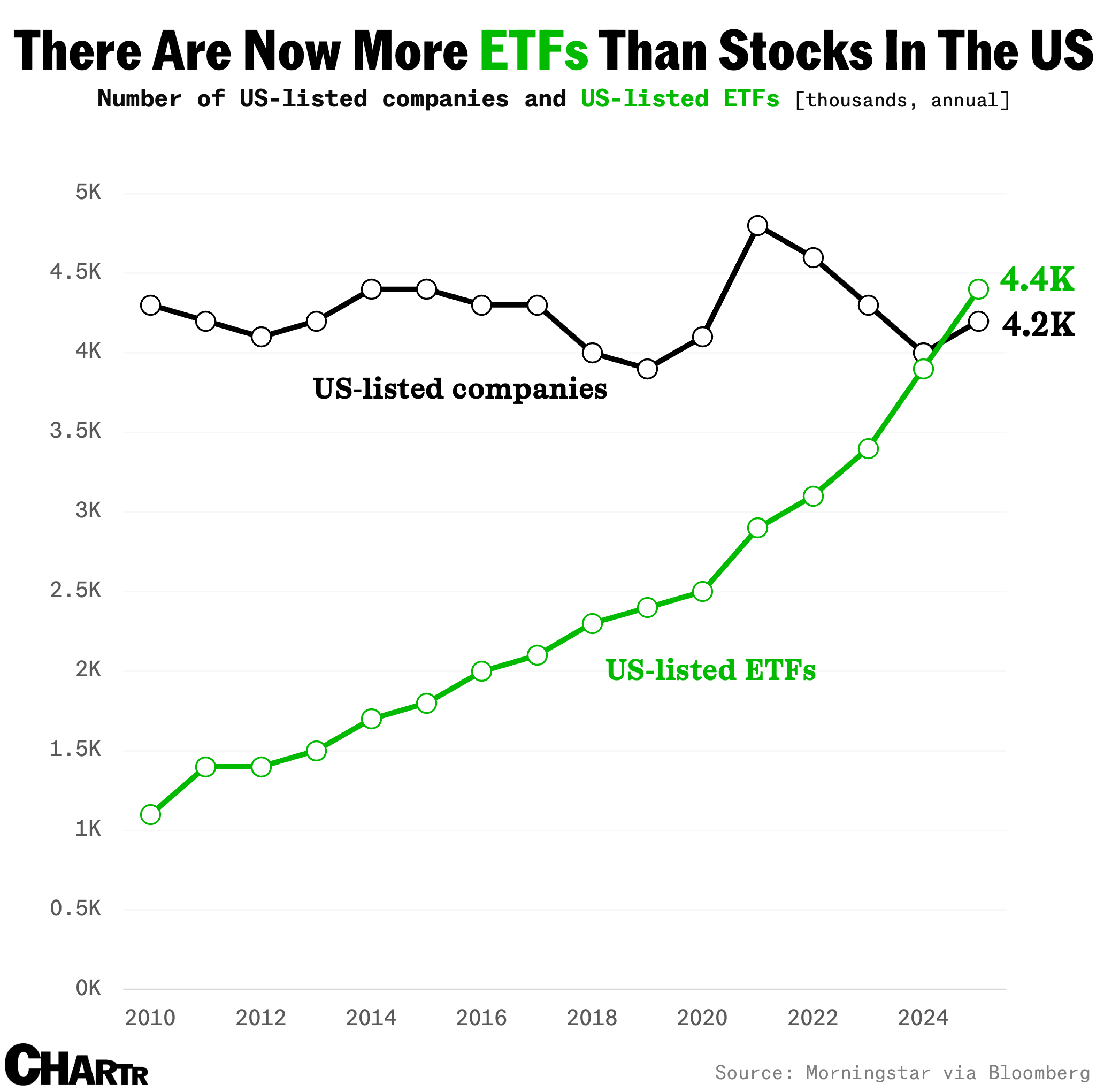
There are more etfs than stocks
Sherwood News

As Tker.co’s Sam Ro comments, it’s like having more recipes than there are ingredients — just like how chicken can go great in a sandwich, or a roast dinner, or a spicy curry, now major stocks routinely find themselves in hundreds of ETFs. Apple, for example, is in a bunch of tech ETFs, US-based ETFs, dividend ETFs, and megacap ETFs, to name but a few.

The trailblazers of the ETF world, passive low-cost index-tracking funds like VOO or SPY, are still the biggest in the game. But what’s changed in recent years is that the recipes have been getting spicier.

As of July this year, 37% of all new money in the ETF world flew into active ETFs, compared to only 3% in 2015. Rather than track a simple benchmark or theme, managers of these funds make investment decisions in the hope of finding better returns. They also tend to charge higher fees.

Many of these active ETF strategies follow classic investing styles like value, momentum, or income. Others are getting creative with derivatives, or niche categories, like the politically conservative YALL or the sin stocks fund VICE. Some of the biggest, like Cathie Wood’s innovation-heavy ARKK, have experienced serious boom and bust periods.

Once hailed as a simple way to invest with just a few options, now there’s an ETF for everything... if you have the patience to trawl through all 4,400 of them to find it.


More Markets

See all Markets
markets

American Eagle posts stronger-than-expected Q4 earnings and revenue

If American Eagle has seen farther, it is by standing on the shoulders of Sydney Sweeney.

The jeans seller posted adjusted earnings of $0.84 per share, ahead of the $0.71 expected by analysts polled by FactSet. It booked $1.76 billion in fourth-quarter revenue, versus the $1.74 billion consensus.

Shares initially climbed more than 5% after-hours before paring gains to about 2%.

“Compelling new product collections, supported by fresh marketing campaigns, led to higher demand trends in the quarter,” said CEO Jay Schottenstein.

American Eagle said it’s expecting same-store sales to grow by high single digits in the first quarter.

Marketing controversy has proved to be a powerful mover of denim for AE. In its third-quarter earnings call in December, AE said its partnership with Sydney Sweeney — together with a Travis Kelce partnership — had garnered more than 44 billion impressions. The retailer hit meme stock status last July when it initially launched its “Sydney Sweeney has great jeans” campaign.

As of Wednesday’s close, American Eagle shares had climbed 120% since the Sweeney ad first landed.

markets

Investors are itching to buy the dip in memory stocks

The intense drubbing in South Korean stocks, with the benchmark Korean index (KOSPI) falling nearly 20% in its first two trading days of the week following a Monday holiday, represented a serious threat to the hottest AI trade: memory stocks.

South Korea’s market is dominated by two high-bandwidth memory giants: SK Hynix and Samsung.

After Tuesday’s tumble, US investors seemingly said enough is enough: it’s a buy-the-dip opportunity.

US memory stocks like Micron, Sandisk, Western Digital, and Seagate Technology Holdings are posting massive gains on the day. The advance comes amid positive commentary at a Morgan Stanley conference on demand for memory chips.

Even more interestingly, the iShares MSCI South Korea ETF is up big today despite the KOSPI falling 12% overnight, its largest drop on record. The ETF’s outperformance of the South Korean equity gauge is the largest since 2008, as the global financial crisis raged.

The daily performance of these two can differ materially since they trade at different times and don’t track precisely the same things. US investors are making the bet that a potential break in this momentum trade and the potential for an unwind of retail leverage in South Korean markets be damned, big drops in memory stocks are meant to be bought.

Latest Stories

Sherwood Media, LLC produces fresh and unique perspectives on topical financial news and is a fully owned subsidiary of Robinhood Markets, Inc., and any views expressed here do not necessarily reflect the views of any other Robinhood affiliate, including Robinhood Markets, Inc., Robinhood Financial LLC, Robinhood Securities, LLC, Robinhood Crypto, LLC, or Robinhood Money, LLC.