Markets
markets
Luke Kawa

Traders doubt the rally. But they don’t fear another crash.

Investors don’t think the V-shaped recovery in financial markets is poised to become a full-blown check mark.

But neither do they fear a brisk return to a market in the kind of free fall markets endured in the sessions following the announcement of reciprocal tariffs on April 2.

That’s the message from the options market, whose cautious tone has contrasted sharply with the blaring risk-on signals sent from the stock market.

Cboe Head of Derivatives Market Intelligence Mandy Xu said, “We’re not seeing any upside chasing” in S&P 500 options. She flagged that the ratio between the implied volatility of 25-delta out-of-the-money S&P 500 call options versus at-the-money options (or call skew) has dipped, indicating meager demand for derivatives to capitalize on another leg back toward all-time highs over the next month.

While there’s no greed to speak of, there’s a calculated, measured fear: investors aren’t buying crash insurance — as seen by the relatively low demand for very far out-of-the-money put options compared to ones that are closer to the index’s current price — but a comparable measure of put skew is well above call skew.

It’s the first noteworthy divergence between put skew and crash insurance seen to date in 2025. As we recently wrote, traders have good reason to return to focus on run-of-the-mill risks rather than extremely large tail risks, given the Trump administration’s willingness to moderate trade policy in response to perceived financial distress.

Relatively low call skew and rising put skew can have a fairly benign/positive interpretation: you don’t need to chase upside in the options market if you’ve already reengaged by buying stocks. And if you’ve bought stocks, you have a need to hedge downside risk again.

Per Deutsche Bank strategists led by Parag Thatte, equity positioning is moving higher and closer to neutral among discretionary investors, while systematic investors are still very light relative to history.

Put it all together and it’s a pretty nuanced picture of a US stock market that has been anything but nuanced lately, on a nine-session winning streak that seems poised to snap on Monday.


More Markets

See all Markets
markets

Infleqtion targets revenue growth of 23% in 2026, up from 12% in 2025

Quantum computing firm Infleqtion said it’s aiming to book $40 million in sales this year as it released its 2025 results after the close on Wednesday.

That would be an increase of roughly 23% compared to the $32.5 million in revenues the company generated in 2025, and would mark an acceleration from growth of 12% last year.

The seller of quantum sensors and computers went public via a SPAC in February after carrying a pre-money valuation of $1.8 billion (well below other pure-play peers like Rigetti Computing, IonQ, and D-Wave Quantum).

“We did $29 million in revenue in 2024, and then we announced that we did $50 million of booked and awarded business in 2025. I think that sets a good foundation for significant revenue growth going forward,” CEO Matthew Kinsella told us in February. “I’ve always deeply believed that we need to develop that muscle of commercialization.”

markets

Retail traders are selling everything but the Magnificent 7, per JPMorgan

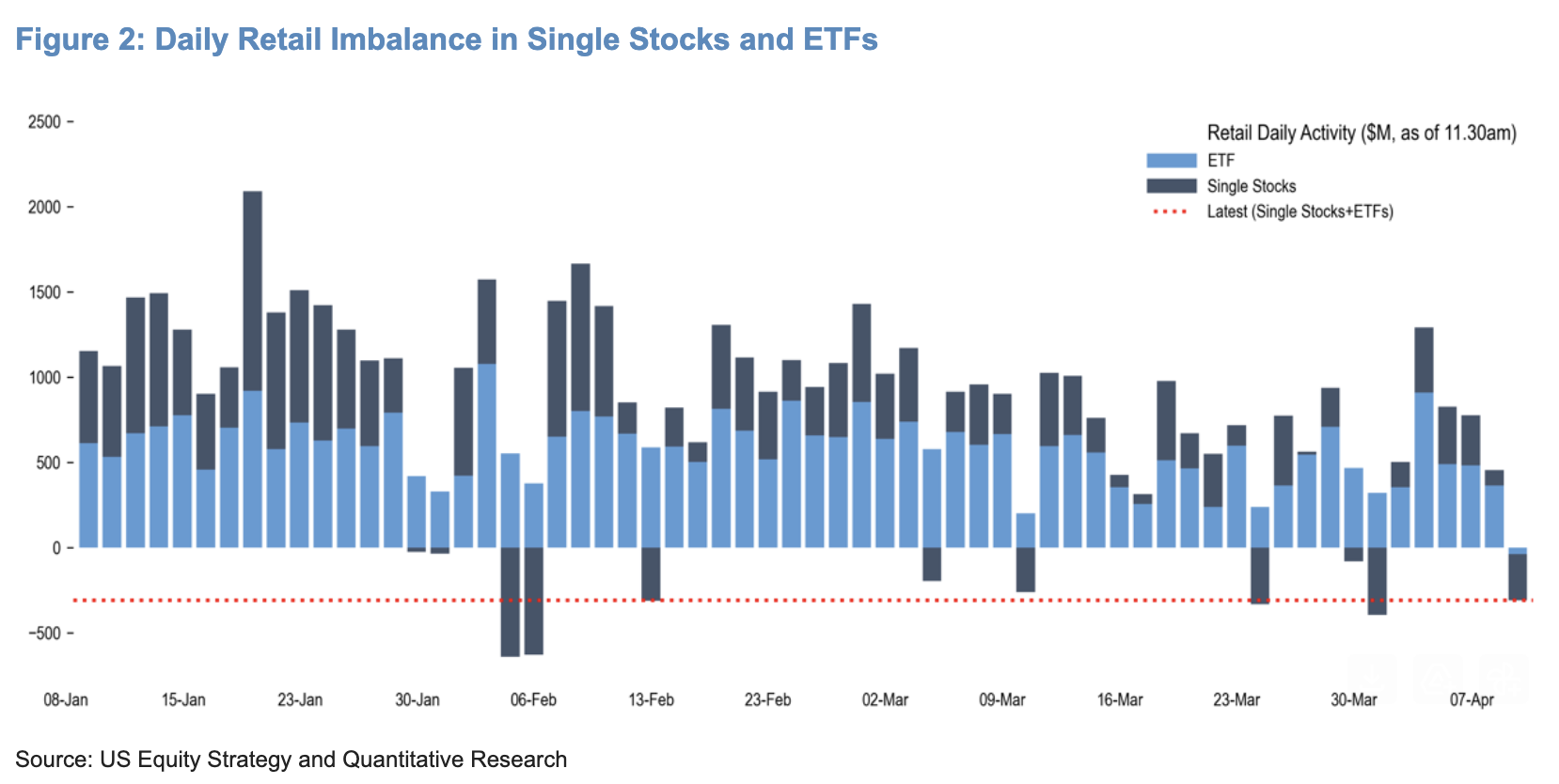
JPMorgan strategist Arun Jain with the skinny on retail trading activity through 11:30 a.m. ET today:

“Retail investors are selling into today’s strength in both ETFs and Single Stocks. In ETFs, they are trimming their broad-based exposure — a major departure from their typical pattern.”

The SPDR S&P 500 ETF and ProShares UltraPro QQQ suffered particularly large outflows, per Jain.

The exceptions to the selling pressure are the Magnificent 7 stocks, he wrote, with Nvidia, Tesla, Meta, and Microsoft enjoying “small net purchases,” while Micron, TSMC, Exxon, and Chevron were the most dumped names.

Retail trading 4/8

Last week, Jain noted that retail traders had been “skipping the dips, selling into rallies, and positioning more defensively” with markets jittery amid the ongoing Mideast war.

markets

Avis shorts facing $1.1 billion in losses as car rental company racks up 155% gains in its recent rally

Whatever traders are doing with Avis — buying, or just renting — it’s causing short sellers an immense amount of pain.

Shares of the car rental company have traded violently on Wednesday, from up nearly 7% at their highs to down almost 4% at their lows, after a face-ripping rally of 155% over the previous 11 sessions.

Per exchange data, roughly half the shares were sold short as of mid-March. S3 Partners, which tracks higher-frequency measures, said that short interest as a share of float had recently been trimmed to about 43%, down from as high as 53% at the start of the year.

Per Matthew Unterman, managing director at S3, Avis shorts are down $1.1 billion on paper over the past 30 days.

This isn’t Avis’ first rodeo: shares went parabolic in Q4 2021 as part of a meme stock moment in which it briefly became the most valuable company in the Russell 2000 small-cap index.

In any event, cheers to u/Bright_Leopard_4326, who admonished other members of the r/ShortSqueeze subreddit for not paying enough attention to the potential for a boom in the stock 10 days ago, when shares were trading below $150.

AVIS short squeeze
Source: r/ShortSqueeze

Latest Stories

Sherwood Media, LLC produces fresh and unique perspectives on topical financial news and is a fully owned subsidiary of Robinhood Markets, Inc., and any views expressed here do not necessarily reflect the views of any other Robinhood affiliate, including Robinhood Markets, Inc., Robinhood Financial LLC, Robinhood Securities, LLC, Robinhood Crypto, LLC, Robinhood Derivatives, LLC, or Robinhood Money, LLC. Futures and event contracts are offered through Robinhood Derivatives, LLC.