Markets
markets

US crude oil hits highest price since 2024 as Iran war roils markets

US crude oil climbed by more than 8.5% in afternoon trading Thursday, pushing the price of benchmark West Texas Intermediate crude above $81 at points, a level it hasn’t seen since the summer of 2024.

The price spike is hammering energy-sensitive stocks like airlines and consumer staples, and driving outperformance among oil and gas companies. Energy is already the S&P 500s top-performing sector by far in 2026.

In a March 5 note, analysts from S&P Global Energy CERA wrote:

The scale and duration of a price spike will depend on how much oil is kept off the market — and for how long — due to danger in the strait, higher shipping insurance rates or damaged Gulf infrastructure.”

US prices at the pump are already surging, rising an average of $0.27 to $3.25 per gallon, a 9% rise in just a single week, according to new data collected by AAA.

In a March 5 note, analysts from S&P Global Energy CERA wrote:

The scale and duration of a price spike will depend on how much oil is kept off the market — and for how long — due to danger in the strait, higher shipping insurance rates or damaged Gulf infrastructure.”

US prices at the pump are already surging, rising an average of $0.27 to $3.25 per gallon, a 9% rise in just a single week, according to new data collected by AAA.

More Markets

See all Markets
markets

Marvell Technology jumps after raising sales guidance for the next two years

Marvell Technology’s robust outlook is carrying the day after the custom chip designer’s Q4 results came in only fractionally above estimates.

For the final quarter of its fiscal 2026, the custom chip designer reported:

  • Net revenue of $2.22 billion (estimate: $2.21 billion).

  • Adjusted net income per share of $0.80 (estimate: $0.79).

For Q1, management offered guidance for:

  • Net revenue of $2.4 billion, plus or minus 5% (estimate: $2.28 billion).

  • Adjusted net income per share of $0.79, plus or minus $0.05 (estimate: $0.75).

During the conference call, management said that full-year sales for fiscal 2027 would be “approaching $11 billion,” up from its guidance of “approximately $10 billion” in December.

“We expect Marvell’s overall revenue in fiscal 2028 to grow close to 40% year over year, reaching approximately $15 billion, roughly $2 billion higher than the outlook we provided in our December earnings call and driving our non-GAAP EPS to well over $5,” CEO Matt Murphy said on the conference call.

Wall Street estimated Marvell’s full-year sales for fiscal 2027 (roughly calendar year 2026) would be a little over $10 billion and a little less than $13 billion for the following year, roughly in line with the firm’s previous guidance.

Shares extended gains to 15% after this boost to the outlook.

There had been massive uncertainty about the status of Marvell’s relationships with its two biggest hyperscaler clients going forward, with some analysts and media reports indicating that the firm was going to lose some of this business and others saying these custom chip programs remain on track.

“In addition to our strong results and outlook, our design wins in fiscal 2026 hit an all-time record, which we expect will continue to fuel our future growth,” Murphy said in a press release. The reference to “design wins,” in concert with the raised guidance, appear to be alleviating some of traders’ concerns about customer migration.

+27¢ ⛽

What a difference a week and a war make.

The average price per gallon for gasoline in the US shot up $0.27 from last week to $3.25, a 9% increase, according to new data from AAA, as escalating tensions in the Middle East push oil prices higher.

Higher fuel costs are rippling through markets: the Consumer Staples Select Sector SPDR Fund is down 2%, and bargain retailers like Dollar General and Walmart are also trading lower.

markets

Nvidia falls on report of US government drafting regulations restricting AI chip exports

According to Bloomberg, the Trump administration will propose regulations that would require US government approval for AI chip shipments worldwide, expanding existing export controls that currently apply to roughly 40 countries.

Nvidia and AMD both dropped on the news that the government would essentially act as a “gatekeeper for the AI industry,” though approval processes will vary and ramp up in complexity with the size of the order, and would only require the involvement of the host country’s government “for truly massive deployments,” Bloomberg’s sources said. Bloomberg added that exports for the largest projects would be approved only for US allies that make stringent security commitments and “matching” investments in American AI, though the draft rule does not specify what that investment ratio would be.

Earlier this week, Bloomberg reported the US is also considering putting a cap on the number of AI chips that Chinese firms can purchase, though Nvidia CFO Colette Kress mentioned on the company’s Q4 earnings call that it does not yet know whether it will be able to ship any AI chips to China regardless of US regulations.

Earlier this week, Bloomberg reported the US is also considering putting a cap on the number of AI chips that Chinese firms can purchase, though Nvidia CFO Colette Kress mentioned on the company’s Q4 earnings call that it does not yet know whether it will be able to ship any AI chips to China regardless of US regulations.

markets

The war is a mega rotation trade

Coming into this week, there had been some very well-defined and well-subscribed trades:

  • Memory stocks > everything, especially software.

  • Rest of the world’s stocks > US stocks.

  • Within the US market, the many > the few (as in, S&P 500 equal weight over S&P 500).

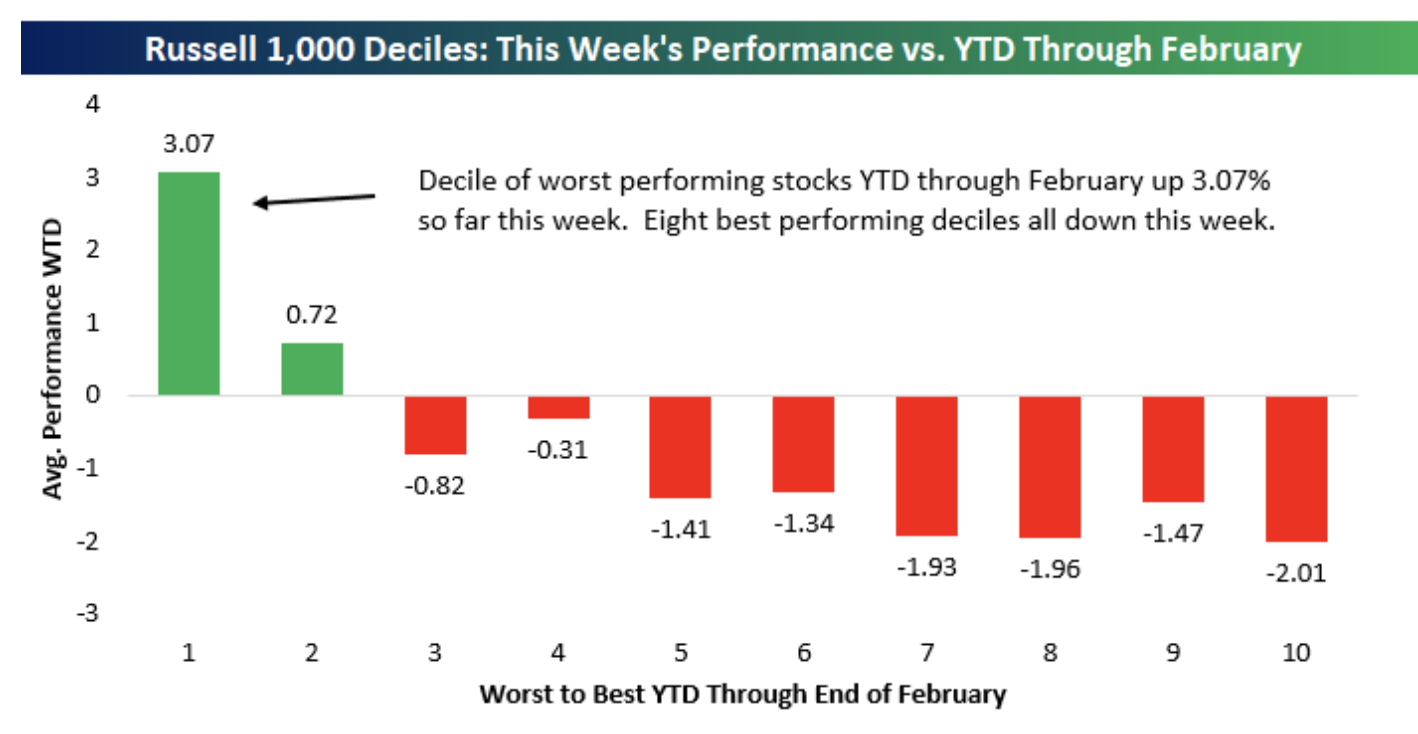
War is far from kind. In fact, for markets, it is seemingly a catalyst for mean reversion: all of these aforementioned trades are reversing this week.

There’s some fundamental backing, or at least an excuse, behind all of these unwinding:

  • Europe, for instance, is much more adversely impacted by oil price shocks than the US;

  • That’s also true for South Korea (whose market is dominated by a pair of memory chip stocks);

  • Oil price spikes are generally negative for economic activity; tech companies (particularly the heavyweights) have tended to enjoy acyclical growth.

“Who knew that a war against Iran would cause a mean reversion trade here in the US?” wrote analysts at Bespoke Investment Group on Wednesday. “So far this week, the best-performing stocks have been ones hit hardest this year through February, and vice versa.”

War as mean reversion
Source: Bespoke Investment Group

For markets, the risk was that war would drive a pickup in correlations within US stocks and between different asset classes. On Tuesday, the price action was validating and accentuating these concerns. Since then, broadly speaking, it hasn’t.

Latest Stories

Sherwood Media, LLC produces fresh and unique perspectives on topical financial news and is a fully owned subsidiary of Robinhood Markets, Inc., and any views expressed here do not necessarily reflect the views of any other Robinhood affiliate, including Robinhood Markets, Inc., Robinhood Financial LLC, Robinhood Securities, LLC, Robinhood Crypto, LLC, or Robinhood Money, LLC.