
Markets
FBL-WC-CLUB-2025-MATCH63-CHELSEA-PSG
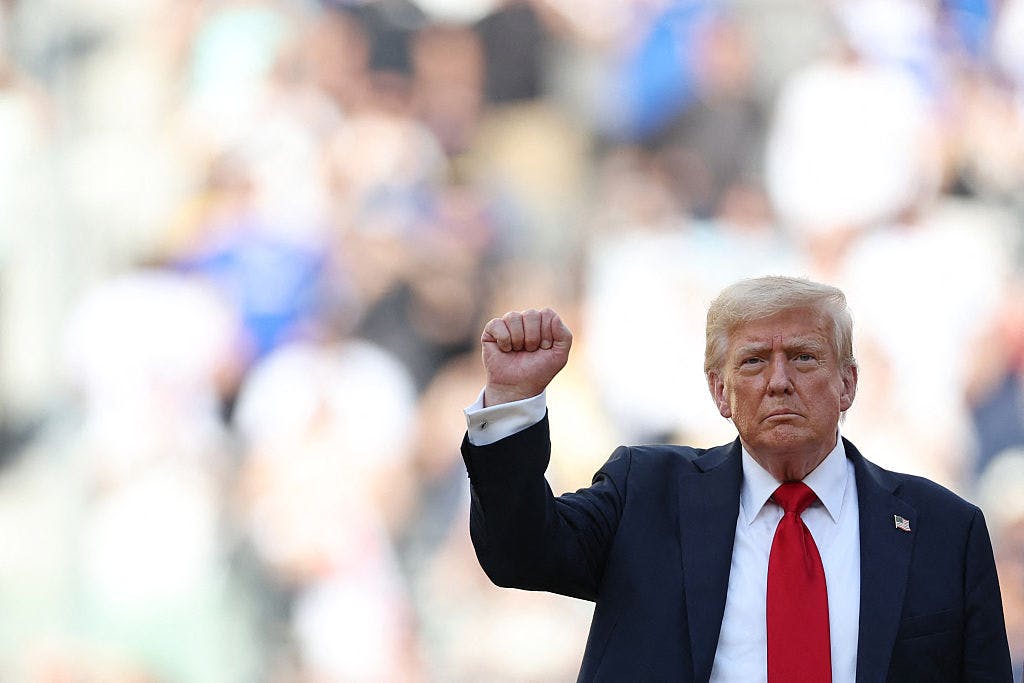
US President Donald Trump at the FIFA Club World Cup Final (Franck Fife/Getty Images)

US stock futures slump as Trump announces tariff hikes on the European Union, Mexico

We’re nearing a “make-it-or-break-it moment” on tariffs, warns ING Economics.

Luke Kawa

There’s no time off from tariff announcements, with S&P 500 futures trading 0.5% lower on Sunday evening in response to the threat of higher levies on imports from two of America’s biggest trading partners.

After the close on Friday, President Donald Trump posted a pair of letters to Truth Social announcing 30% tariffs on imports from Mexico and European Union, separate from any sectoral tariffs, effective August 1.

For the EU, Trump cited the US’s longstanding trade deficit with the bloc; in the case of Mexico, he said the same while adding that the nation has not done enough to help secure the border. The euro and Mexican peso are also weakening versus the US dollar in early trading.

The market’s reaction to the flurry of tariff news in 2025 has looked a little something like this:

  • Trump floats a ton of onerous tariffs;

  • Trump delays and/or waters down these tariffs;

  • Tariff rates, in aggregate, still go up materially; and

  • Stock markets (and earnings estimates) keep going up, in part because initial announcements of onerous tariffs are yet to be fully realized.

The narrative increasingly embedded in the markets is that tariffs are here, but won’t be as bad as once feared or enough to tip the US economy into a recession.

Strategists are divided on whether these latest declarations make deals before the new August 1 deadline more or less likely.

“August 1 is less than three weeks away, and as it seems unlikely that the Trump Administration can offer one ally something it does not offer all (e.g. say a special deal on autos for say Japan, but not South Korea or the EU), the prospects for a negotiated outcome and avoiding broad based trade escalation by the end of the month has now fallen even lower,” wrote Jacob Funk Kirkegaard of 22V Research.

On the other hand...

“On the EU side, the 30% threat will resonate, and — we think — act as a catalyst to force the EU to accept a deal that it may not have countenanced before (e.g. with only limited US concessions regarding autos),” Nico FitzRoy, senior Europe strategist at Signum Global Research, wrote. “On the US side, we think the most likely reasoning behind’s Trump’s announcement is to use the 30% threat to squeeze out as good a deal as possible from the EU (rather than simply wanting to implement the tariff), as we believe recent events suggest there is now enough evidence Trump actually wants a deal.”

And others, reasonably, are happy to say that they aren’t sure.

“We have given up speculating about any longer-term strategies in these trade negotiations,” ING Economics’ Carsten Brzeski and Inga Fechner wrote. “What the letters of the last days, and in particular the letters to the EU and Mexico, show is that we are nearing a make-it-or-break-it moment.”

More Markets

See all Markets
markets

Nike sinks to lowest level since 2014 after warning of “challenged” sales environment in Q4 report

Did Nike do it?

Investors had a mixed reaction after the global sports apparel company reported its fourth quarter earnings on Tuesday after the bell. Shares initially rose 5% as Nike beat out Wall Street expectations amid a hefty tariff refund bonus. However, the stock then sank to its lowest level since August 2014 in postmarket trading.

Here are the Q4 numbers:

  • Revenue of $11.0 billion (estimate: $10.8 billion).

  • Adjusted earnings per share of $0.20 (estimate: $0.12).

Ahead of this report, Nike warned that results would be flattered by a one-time tariff refund (now estimated at roughly $0.52 per share for the bottom line). That gave the company an extra cushion in snapping its streak of seven quarters of year-over-year profit declines.

Over the past year, the company had been punished by tariffs on imported goods, stagnant consumer spending, and increasing competition from other footwear brands like New Balance, Adidas, and Hoka.

Outgoing CFO Matthew Friend deemed it an “increasingly challenging operating environment, where sell-through remains challenged.”

markets

Rocket Lab deal lifts space stocks

Shares of Rocket Lab are surging after announcing an $8 billion acquisition of satellite communications operator Iridium Communications, helping lift a broader basket of space-related stocks as investors piled back into the sector.

Planet Labs, AST SpaceMobile and Redwire all traded higher alongside Rocket Lab, extending gains in an industry that has drawn enhanced investor attention in recent months in light of the strategic importance that governments place on space and satellite communications infrastructure.

In a presentation, Rocket Lab’s management called the purchase “a shortcut” for its satellite communications business.

Under the terms of the agreement, Iridium shareholders will receive $27 in cash and Rocket Lab stock, valuing Iridium at $54 per share. Backed by a $3.6 billion bridge loan committed by Deutsche Bank and Wells Fargo, Rocket Lab absorbs Iridium’s globally licensed spectrum and an active base of 2.5 million subscribers.

Rocket Lab has also remained one of the most active launch providers in the sector. The company completed its 12th launch of the year last week, maintaining one of the highest launch cadences among commercial space companies.

Today's rally helps offset a brutal stretch for the group. Rocket Lab shares had fallen over 35% over the prior month, while Planet Labs stock was down more than 40% and AST SpaceMobile stock was down around 30% over the same window.

markets
Jake Lahut

Comcast shares rise on news of NBCUniversal spinoff deal

Comcast rose on the news that the telecom behemoth is spinning off NBCUniversal and Sky from its cable portfolio. 

Comcast initially jumped up to 17% in early trading, with the deal leaving management to focus on its core verticals of cable, wireless, and business services. 

NBCUniversal and Sky will form a new publicly traded company, similar to Versant Media, the holding company of CNBC and MS NOW that Comcast officially spun off in January. Bravo, one of the most lucrative properties that remained at Comcast, will remain part of NBCUniversal in the deal. The Universal theme parks and studios will also come with the new spinoff entity, along with Telemundo and Peacock.

Mike Cavanagh, the co-CEO of Comcast, will become the CEO for NBCUniversal, according to CNBC. 

The spinoff will be completed in about a year, according to a Comcast company statement. Its shareholders will also own shares in NBCUniversal, according to the same statement.

Latest Stories

Sherwood Media, LLC and Chartr Limited produce fresh and unique perspectives on topical financial news and are fully owned subsidiaries of Robinhood Markets, Inc., and any views expressed here do not necessarily reflect the views of any other Robinhood affiliate, including Robinhood Markets, Inc., Robinhood Financial LLC, Robinhood Securities, LLC, Robinhood Crypto, LLC, Robinhood Money, LLC, Robinhood U.K. Ltd, Robinhood Derivatives, LLC, Robinhood Gold, LLC, Robinhood Asset Management, LLC, Robinhood Credit, Inc., Robinhood Ventures DE, LLC and, where applicable, its managed investment vehicles.

