

Markets
Wall Street
Getty Images
Slice of pie

The US stock market has become the global market over the last 60 years. Will that continue?

Goldman Sachs sees another $300 billion from foreign investors flowing into US stocks this year, even as tariff risks loom and growth forecasts are slashed.

Hyunsoo Rim

Foreign investors hold a record slice of America’s $93 trillion stock market — and they might not let go anytime soon.

As of Q4 2024, overseas investors owned $16.5 trillion, or 18%, of US equities, the highest share on record, according to Federal Reserve data. Thats up from 8% in 2000 and just 2% in the 1950s.
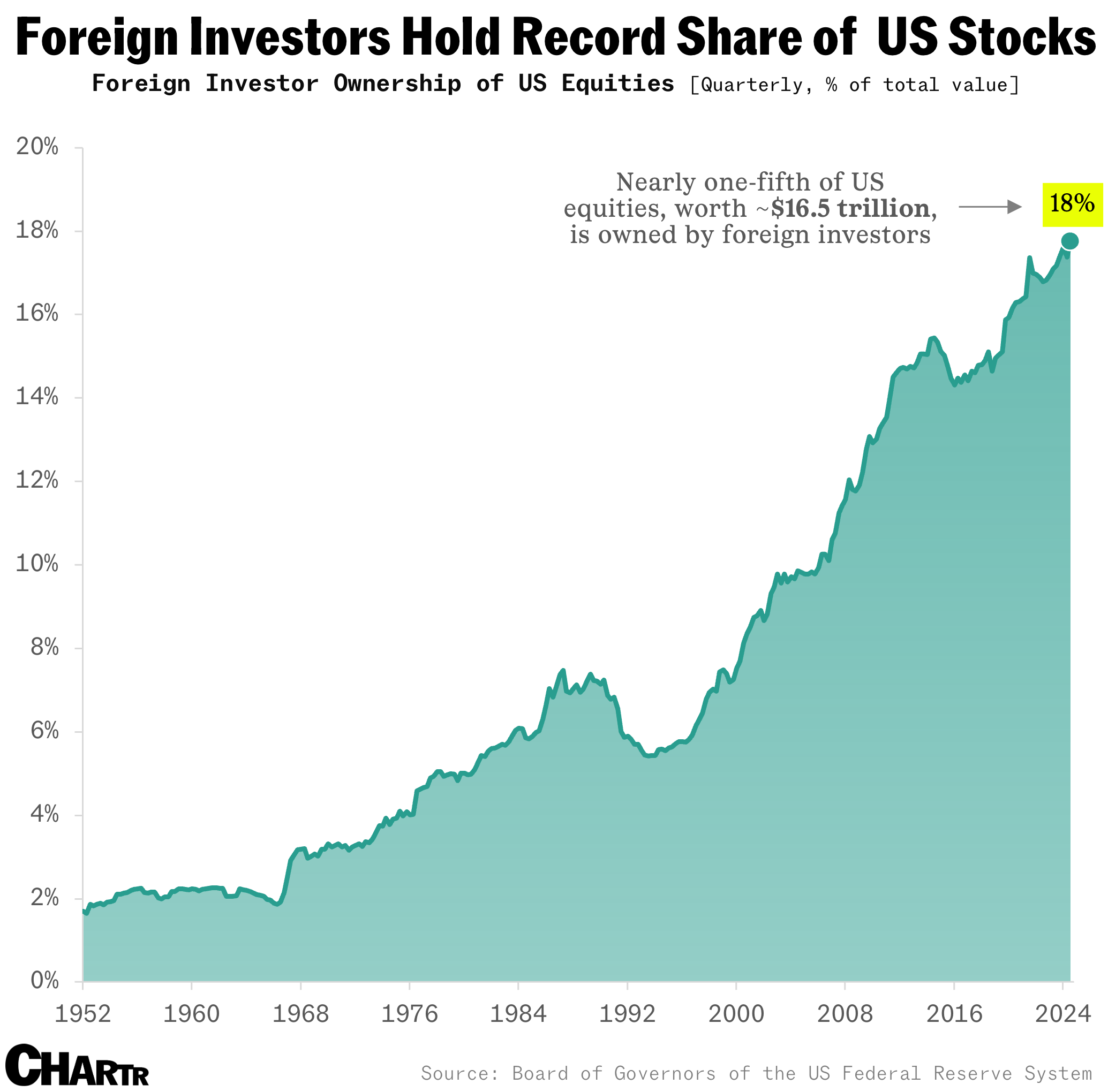
Foreign ownership US stocks
Sherwood News

TINA

As globalization gripped the world, the American stock market became the go-to investment for trillions of dollars of capital. With the world’s largest and most innovative companies like Apple and Nvidia in the United States, if you were an institutional investor in India or an individual in Italy, there was no alternative to buying US stocks.

But with protectionist policies like tariffs looming and US stocks seeing a sluggish start to 2025 — the SPDR S&P 500 Trust is down 3% year-to-date, lagging Europes STOXX 600 (up 9%) and Chinas CSI 300 (up 1%) — is growing foreign ownership a trend that’s likely to continue?

Researchers from Goldman Sachs, led by David Kostin, outlined in a note published Friday why they believe foreign investors will keep buying. They argued that the US market’s size and liquidity — the S&P 500 is 4x the size of Europe’s STOXX 600 and 8x bigger than China’s CSI 300 — makes it impossible to ignore for global investors looking to invest large sums.

Furthermore, though slowing growth has become a concern on Wall Street, Goldman still expects S&P 500 earnings to grow 7% annually in 2025 and 2026, outpacing Europes 4% and 6% growth in the same period. They also observed that a weakening US dollar — which makes US stocks cheaper for overseas buyers — could support buying: the bank expects global investors to pour another $300 billion into US equities this year, roughly matching last year’s inflows.

Of course, any significant deterioration of the fundamental US economic picture could push investors to look elsewhere.


More Markets

See all Markets
markets

Carvana craters after Q4 earnings miss estimates

Used car retailer Carvana plummeted after fourth-quarter profits came in shy of estimates.

Adjusted EBITDA of $511 million came in below the consensus call for $535.7 million, more than offsetting better-than-expected sales of $5.6 billion (estimate: $5.27 billion).

Carvana sold 163,522 used vehicles to retail customers in the quarter, up 43% from last year and ahead of expectations. With that result, Carvana further closes its retail sales gap with rival CarMax, which sold 169,557 vehicles in its most recent quarter.

Carvana posted a retail gross profit per vehicle of $3,076, down 7.7% from the same period last year. In a letter to shareholders, Carvana said its reconditioning costs came in higher than expected in Q4, which led to an additional impact on retail gross profit per unit. Lower shipping fee revenue, higher non-vehicle costs, and higher industrywide retail depreciation rates also drove the decline, the company said.

Carvana said it expects to see elevated reconditioning costs again in the first quarter, but expects a sequential increase in retail GPU. Carvana said it expects “significant growth in both retail units sold and Adjusted EBITDA” in the first quarter and full year ahead.

As of Wednesday’s close, Carvana shares were down about 24% since an all-time closing high in January, after a report from short seller Gotham City questioning its accounting practices sent the stock reeling. A Carvana spokesperson told Sherwood News that the report was “inaccurate and intentionally misleading.”

markets

DoorDash reports earnings miss, underwhelming earnings guidance

DoorDash reported earnings results that missed Wall Street expectations and provided underwhelming earnings guidance Wednesday after the bell, which it attributed to harsh weather and increased spending.

For the final three months of 2025, DoorDash reported:

  • Earnings per share of $0.48, compared to the $0.59 analysts polled by FactSet were expecting.

  • Revenue of $3.9 billion, in line with the $3.9 billion analysts were penciling in.

  • Gross order value (the total amount spent on the platform) of $29.7 billion, compared to the $29.2 billion analysts were expecting.

For the current quarter, the company expects:

  • GOV between $31.0 billion and $31.8 billion, versus the $30.7 billion analysts are expecting.

  • Adjusted EBITDA between $675 million and $775 million, far below the $801.9 million analysts are expecting. The company said spending on Deliveroo, its recent UK acquisition, as well as extreme winter weather in the US are weighing on its profit guidance.

Shares fell as much as 11% in after-hours trading. The stock is down more than 20% so far this year.

DoorDash’s costs have gone up as it ramps up investment in autonomous delivery and international expansion, among other things. “This is a massive and expensive undertaking and honestly one you shouldn’t do if you thought your best days were behind you,” CEO Tony Xu said in a letter to shareholders.

Ethan Feller, a strategist at Zacks Investment Research, said the underlying business remains strong even if the stock faces pressure in the near term.

“None of these are structural issues, but soft guidance is soft guidance — and the market rarely gives credit for context when a stock is already under pressure,” he said.

markets

Figma spikes after reporting better-than-expected Q4 results, blowout Q1 and full-year sales guidance

Figma reported Q4 results that exceeded Wall Street’s expectations and robust sales guidance for the current quarter and full year.

Shares are spiking in after-hours trading.

For the final three months of 2025, the digital design and development platform company reported:

  • Revenue of $303.8 million, compared to the $293.1 million analysts were penciling in.

  • Adjusted earnings per share of $0.08, compared to the $0.07 analysts polled by Bloomberg expected.

For sales, management expects:

  • Q1 revenue between $315 million and $317 million (estimate: $293.6 million).

  • Full-year revenue between $1.366 billion and $1.374 billion (estimate: $1.29 billion).

The lower ends of these ranges are above the highest analyst sales estimates for both Q1 and 2026 as a whole.

This marks the company’s second earnings report since going public over the summer. Its share price has taken a hit this year alongside many of its software peers, and management will be looking to show that AI can be an accelerant, rather than a threat, to its business. On Tuesday, Figma announced a partnership with Anthropic to integrate AI coding tools.

“Our healthy balance sheet and positive free cash flow gives us the flexibility to continue investing in AI and the platform while maintaining financial discipline for sustainable, long-term growth,” CFO Praveer Melwani said in the press release.

As of the close on Wednesday, the stock was down 35% for the year and roughly 80% below its closing level at the time of its July IPO.

markets

Record labels dip as Google adds AI music generation to its Gemini app

Google on Wednesday said it’s rolling out the ability for Gemini app users aged 18 and up to generate 30-second AI music tracks.

The tool is available globally, as Google launches beta access to its Lyria 3 generative-AI music model.

Addressing the potential for skirting the lines of copyright law (as seen in other recent DeepMind AI tools), Google said:

“If your prompt names a specific artist, Gemini will take this as broad creative inspiration and create a track that shares a similar style or mood. We also have filters in place to check outputs against existing content. We recognize that our approach might not be foolproof, so you can report content that may violate your rights or the rights of others.”

Shares of record labels including Universal Music Group and Warner Music dropped 2% on the news. Spotify briefly dipped before rebounding, and Sony shares also saw a slight decline.

Last month, Morgan Stanley published a survey that found up to 60% of Gen Z respondents listen to AI music, for an average of three hours per week. Earlier this year, Bandcamp banned all music wholly or substantially generated using AI.

Addressing the potential for skirting the lines of copyright law (as seen in other recent DeepMind AI tools), Google said:

“If your prompt names a specific artist, Gemini will take this as broad creative inspiration and create a track that shares a similar style or mood. We also have filters in place to check outputs against existing content. We recognize that our approach might not be foolproof, so you can report content that may violate your rights or the rights of others.”

Shares of record labels including Universal Music Group and Warner Music dropped 2% on the news. Spotify briefly dipped before rebounding, and Sony shares also saw a slight decline.

Last month, Morgan Stanley published a survey that found up to 60% of Gen Z respondents listen to AI music, for an average of three hours per week. Earlier this year, Bandcamp banned all music wholly or substantially generated using AI.

Latest Stories

Sherwood Media, LLC produces fresh and unique perspectives on topical financial news and is a fully owned subsidiary of Robinhood Markets, Inc., and any views expressed here do not necessarily reflect the views of any other Robinhood affiliate, including Robinhood Markets, Inc., Robinhood Financial LLC, Robinhood Securities, LLC, Robinhood Crypto, LLC, or Robinhood Money, LLC.
