Tech
Cartoon of family Watching TV
(Getty Images)
BROAD-CAST

Americans watched YouTube more than any other platform on TVs in February

YouTube’s share of TV usage has increased 53% in the last two years, per Nielsen.

Tom Jones

When it first landed on Apple devices, the YouTube app icon was a little, beige, vintage-looking cartoon TV. It stuck with that for years before eventually distancing itself from the older, more familiar medium, switching in its distinctive red play button — an icon that’s gently seared itself into the minds of billions.

Now, years on, YouTube seems to be taking over the medium it once mimicked.

Big(ger) screen

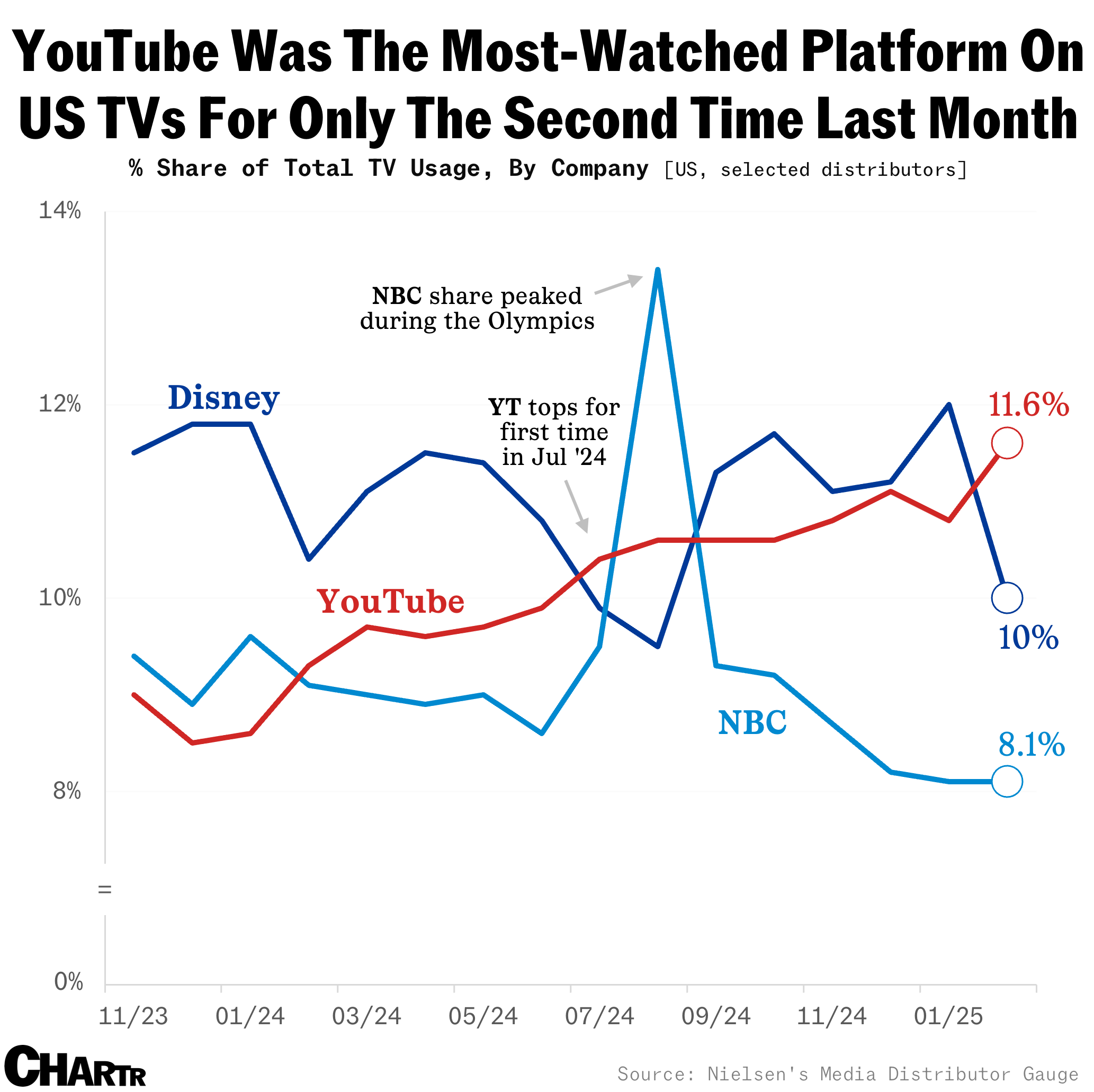
According to February data from Nielsen’s Media Distributor Gauge report, YouTube was the most-watched platform across US televisions, taking an 11.6% share of screen time and topping the distributor list for only the second time since Nielsen began tracking the data.

Put another way: Americans watched YouTube on their TVs more than anything else — more than Disney (and all of its entities), NBC, Paramount, Fox, Netflix. Everything.
YouTube TV share chart
Sherwood News

YouTube, which Google acquired in 2006, having clinched the top spot again underscores the growing shift in how people are consuming content from the platform, with its CEO last month confirming that people are watching on their TVs more than their phones for the first time.

Apart from the two YouTube instances and a high jump from NBC during its Olympics coverage, which saw the company take a record 13.4% share of TV usage in August last year, the Walt Disney Company has been winning the war for American eyeballs, with channels like ESPN, ABC, and its streaming services all counting toward its overall share. Indeed, thanks mostly to the ESPN-aired College Football Playoffs, Disney made up 12% of TV usage in January — its highest monthly total so far. 

While Nielsen has made only distributor figures from November 2023 onward public, it revealed that YouTube accounted for just 7.9% of American TV viewing time in February 2023, meaning the number of us who’ve been switching on our TV sets to tune in to the latest offerings from Mr Beast et al. has jumped 53% in just two years.


More Tech

See all Tech
🚀 $100B

Alphabet’s 2015 investment in SpaceX is about to pay off handsomely with the company’s hotly anticipated IPO later this year, which is expected to be the largest in history.

Bloomberg reports that according to new financial filings, Alphabet’s investment could be worth up to $100 billion.

Google invested in SpaceX in 2015 when it, along with Fidelity, invested $1 billion in a round that valued SpaceX at $10 billion. At the end of 2025, Google owned just over 6% of SpaceX, per Bloomberg’s reporting on the more recent filings. That stake has likely been diluted due to SpaceX’s merger with xAI.

$1

Barclays says autonomous couriers — think sidewalk robots and drones — could push delivery costs down to as little as $1 per order, from between $5 and $7 today and closer to $9 for traditional deliveries in high-labor-cost markets. If robots save $4 on every delivery, and enough companies start using them, the food delivery industry, including companies like DoorDash and Uber, could end up with $16 billion in extra profit every year, according to Barclays.

The catch: we’re nowhere near that world yet. Robots and drones handle less than 1% of deliveries today. Even by 2035, Barclays only sees penetration hitting around 10%.

Google’s Wing and Amazon have also been trying to crack last-mile product delivery — a reminder that this is part of a broader race to automate the most expensive leg of e-commerce.

$10B

Uber has long had an asset-light business model: it provided the ride-hailing platform, and its contract workers brought their own vehicles. That’s changing as Uber positions itself at the center of the robotaxi era.

The Financial Times estimates that Uber has committed more than $10 billion to buying robotaxi fleets ($7.5 billion) and investing in the companies that make them ($2.5 billion). That includes yesterday’s announcement that its expanding its investment in Lucid, a deal worth about $2 billion, with plans to buy 35,000 vehicles.

This shift pits Uber against industry leaders like Google’s Waymo and Tesla, whose models involve company-owned vehicles running on proprietary platforms. While these autonomous fleets eliminate the need for drivers, they introduce new capital-intensive requirements for charging, cleaning, storage, and repair.

Latest Stories

Sherwood Media, LLC produces fresh and unique perspectives on topical financial news and is a fully owned subsidiary of Robinhood Markets, Inc., and any views expressed here do not necessarily reflect the views of any other Robinhood affiliate, including Robinhood Markets, Inc., Robinhood Financial LLC, Robinhood Securities, LLC, Robinhood Crypto, LLC, Robinhood Derivatives, LLC, or Robinhood Money, LLC. Futures and event contracts are offered through Robinhood Derivatives, LLC.