

Tech
Personnel evaluation by artificial intelligence,blue background,vector illustration
(Getty Images)

Big Tech isn’t hiring like it used to, unless you say the magic words

Artificial intelligence is rewriting who gets hired, for what, and why.

When Big Tech started slashing jobs in late 2022, it felt like a brief (and painful) correction to the pandemic-era hiring binge, when Apple, Amazon, Meta, Microsoft, and Alphabet collectively added more than 960,000 jobs during the peak of the digital demand boom.

Nearly three years later, however, the layoffs haven’t really stopped.

According to TechCrunch, more than 22,000 US tech workers have been let go just this year — including Intel slashing 20% of its workforce, Meta trimming Reality Labs, Amazon’s ~100 job cuts, Google’s back-to-back downsizing rounds, and just last week, Microsoft laying off 6,000 employees globally.

Looking across a selection of the largest public US technology firms, it’s easy to see that headcount growth has either slowed or outright reversed in the past two years for many.

Some notable exceptions? Netflix, which has been remarkably lean for more than a decade with just ~14,000 employees, and chip designers and semiconductor companies like Nvidia and Broadcom, which are powering much of the AI revolution.

In fact, that divergence has been playing out within America’s tech companies as well. If you’re close to the action in AI, your stock is probably rising internally. But if you’re in an operational role, administrative job, or even in a field of software engineering that’s more exposed to AI, you might not be feeling as secure.

That pressure is not just about who’s being let go — it’s also about who’s not getting hired.

Since February 2020, US job listings for software development roles have fallen nearly 40%, and IT help desk roles are down over 30%, according to data from hiring platform Indeed. That’s significantly worse than other sectors like finance or legal, and well below the broader job market, where listings are up 6%.

Postpandemic, much of the tech world’s obsession with getting lean — CEO Mark Zuckerberg called 2023 the “year of efficiency” for Meta — came from rising interest rates, margin pressure, and a reckoning with Covid-era overhiring. But now, something else is reshaping the tech job market, which some experts are calling “a very powerful ChatGPT effect.”

According to the University of Maryland’s January research, the number of IT job postings dropped 27% from the end of 2022 to 2024, while AI-related roles jumped 68%.

Researchers see this divergence as “clear evidence” of ChatGPT’s growing influence, as the chatbot’s late-2022 debut prompted companies to rethink how they build (and staff) their tech stacks — starting with the lowest-hanging tasks for machines to take over. That has only accelerated in the wake of rival chatbots like DeepSeek, Claude, Perplexity, and others.

Kanary in the coal mine?

Take Klarna, the Swedish “buy now, pay later” firm that’s been leaning hard on AI, so much so that a hyperrealistic AI-generated avatar of CEO Sebastian Siemiatkowski presented the company’s quarterly earnings earlier this week. 

Beyond its actual results, what grabbed investors’ attention — or at least, what Klarna execs probably hoped would be the focus ahead of its long-awaited IPO — was a whopping 154% jump in its revenue per employee over the past two years, which reached an impressive $877,000.

Under a mixed agriculture/military metaphor titled, “Reaping the benefits of spearheading AI,” Klarna touted that it had reduced its workforce by roughly 40% in just two years.
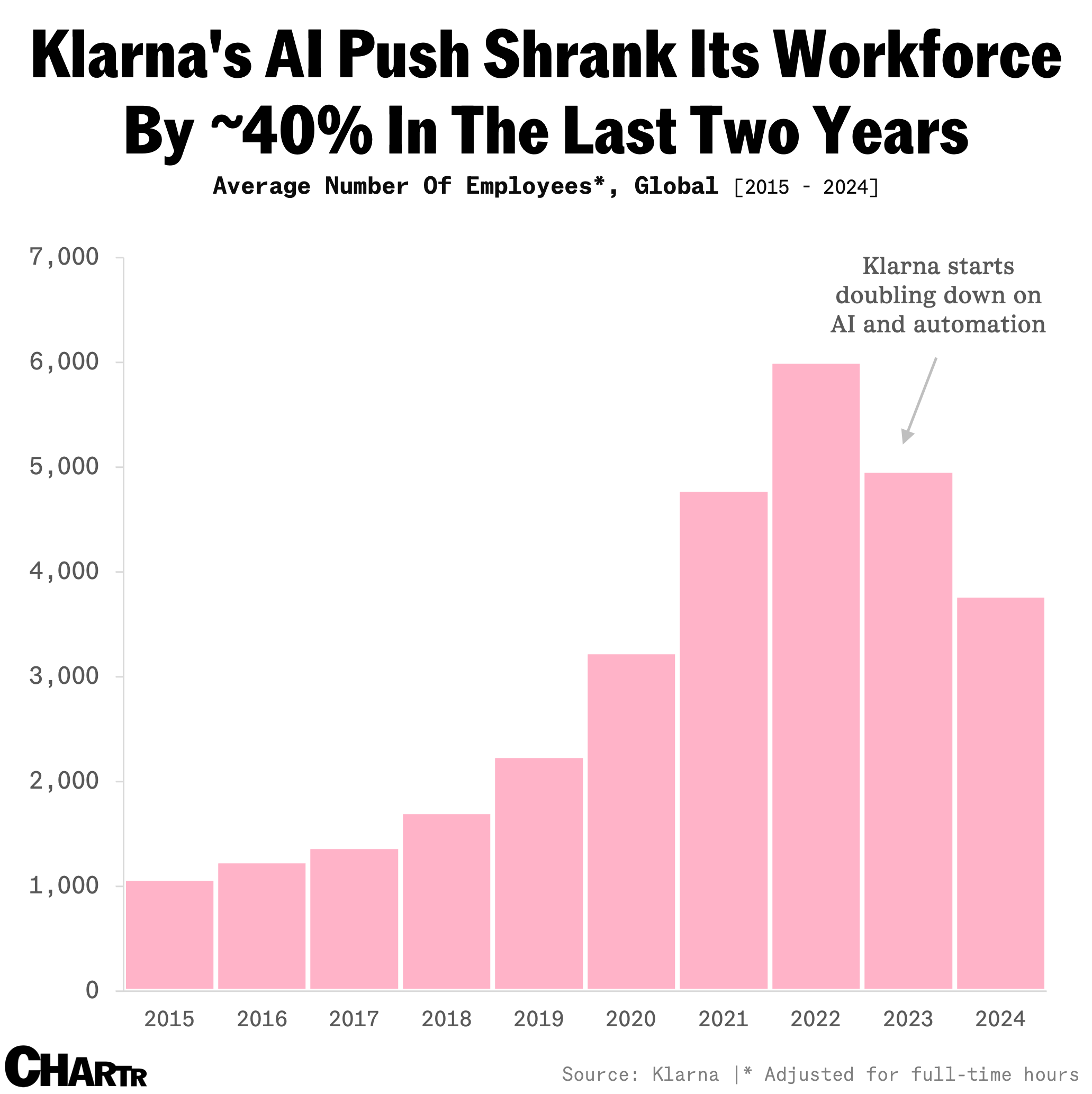
Klarna chart
Sherwood News

The biggest cost savings in Q1 came from customer service, where Klarna replaced human agents with its in-house AI chatbot, cutting service costs by 40% since 2023.

That’s a sector that has long been cited as one of the most vulnerable to AI, with Klarna saying its chatbot now does the work of 700 people. Following complaints about its “lower quality,” however, Klarna recently said it will bring back real people — though it’s unclear how many bots (and humans) the company will ultimately retain.

Despite the slimmed-down workforce, Klarna’s net loss more than doubled in Q1, to some $99 million.

From phones to keyboards

But it’s not just about call centers anymore; AI is creeping into corporate jobs, too, the kind of work once considered out of reach for automation. As part of larger global layoffs, Microsoft recently cut ~2,000 jobs in its home state of Washington and software engineers bore the brunt of the pain, accounting for 40% of the cuts, per Bloomberg. CEO Satya Nadella revealed that AI now writes up to 30% of the company’s code on certain projects. Over at Google, Chief Scientist Jeff Dean said in March that AI could soon match the performance of junior engineers.

It raises the real question: is any of this shift showing up in actual hiring data?

To the relief of the 2.2 million software developers in the US, it seems they haven’t entirely been sidelined just yet — though AI is reshaping the rules of who gets in the door.
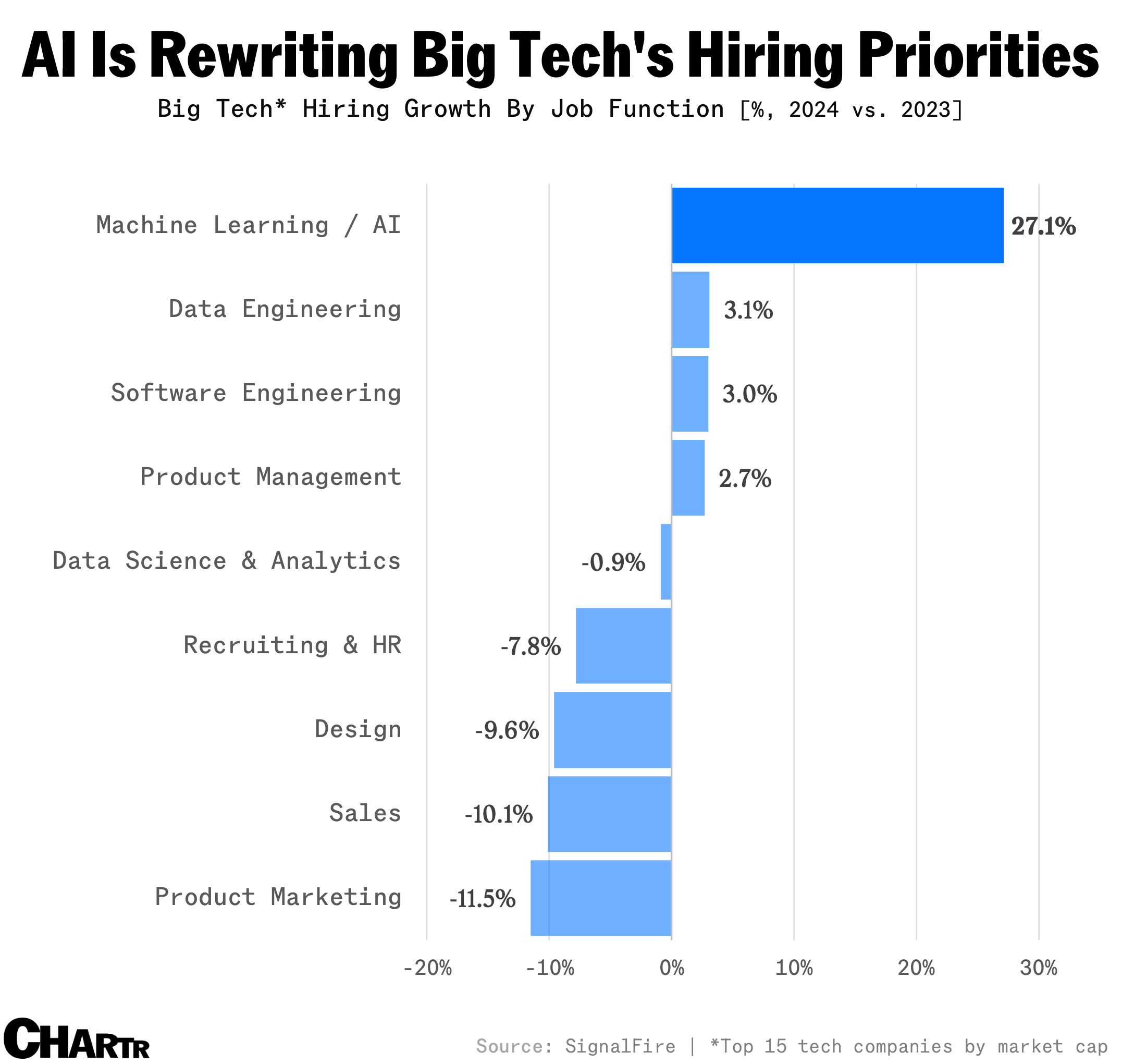
AI Jobs chart

According to a new report from venture capital firm SignalFire, Big Tech’s hiring for software engineering roles still grew about 3% year over year last year, while there was a 27% surge in AI hires, and less technical functions like marketing and sales fell by double digits.

And while tech hiring hasn’t collapsed across the board, early-career workers are taking the hardest hit — when the overall labor market is already freezing out job seekers fresh out of college. Per SignalFire, new-grad hiring at Big Tech fell 25% last year and is now more than 50% below prepandemic levels. Meanwhile, mid- and senior-level hiring is surging — up 27% year over year for those with two to five years of experience, and 34% for those with five to 10 years — as companies opt for seasoned engineers who can hit the ground running, rather than training juniors when AI can handle the basics.


More Tech

See all Tech
tech

Anthropic launches “Claude Design,” sending shares of Figma and Adobe down

Anthropic has been slowly and steadily gaining a leading share in the enterprise AI market by focusing on coding, spreadsheets, and other common productivity and workplace apps.

Now it’s going after design apps.

Today Anthropic launched Claude Design, a dedicated app powered by its latest model, Claude Opus 4.7, that lets users use text prompts to build website designs, user interface prototypes, presentations, and marketing materials.

Shares of Figma and Adobe sank on the news.

While Claude has previously had the ability to create designs and user interfaces, breaking it out into a dedicated app signals a major new piece of its enterprise strategy alongside its popular Claude Code product.

Today Anthropic launched Claude Design, a dedicated app powered by its latest model, Claude Opus 4.7, that lets users use text prompts to build website designs, user interface prototypes, presentations, and marketing materials.

Shares of Figma and Adobe sank on the news.

While Claude has previously had the ability to create designs and user interfaces, breaking it out into a dedicated app signals a major new piece of its enterprise strategy alongside its popular Claude Code product.

tech

Apple’s China iPhone shipments surged 20% in Q1 even as overall smartphone shipments fell

Apple’s iPhone shipments in China jumped 20% last quarter, even as the country’s overall smartphone market fell 4%, according to new data from Counterpoint Research. Rising memory costs have pushed prices higher across the industry, weighing on demand.

Apple appears poised to ride out the broader smartphone slump. Its strength at the less price-sensitive high end of the market and its unusual leverage over suppliers, which helps keep costs in check, give it an edge over rivals.

Greater China remains a critical region for Apple, making up about 18% of its total revenue in the fourth quarter. The company accounted for 19% of China’s smartphone market in the first quarter, up from 15% a year earlier, per Counterpoint.

tech
Rani Molla

Anthropic has surged past OpenAI in capturing business spending on generative-AI software

Last quarter, Anthropic attracted the lion’s share of trackable business spending on generative-AI software, according to new data from Ramp, a fintech company that provides corporate cards and expense management software for small firms and Fortune 500 companies alike.

The data showed that in the first quarter, Anthropic saw 37% of spending, its biggest share yet, versus 33% for OpenAI. Notably, the dataset doesn’t capture spending by Google or Microsoft.

OpenAI, which makes ChatGPT, still leads in overall adoption at 81% of AI buyers, but Anthropic is catching up, at nearly 63% in March. Overall, more than half of Ramp’s customers currently pay for AI, up from just 18% two years ago.

Anthropic’s enterprise tools, including Claude Code and Cowork, have been making waves among the business class, sending its revenue soaring.

Anthropic’s revenue share is even higher among companies spending on AI for the first time.

“Anthropic has definitely been on a tear,” Ara Kharazian, Ramp’s economist, told Sherwood News. “Its increase in adoption rates has been driven by its ability to sell to less technical users and smaller contracts than it typically has.”

It’s notable that midway through the first quarter, Anthropic had a falling-out with one of its biggest customers, the US government, which near the end of February decided to shun Anthropic’s products and lean into working with OpenAI.

tech
Jon Keegan

Report: Google ditches its objection to defense work, pitches Gemini to Pentagon

In 2018, Google employees protested against the company’s tech being used for the US military’s Project Maven — a drone targeting program — reminding the company of its “don’t be evil” motto.

After the controversy, the company declined to renew the contract with the Pentagon, drawing a bright line between Big Tech and the national security establishment.

What a difference a few years makes.

Google is now actively working to get its Gemini AI model to be used in classified national security settings, according to a new report from The Information. Seeking a similar deal to the one OpenAI hashed out with the Pentagon, Google reportedly wants a contract that allows use of Gemini in classified work, but with a prohibition on mass domestic surveillance and autonomous lethal weapons.

But Google is playing catch-up in a major way. Amazon and Microsoft both have been widely used for classified defense work, and contractors are already experienced in working with their cloud systems, while Google’s services have never been used in classified work.

What a difference a few years makes.

Google is now actively working to get its Gemini AI model to be used in classified national security settings, according to a new report from The Information. Seeking a similar deal to the one OpenAI hashed out with the Pentagon, Google reportedly wants a contract that allows use of Gemini in classified work, but with a prohibition on mass domestic surveillance and autonomous lethal weapons.

But Google is playing catch-up in a major way. Amazon and Microsoft both have been widely used for classified defense work, and contractors are already experienced in working with their cloud systems, while Google’s services have never been used in classified work.

Latest Stories

Sherwood Media, LLC produces fresh and unique perspectives on topical financial news and is a fully owned subsidiary of Robinhood Markets, Inc., and any views expressed here do not necessarily reflect the views of any other Robinhood affiliate, including Robinhood Markets, Inc., Robinhood Financial LLC, Robinhood Securities, LLC, Robinhood Crypto, LLC, Robinhood Derivatives, LLC, or Robinhood Money, LLC. Futures and event contracts are offered through Robinhood Derivatives, LLC.
