Tech
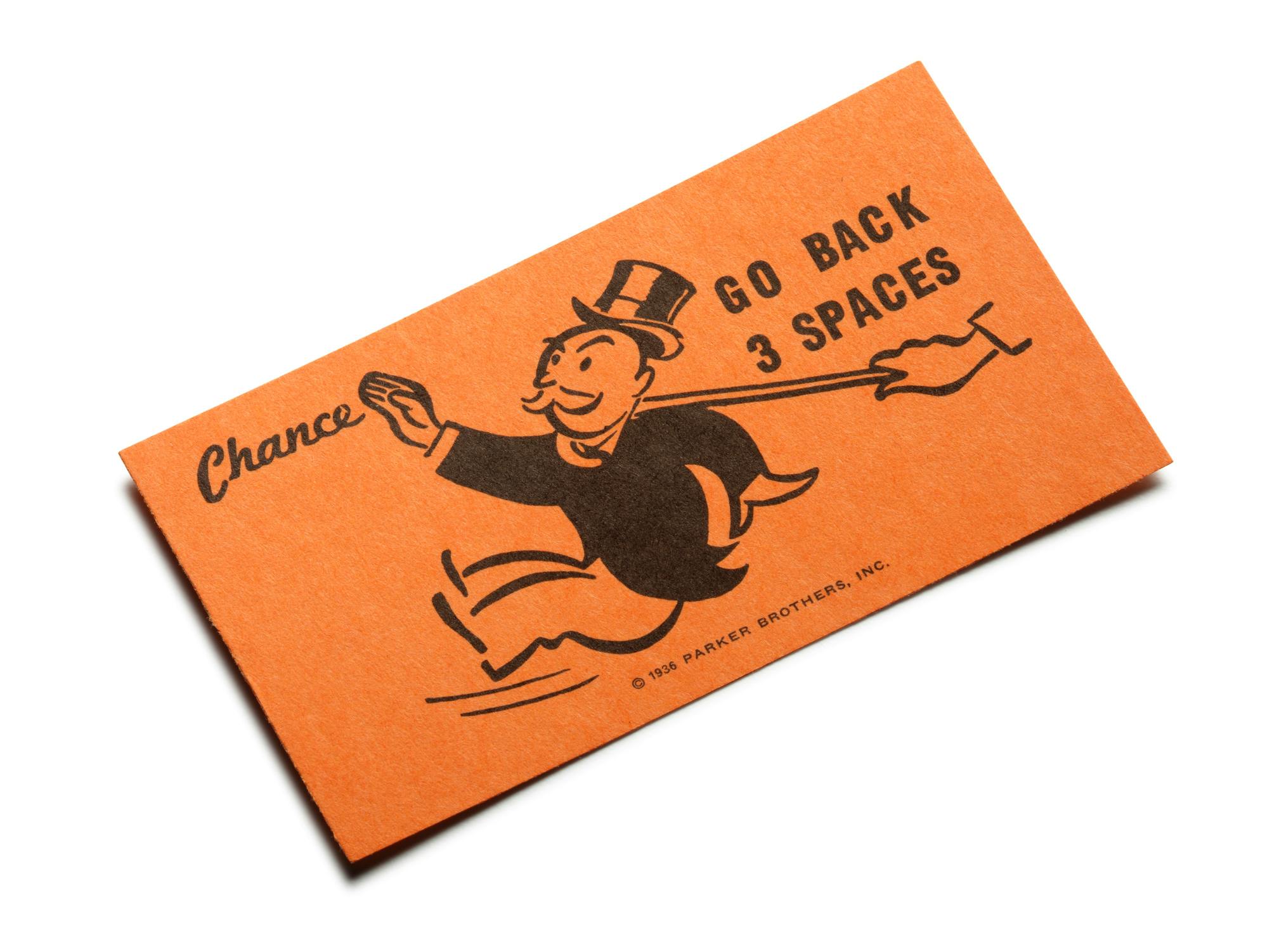
Go Back Three Spaces
Getty Images
MONOCHROME

Google may have to sell off Chrome — but who could buy it?

Forcing a sale of Google Chrome could weaken Google’s stranglehold on search.

Tom Jones

“Which lawyers did Microsoft use for its antitrust case in 2000” — Google execs this morning, probably.

Done searching

According to a report from Bloomberg yesterday, Department of Justice officials are planning to recommend that Amit Mehta — the US District Judge who ruled in August that Alphabet’s search giant holds an illegal monopoly over the market — force the company to sell off its Google Chrome browser, impose data-licensing requirements, and implement measures around the company’s Android operating system and burgeoning AI efforts.

Those recommendations show just how serious America’s antitrust authorities are about cracking down on Google’s dominance in the world of looking stuff up online. It’s the biggest antitrust action against Big Tech in the US since the United States vs. Microsoft Corp. case more than two decades ago (spoiler: Microsoft wasn’t broken up).

According to Statcounter, Google Chrome has a 67% share of the global web-browser market — way ahead of the next biggest competitor, Apple’s Safari, the default browser on every iPad and iPhone (unless users switch their settings). Though Chrome isn’t a huge money spinner in a direct sense, being free to download and use, it’s a phenomenal source of traffic for the search engine itself, which makes plenty of money (some $49 billion last quarter). On Chrome, users are sent straight to google.com by default when they search, and Google gets data on what logged-in users are doing, helping its targeted-advertising efforts.
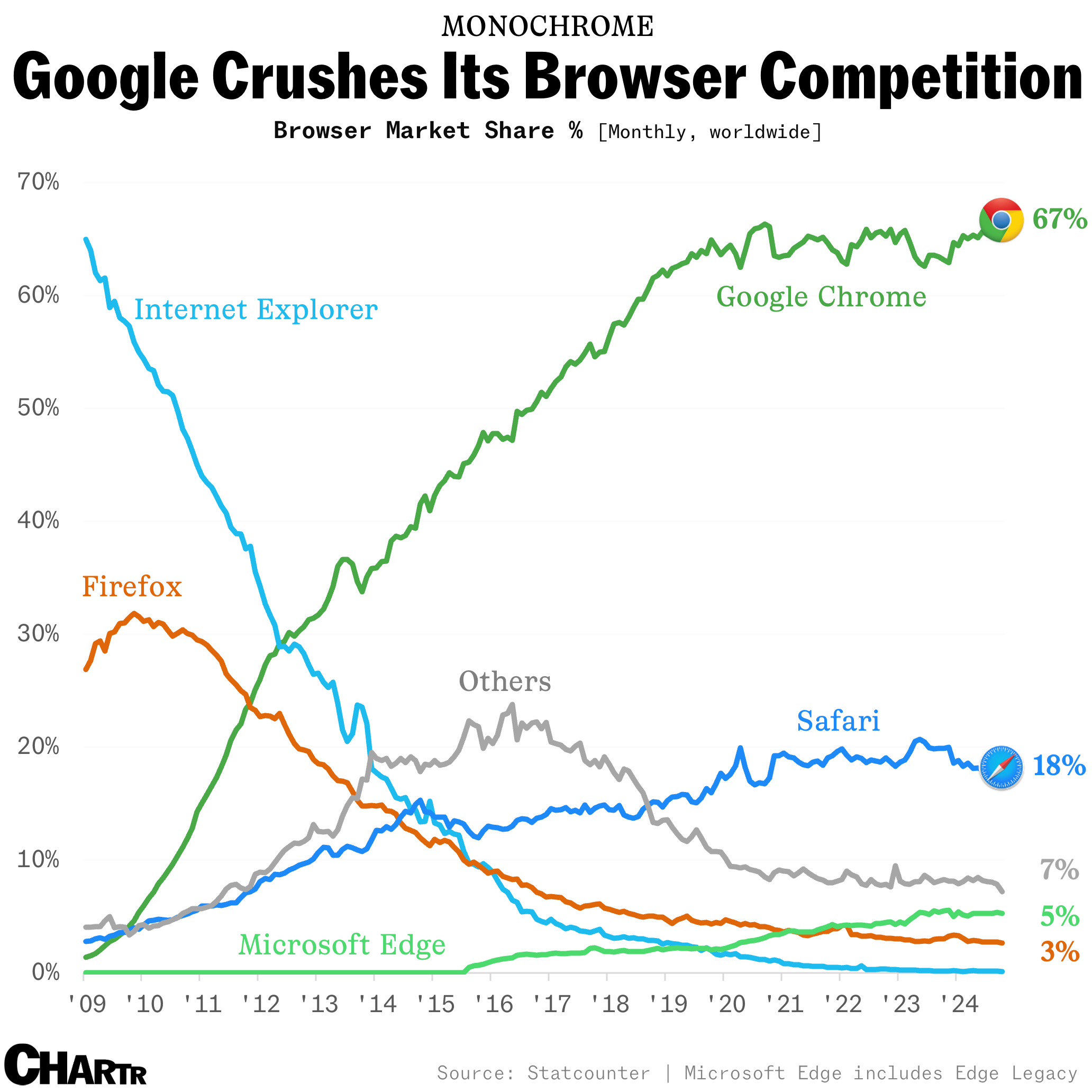
Google Chrome market share
Sherwood News

Gatekeeping gateway

While Chrome was never really the product at the heart of the DOJ’s lawsuit, which was first launched under the Trump administration in 2020, the browser plays a massive part in the crux of the case — Google’s total domination of search. According to website-intelligence platform Similarweb, google.com has a staggering 93% share of American web searches.
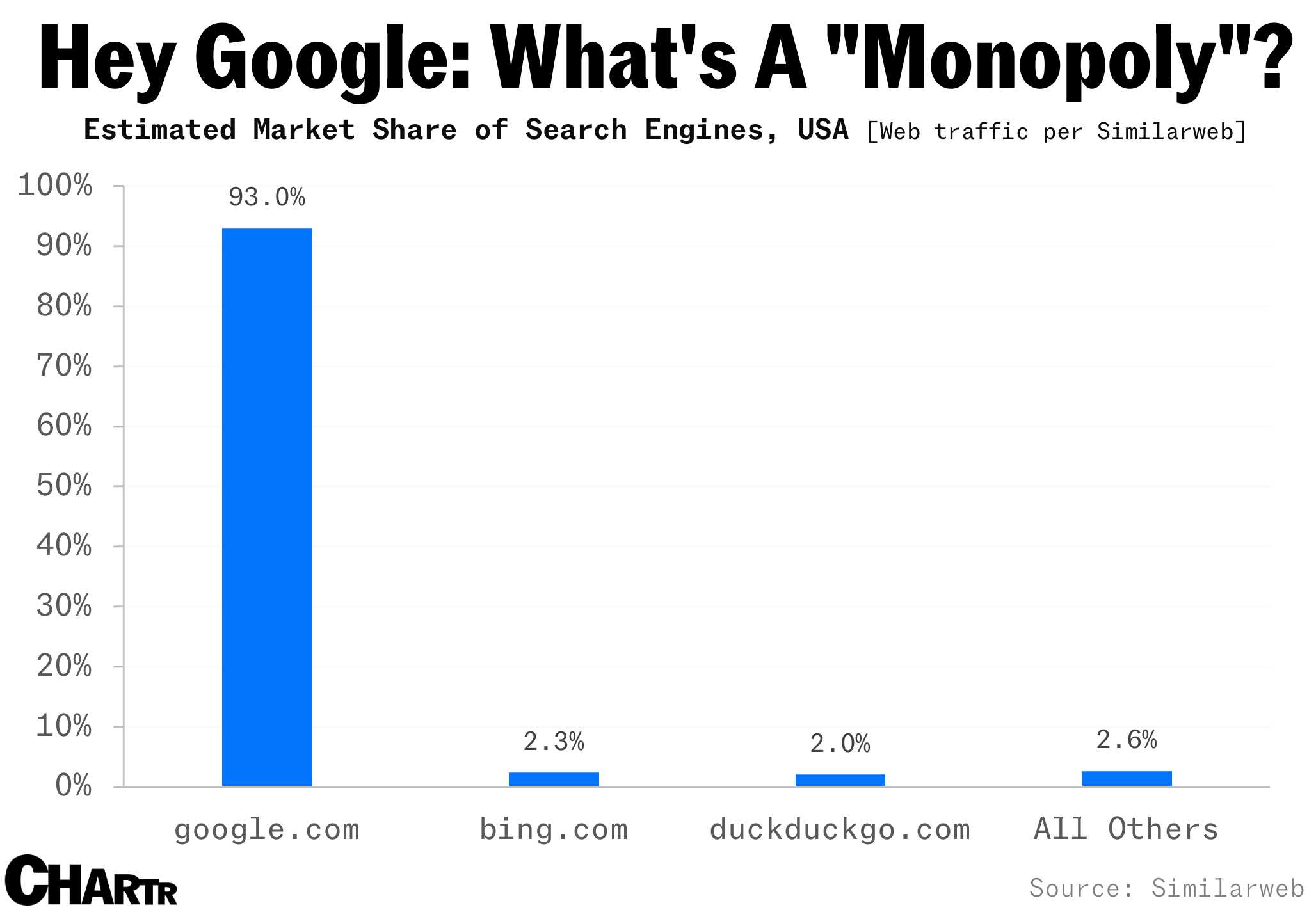
Google market share searches (Similarweb)
Sherwood News

That level of domination, as antitrust expert George Hay simplified for Sherwood News in the wake of the August ruling, amounts to a monopoly which Google monetizes with advertising and cements via exclusive deals with the makers of Apple and Android devices. Thanks to unsealed court documents, we know that Google paid Apple an eye-watering $20 billion in 2022 alone to be the default search engine in Apple’s Safari browser. If Chrome was owned by someone else, Google would presumably have to pay to be the default search engine in a similar fashion.

The obvious complication with forcing Alphabet to sell Google Chrome is that it’s really big. There’s not that many companies that could afford and make use of an internet browser that has hundreds of millions of users and, from the small pool of competitors that could (e.g. Amazon, Microsoft, Apple), which of them would be impervious to the same monopoly charges further down the line? While such recommendations might work in theory, breaking up Google in practice, as Rani Molla observed in August, will prove hard to do.

More Tech

See all Tech
tech

AI leaderboard maker LMArena hits $1.7 billion valuation

If you want to know who’s up and who’s down in the AI model world, look no further than LMArena’s leaderboard. The startup has just raised a $150 million series A fundraising round, with a valuation of $1.7 billion.

In seven months, LMArena has raised $250 million, according to TechCrunch.

The leaderboard started as a research project by cofounders Anastasios Angelopoulos and Wei-Lin Chiang when they were graduate students at UC Berkeley.

The public leaderboard — formerly known as “Chatbot Arena” — shows the results of human evaluations of AI models for various tasks. Users can rate which model did a better job on one task in a sort of blind taste test.

The leaderboard is a hotly contested proving grounds for new models, and the company occupies a powerful position in an industry that lacks independent, industry-standard evaluations.

The leaderboard started as a research project by cofounders Anastasios Angelopoulos and Wei-Lin Chiang when they were graduate students at UC Berkeley.

The public leaderboard — formerly known as “Chatbot Arena” — shows the results of human evaluations of AI models for various tasks. Users can rate which model did a better job on one task in a sort of blind taste test.

The leaderboard is a hotly contested proving grounds for new models, and the company occupies a powerful position in an industry that lacks independent, industry-standard evaluations.

tech

Uber jumps after unveiling Lucid robotaxi at CES

Uber shares jumped more than 5% after the company unveiled a production-intent robotaxi developed in partnership with Lucid and Nuro at the Consumer Electronics Show on Monday. The autonomous vehicle runs on Nvidia’s Drive AGX Thor computer. Nvidia itself announced a slate of autonomous hardware and software announcements at CES.

The companies said this fall that the San Francisco Bay Area will be the first market for the joint effort. The robotaxi is already being tested on public roads, with a commercial launch planned for later this year.

Uber + Lucid + Nvidia is just another example of the tangled web of partnerships in the autonomous driving space, where Nvidia is now becoming more and more prominent.

The companies said this fall that the San Francisco Bay Area will be the first market for the joint effort. The robotaxi is already being tested on public roads, with a commercial launch planned for later this year.

Uber + Lucid + Nvidia is just another example of the tangled web of partnerships in the autonomous driving space, where Nvidia is now becoming more and more prominent.

tech

Meta delays international Ray-Ban Display expansion thanks to “unprecedented demand” and “extremely limited inventory”

Meta said today that it’s delaying the early 2026 international expansion of its Ray-Ban Display glasses because of “extremely limited inventory” and “unprecedented demand.” The company didn’t specify whether the issue was more supply or demand, but has previously insisted its smart glasses are a hit.

Waitlists for the smart glasses, which are controlled with a band you wear on your wrist, extend “well into 2026.”

“We’ll continue to focus on fulfilling orders in the US while we re-evaluate our approach to international availability,” the company wrote. Expansion had been planned for the UK, France, Italy, and Canada.

In order to buy the smart glasses, consumers must do an in-person product demo to ensure the tech is “properly fitted to you,” according to Meta. Demos in New York City are unavailable for the next few weeks, the company’s scheduling website shows. It also notes that “that due to high demand, the product may be sold out and unavailable for purchase after your demo.”

US-AI-TECH-COMPUTERS-TELECOM

Nvidia’s autonomous tech gives other automakers a chance to take on Tesla

Nvidia made a number of autonomous vehicle announcements at CES yesterday that should have Tesla worried.

Latest Stories

Sherwood Media, LLC produces fresh and unique perspectives on topical financial news and is a fully owned subsidiary of Robinhood Markets, Inc., and any views expressed here do not necessarily reflect the views of any other Robinhood affiliate, including Robinhood Markets, Inc., Robinhood Financial LLC, Robinhood Securities, LLC, Robinhood Crypto, LLC, or Robinhood Money, LLC.