


Inside Oklo’s audacious plan to turn leftover weapons-grade plutonium into a nuclear bridge fuel
“There’s enough energy in nuclear waste to power the country for 150 years, and every year we produce enough for another four years,” the CEO of Oklo told Sherwood News.
Jake DeWitte’s big dream was going small. Since the first American nuclear power plant came online at the end of 1957, reactors had been built as bespoke, billion-dollar behemoths, designed to pump out hundreds of megawatts of electricity to offset the high up-front construction costs with greater economies of scale. By the time DeWitte and his wife, Caroline, founded their nuclear startup, Oklo, in 2013, the United States was struggling to build any new reactors.
If the process of constructing reactors could become more like manufacturing an airplane than building an entire airport, so went industry thinking, the cost of new atomic power stations would come down dramatically. Rather than an enormous jetliner, like some of the developers racing to build the nation’s first small modular reactor seemed to have in mind, DeWitte proposed something closer to a Cessna, with so-called “microreactors” that produced as little as 15 megawatts of power.
But it was really something more like a supersonic Cessna. What really made Oklo stand apart was the design of the reactor. Rather than use water as a coolant like all of the 94 commercial reactors in operation in the US, Oklo wanted to use liquid sodium metal. With a coolant that could reach much higher temperatures, Oklo could burn through more of the toxic material that makes the half-life of nuclear waste take centuries to decay, and get hot enough to supplant fossil fuels in some industrial applications.
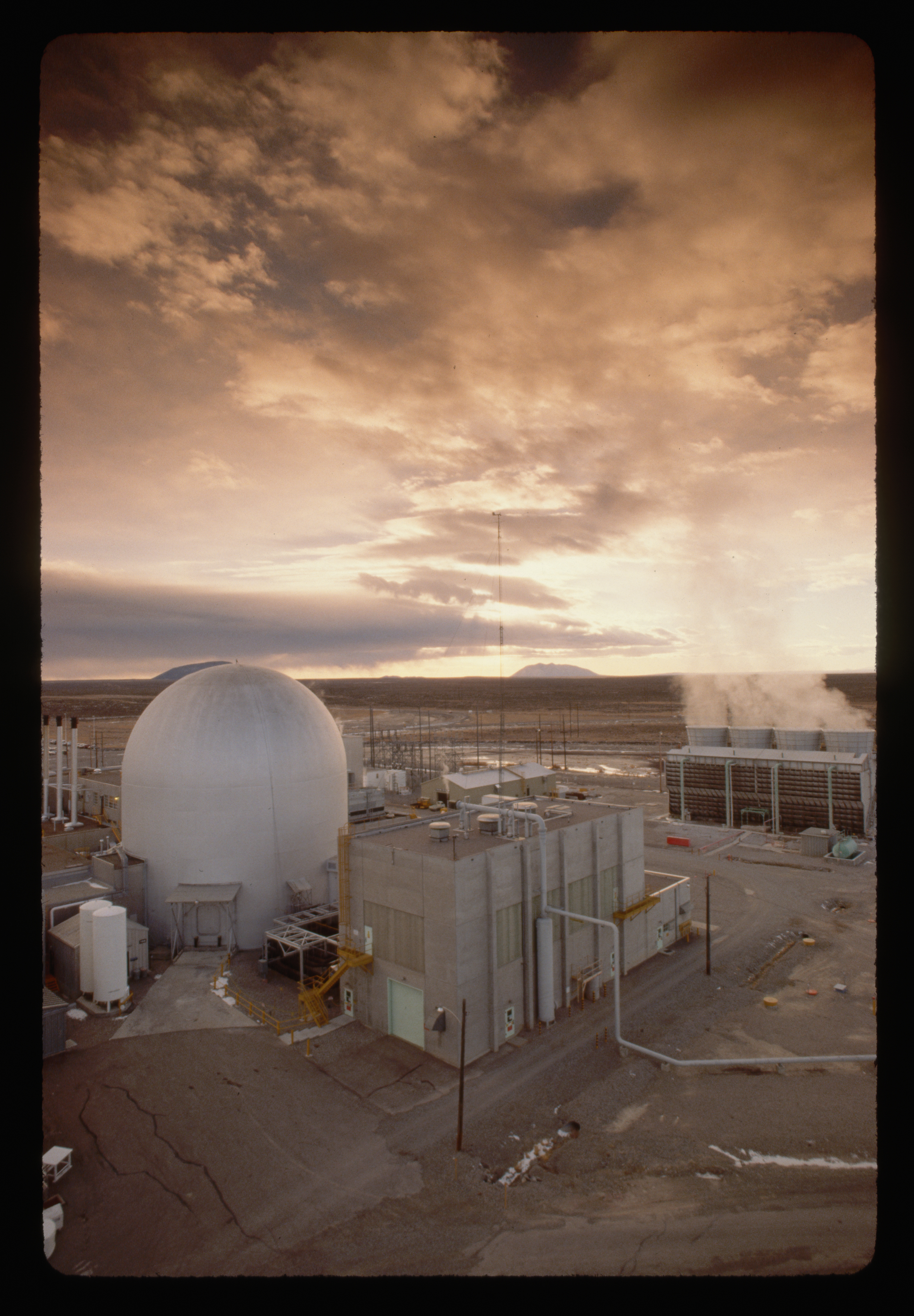
It wasn’t a novel idea. So-called fast reactors had been used in experiments across the world since the dawn of the nuclear age. In fact, Oklo even got a leg up in its efforts to commercialize its technology by obtaining fuel from the leading US experiment, the EBR-II test reactor at the Argonne National Laboratory north of Chicago that shut down in 1994. But the problem for Oklo — and for other nuclear startups using liquid-metal coolants, such as Bill Gates’ TerraPower — is that the fuel needed for fast reactors was hard to come by. And the only real commercial vendors were the Russian and Chinese governments. The low-enriched uranium that powers traditional light water reactors transforms only about 5% of its material to the fissionable isotopes that spark a nuclear reaction. High-assay, low-enriched uranium (HALEU), the fuel of choice for these next-generation reactor startups, sees its material transformed through enrichment by as much as 20%.
But as American enrichment companies and the US government scramble to build a domestic supply chain for making HALEU (pronounced HAY-loo), Oklo thinks it has come up with another option.
On Wednesday, the Santa Clara, California-based company announced a major milestone. This week, Oklo split its first atoms at the nuclear test site Los Alamos National Laboratory, which operates in the Nevada desert. What made that achievement a turning point, however, is the fuel Oklo used to go critical: plutonium.
The human-made isotope, created as a byproduct of a fission reaction using uranium, has long held a fearsome place in the American imagination. Throughout the 20th century, the US government stockpiled plutonium for use in atomic weapons. Its long-lived radioactive waste makes plutonium particularly toxic. The US still has tons of the stuff lying around from Cold War-era bomb-making. And conveniently, it’s basically the perfect fuel for a fast reactor.
“One of the biggest constraints and bottlenecks to deploying new nuclear at scale is fuel availability. That’s solvable, but it’s not going to be solved very quickly,” DeWitte told Sherwood News last week ahead of the announcement. “We have a pretty cool opportunity as a country to solve that.”
The plan? Turn extra plutonium that the US government is paying to keep in storage into a “bridge fuel” that can power new reactors until HALEU producers can increase the domestic supply in the 2030s.
Until recently, the US Department of Energy had planned to take as much as 20 metric tons of plutonium, mix it with sand and kitty litter, and bury the material in the desert in New Mexico. But, in May, President Donald Trump signed an executive order directing the agency to halt its disposal process. In August, the Energy Department announced a program to make the material, much of it harvested from dismantled warheads, available for reactor companies. The agency is expected to unveil the recipients of that plutonium in the coming weeks.

Oklo is in the running to get some. Depending on how much the company can secure, DeWitte said it could produce enough fuel to generate 2.5 gigawatts of electricity, equal to the power demands of nearly 2.5 million American households. That, in turn, would help companies like Oklo prop up the supply for HALEU.
“If this bridges the first 1 to 2 gigawatts of new, advanced nuclear-generating capacity and the vast majority of the first nuclear is fueled by this,” DeWitte said, “it’s going to kickstart our ability to go to enrichers and give much stronger offtake agreements to help spin them up much faster.”
When fast reactors were first under development in the 20th century, the plan was to eventually power them with plutonium. The EBR-II test reactor, for example, was transitioning to running on plutonium. So-called fast “breeder” reactors — the machine’s initials stood for “experimental breeder reactor” — took on that name because the operations were supposed to produce more plutonium than was needed to sustain the reaction, giving the reactors the dual purpose of generating power and churning out material for bombs. While Russia last year started decommissioning a reactor specifically designed to produce plutonium for weapons, Moscow’s state-owned nuclear company recently transitioned one of its fast reactors to run on plutonium-based fuel.
“I’m a fast reactor guy at heart, and plutonium is the name of the game,” said Nick Touran, a nuclear engineer who spent 15 years working at TerraPower and runs the consultancy What Is Nuclear.
“Plutonium still gets an ‘ew’ reaction out of the public. You say plutonium, and they say, ‘Oh, that’s scary.’ It still has a negative connotation,” he added. “But it’s undeniably a better reactor fuel. You get more neutrons out when you split a plutonium atom.”
Still, he said calling plutonium “a bridge fuel to HALEU is inherently misleading.”
“If anything HALEU should be a bridge fuel to plutonium,” Touran said, noting that HALEU is rare because it’s expensive to produce. “There’s no future with lots of HALEU.”
That’s not how the US government sees things. Congress earmarked $500 million for HALEU production in former President Biden’s landmark spending law, the Inflation Reduction Act. The Trump administration has continued distributing tens of millions of dollars for infrastructure to produce and deliver HALEU, and providing some of the government’s existing inventory to private reactor companies, including TerraPower and Oklo.
Oklo also wants to be part of the production side. Along with the startup’s reactor business, the company is working to commercialize technology to recycle nuclear waste, another potential source of HALEU. The work Oklo has done with national labs to test out the potential for different recycling technologies could make taking on plutonium easier. While the strict regulation of plutonium makes it difficult to ship the material around, Oklo could partner with Los Alamos or another lab to work on its fuel assemblies if the Energy Department grants some of the 20 metric tons to the company. That would keep the material within the ecosystem of the Energy Department, and allow Oklo to avoid the kind of oversight that traditional utilities would face from the Nuclear Regulatory Commission.
To get NRC approval, companies would need to present data on the safety of using plutonium as fuel. That’s partly what Oko is aiming to do.
“Has this been done before? Totally,” DeWitte said, referring to reactors going critical with plutonium fuel in the US. “Has it been done before to collect and expand a data set? No, that’s why we’re doing it.”
Even if Oklo received the full 20 metric tons of plutonium, “that’s not much,” said Koroush Shirvan, a researcher in advanced nuclear technologies at the Massachusetts Institute of Technology.
“If we’re talking about decarbonization, this isn’t significant,” he said. “To generate more, we need to reprocess. That requires a reprocessing plant, which is something Oklo has talked about.”
While Russia, France, and Japan all reprocess and recycle nuclear waste, the US killed its initial attempt to build a plant in the 1970s, and no private company has seriously tried again since. Oklo has competition to build the country’s first recycling facility. But the bigger hurdle, Shirvan said, is the fact that producing nuclear fuel from scratch is still generally cheaper.
“We know the costs. I really don’t understand the economic case,” he said. “But is it a morally right thing to do? Yes. Recycling, whether it’s nuclear fuel or plastic bottles, is the morally right thing to do.”
In the meantime, DeWitte said, there are other potential sources of plutonium. The United Kingdom is planning to dilute and bury its stockpile. Japan, meanwhile, has its own inventory in storage. Between the two countries is as much as 150 tons of material, DeWitte said.
“That’s another 10 to 16 gigawatts,” he said.
Demonstrating that the things people fear most about nuclear power, such as spent fuel waste and weapons-grade material, could be transformed into clean energy could upend the debate over atomic energy, DeWitte said.
“There’s enough energy in nuclear waste to power the country for 150 years, and every year we produce enough for another four years,” DeWitte said. “With recycling, we could power the country for another 1,000 years. If you want a silver bullet, that’s your silver bullet. We know it works. It’s achievable.”
But someone needs to go first. And with a stock valued at over $12 billion without any real revenue yet, Oklo wants to be the one to try.
Alexander C. Kaufman is an award-winning journalist whose work has appeared in The Atlantic, Heatmap, Canary Media, and HuffPost, and who writes the Field Notes newsletter.




