

Tech
Hand Pressing Buttons (CSA Images/Getty Images)

Threads’ chaotic “For You” feed quantified

How old are the posts Threads are recommending to its users?

Since Twitter's rapid unscheduled disassembly following Elon Musk's purchase of the platform, hundreds of millions of users have turned to Meta’s Threads as a potential replacement for the newsy town square experience, minus the hate speech and crypto scams.

The year-old platform now has over 200 million users and has been rapidly adding features to achieve golden age Twitter product parity. While users have been praising the improved quality of discourse, and a seemingly functional content moderation team, one the most frequent complaints has been how bad the default “For You” feed view is for following breaking news, something that Twitter (in the pre-Musk days) excelled at. 

Threads users routinely mock what seems like a pretty consistent 48 hour delay for event-specific posts, which is especially frustrating as we live through one the most chaotic election years in recent memory. 

Post from @miasato.2
(Threads post from @miasato.2)

To try and better understand how much the algorithmic “For You” feed varies from the more straightforward, reverse-chronological “Following” feed, I analyzed 300 posts from both feeds from my Threads account.

No recent posts For You 

When I plotted out the age of each post from my “For You” 300 post sample, indeed it does show a chaotic scramble. 

If there was an earthquake in your area, and you jumped onto Threads on your phone, the default view you see is “For You,” which includes accounts you don’t follow. Based on my sample, it’s very unlikely any urgent posts on breaking news would show up until hours later. 

Over one-third of the posts in my “For You” feed were between six and twelve hours old. Only 12% of the posts happened within an hour of seeing them in my feed. If you really want to follow what the chatter is surrounding a breaking news event, you should be looking at your “Following” feed. Of course, that relies on you having a well-curated list of people who follow and share news.

When I plotted the posts from my “Following” feed, which includes posts from the 954 accounts that I follow, you can see a very different pattern. A clear line of posts going up and to the right, indicating a reverse-chronological series of posts getting older as I scrolled down my feed. 38% of the posts in this feed were posted within an hour, and the vast majority were less than six hours old. Much more useful for breaking news. 

Stubborn default settings

Users have been clamoring for a way to control what their default feed view is, but Meta loves the algorithmic feed, so in order to swap views, you need to know where to find the controls for this, which isn't exactly obvious. On mobile, you have to reveal the hidden controls by tapping the Threads logo. It's a bit easier on the web, where you just click on the drop down menu at the top of the feed. On the web, you can also just bookmark https://www.threads.net/following to get straight to the most recent stuff.  

Another thing that makes the stubborn initial “For You” feed problematic, is that by default, Threads limits recommending any “political content” from users that you aren't following. You have to dig into your settings to opt-in to see recommended political posts from accounts you don't follow. This decision has been criticized by political observers and creators, especially during this intense election year. The company does not limit political posts in your “Following” feed.

This dataset is admittedly a small sample, of just one account at one moment in time, so your mileage may vary. Meta says that Threads' AI system “blends” content from recommended posts and accounts you follow, and considers your inferred interests and your behavior on the platform to decide what to show you. 
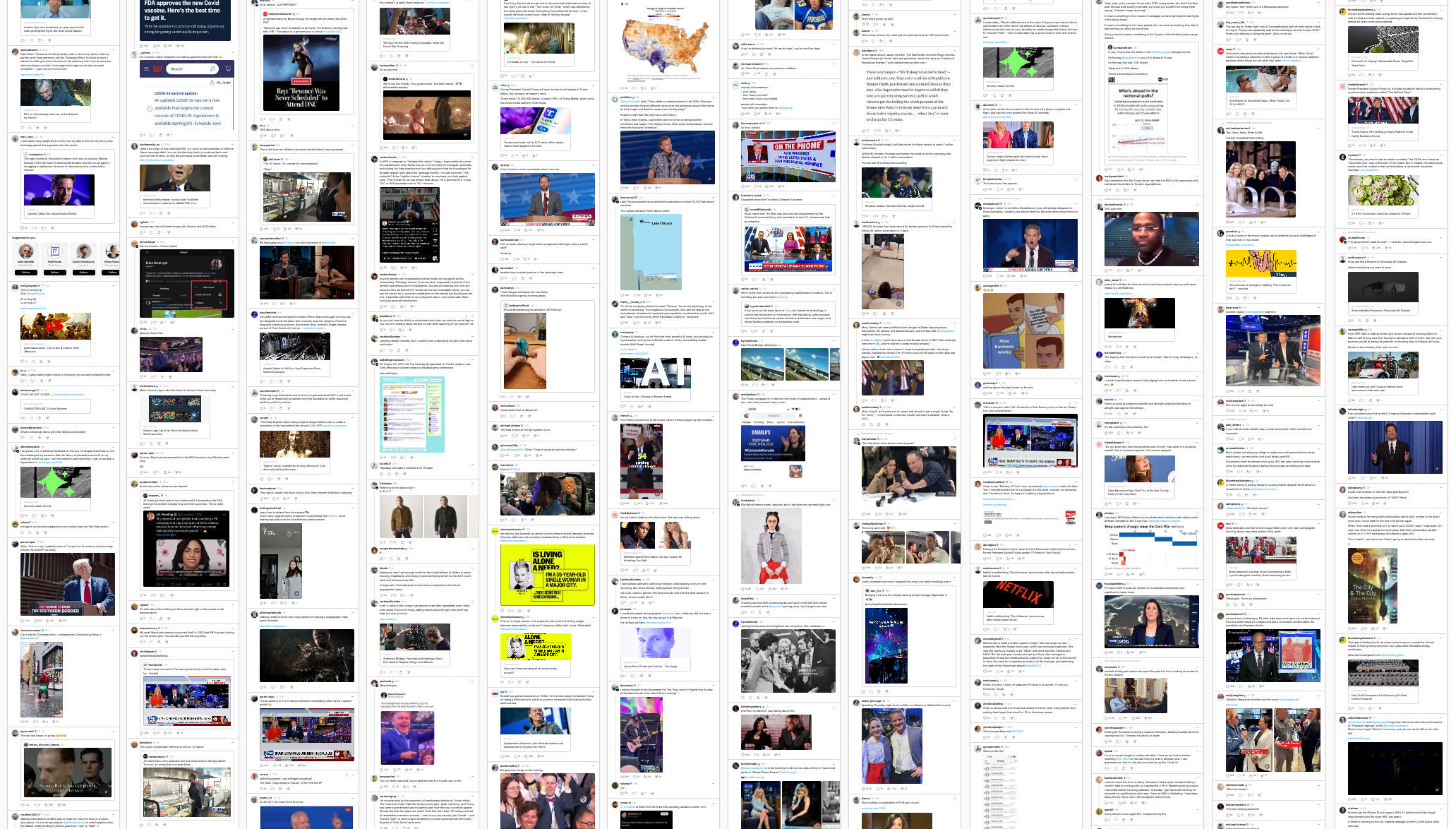
A quilt of Threads posts.
Some of the 300 Threads posts in this analysis. (Image: Jon Keegan)

But you will have to take Meta's word on it. Earlier this month Meta shuttered its CrowdTangle tool, which provided researchers with a crucial view into what content is shared on Facebook and Instagram. Meta recently released a Threads application programming interface, but right now it mainly enables automated posting and a platform-wide analysis isn't yet possible.  

Like the rest of Meta's algorithmic systems, it continues to be a black box.

Meta did not respond to a request for comment.

More Tech

See all Tech
tech

OpenAI’s models are officially coming to Amazon

Amazon is finally getting in on the hottest ticket in tech.

After Microsoft announced yesterday that it has agreed to give up its exclusive rights to sell OpenAI’s models, Amazon, as expected, will start offering them to customers — something Amazon Web Services CEO Matt Garman says users have been asking for “for a really long time.” Some models are available now in preview, and the most powerful GPT versions will show up “in the coming weeks.”

This is a big shift in the AI cloud wars. Microsoft’s early bet on OpenAI gave Azure an edge by locking up the most in-demand models. Now that exclusivity is gone, Amazon and other competitors can finally offer them too, closing a key gap and competing more directly for AI customers.

This is a big shift in the AI cloud wars. Microsoft’s early bet on OpenAI gave Azure an edge by locking up the most in-demand models. Now that exclusivity is gone, Amazon and other competitors can finally offer them too, closing a key gap and competing more directly for AI customers.

tech

Ship-tracking app surges as Iran war continues

As Middle East peace talks stretch on, with Tehran reportedly offering to reopen the Strait of Hormuz if the US lifts its blockade and the war ends, the owner of shipping intelligence platform MarineTraffic revealed that the app has gained millions of new users since the conflict began.

MarineTraffic’s user count jumped to 8.5 million this April, up from 3.5 million a year ago, the cofounder of its parent company, Kpler, said in an interview with the Financial Times. Paid subscribers, often workers within companies and governments looking for more data on supply chains and commodities trading, rose 11,000 in the same period.

Kpler, which also owns shipping intelligence platform FleetMon, draws its data from a range of sources, including the Automatic Identification System, satellites, and more than 500 people on-site, like port terminal operators.

Per Appfigures data, MarineTraffic is estimated to have raked in almost $1 million across March and April in app revenue (through April 27), more than double the ~$346,500 from the same months last year. Across the full year, Kpler expects to earn between $300 million and $400 million in annual recurring revenues.

tech

Google will supply AI models to Pentagon in classified deal, per The Information

Google has become the latest tech company to ink an agreement to supply the Department of Defense (War) with AI, having reportedly closed a classified deal that allows the Pentagon to use its AI for “any lawful government purpose,” according to The Information.

The Information initially reported talks between the Alphabet-owned company and the US government around two weeks ago, following the messy breakdown of the relationship between Anthropic and the Trump administration — and the rushed OpenAI deal that took its place.

The move has reportedly sparked opposition among Google employees, with The Washington Post reporting that over 600 workers signed a letter to CEO Sundar Pichai to ask him to bar the Defense Department from using the company’s AI models for any classified work.

The Information initially reported talks between the Alphabet-owned company and the US government around two weeks ago, following the messy breakdown of the relationship between Anthropic and the Trump administration — and the rushed OpenAI deal that took its place.

The move has reportedly sparked opposition among Google employees, with The Washington Post reporting that over 600 workers signed a letter to CEO Sundar Pichai to ask him to bar the Defense Department from using the company’s AI models for any classified work.

Latest Stories

Sherwood Media, LLC produces fresh and unique perspectives on topical financial news and is a fully owned subsidiary of Robinhood Markets, Inc., and any views expressed here do not necessarily reflect the views of any other Robinhood affiliate, including Robinhood Markets, Inc., Robinhood Financial LLC, Robinhood Securities, LLC, Robinhood Crypto, LLC, Robinhood Derivatives, LLC, or Robinhood Money, LLC. Futures and event contracts are offered through Robinhood Derivatives, LLC.

