Business
Democratic National Convention (DNC) 2024 - Day One
US Vice President Kamala Harris speaks during the 2024 Democratic National Convention in Chicago (Jacek Boczarski/Anadolu via Getty Images)
Election Coherence

Companies are talking about this election way more than they talked about 2016 or 2020

Politics is front-of-mind for the corporate leaders who say they’ll do well no matter who’s in the White House.

Rani Molla

The policies of the next president can always affect companies’ financial future, but this upcoming election seems to be more pressing than usual for leaders at S&P 500 companies.

The number of times “election” or “elections” were mentioned on Q2 earnings calls — measured from Jun 15-Aug 15 — this year was nearly double what it was during the last two presidential election years, according to data from FactSet.

Many of those companies this year cited energy and carbon emissions policies, which vary greatly between Kamala Harris and Donald Trump. A second Trump presidency would be more supportive of domestic oil drilling, at least rhetorically, while the price backdrop will play a bigger role in actual production. It would also include rolling back the Inflation Reduction Act, a policy Harris helped implement and incentivizes electric cars as well as green energy projects.

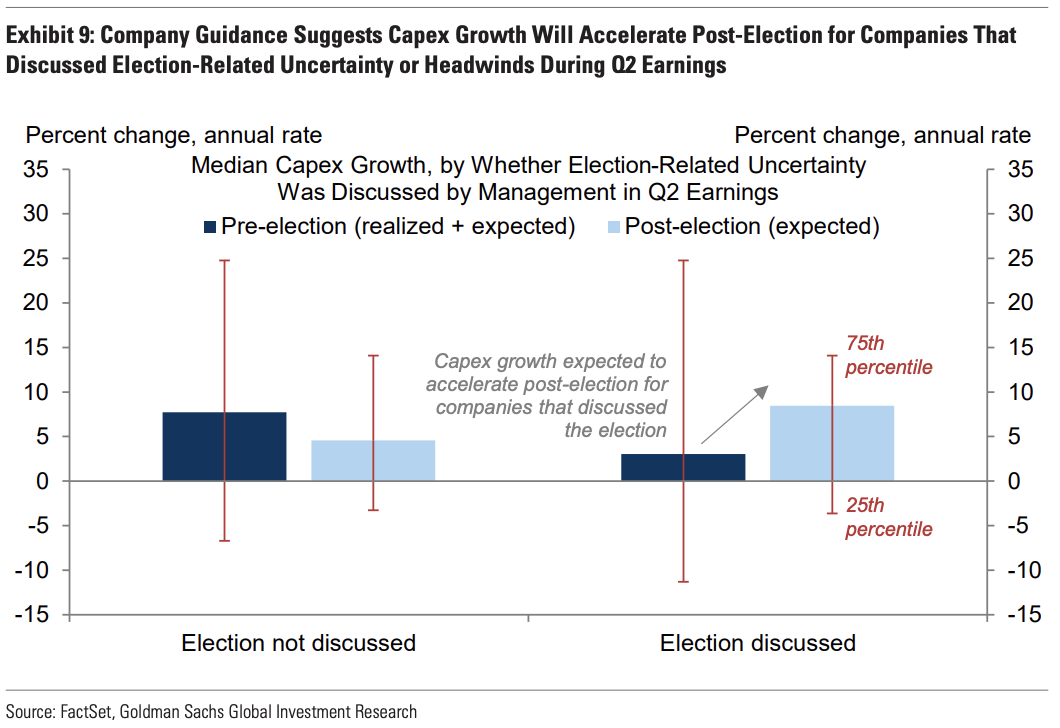
In fact, this uncertainty over the policy environment appears to be weighing on businesses’ investment spending.

“Some companies—mostly financials, government contractors, and those with exposure to the Inflation Reduction Act—noted this earnings season that either they or their customers are postponing some investment decisions until after the election,” writes Ronnie Walker, senior economist at Goldman Sachs, who flagged that capital expenditures have been lower among firms that have discussed the election. He expects that trend to reverse thereafter.
CapEx and election uncertainty
Goldman Sachs

Of course, many of those executives tried to make the case that they’re positioned to succeed, regardless of who wins.

“Ford has had a lot of history — a lot of experience and wisdom after 120 years of elections,” CEO James Farley told investors, saying that the car company wouldn’t alter its electric vehicle push over “short-term” compliance changes. “It is not a strategy where we handicap the presidential election for the next one and the next one and see what we can get away with the EPA. That is not how we run Ford.”

History suggests that collectively, they’re right. The stock market and earnings usually go up no matter who’s in the White House. But the very fact that companies are talking about this election so much this time around also suggests it might be a bigger deal than they’re letting on.

Updated with comments from Goldman Sachs analyst.

More Business

See all Business
business

Demis Hassabis, Google DeepMind’s CEO and founder, was also an early Anthropic investor

A chess prodigy and an actual a knight of the realm in the UK, it’s perhaps no surprise that Demis Hassabis has made some strategic moves about his exposure to AI upside. According to people familiar with the matter, the influential AI architect became an angel investor in Anthropic, currently behind many of the leading AI models, per Arena AI leaderboards.

The Nobel Prize winner’s position in the Claude creator was previously undisclosed and, per the Financial Times, highlights Hassabis’ “growing influence across the AI industry.”

Google, which bought DeepMind, the company that Hassabis cofounded and heads to this day, for a reported ~$400 million in 2014, is also a key Anthropic investor. The tech giant reportedly plans to invest up to $40 billion in the AI company as part of the mutually beneficial relationship the pair have forged, with reports that Anthropic has committed to spending $200 billion in the other direction on Google’s cloud services over the next five years.

Im playing all sides, so I always come out on top

In addition to his financial support for Anthropic, Hassabis has also invested in a range of AI startups launched by colleagues, such as Inflection AI, a company set up by DeepMind cofounder Mustafa Suleyman (who is now CEO of Microsoft AI), as well as efforts from other collaborators, like David Silver’s Ineffable Intelligence.

Hassabis also emerged as a recurring figure on the fringes of the recent Elon Musk v. Sam Altman trial, cropping up repeatedly in testimonies and court documents and appearing to live, as The Verge put it, “rent-free” in Musk’s head.

Founded in 2021, Anthropic has recently raised funding at a reported $900 billion valuation, sending it soaring ahead of competitor OpenAI.

The Nobel Prize winner’s position in the Claude creator was previously undisclosed and, per the Financial Times, highlights Hassabis’ “growing influence across the AI industry.”

Google, which bought DeepMind, the company that Hassabis cofounded and heads to this day, for a reported ~$400 million in 2014, is also a key Anthropic investor. The tech giant reportedly plans to invest up to $40 billion in the AI company as part of the mutually beneficial relationship the pair have forged, with reports that Anthropic has committed to spending $200 billion in the other direction on Google’s cloud services over the next five years.

Im playing all sides, so I always come out on top

In addition to his financial support for Anthropic, Hassabis has also invested in a range of AI startups launched by colleagues, such as Inflection AI, a company set up by DeepMind cofounder Mustafa Suleyman (who is now CEO of Microsoft AI), as well as efforts from other collaborators, like David Silver’s Ineffable Intelligence.

Hassabis also emerged as a recurring figure on the fringes of the recent Elon Musk v. Sam Altman trial, cropping up repeatedly in testimonies and court documents and appearing to live, as The Verge put it, “rent-free” in Musk’s head.

Founded in 2021, Anthropic has recently raised funding at a reported $900 billion valuation, sending it soaring ahead of competitor OpenAI.

business

Jury rules against Musk in lawsuit against OpenAI and Altman

Jurors in Tesla CEO Elon Musk’s lawsuit against Sam Altman, Greg Brockman, and OpenAI found the defendants not liable on all claims on Monday.

In a unanimous verdict reached after less than two hours of deliberation, the Oakland jury found that Musk had waited too long to bring his case forward, exceeding the statute of limitations.

Musk had alleged that OpenAI abandoned its founding mission as a nonprofit dedicated to developing AI for humanity and instead became a profit-driven company closely tied to Microsoft.

The verdict caps off a three-week blockbuster tech trial that could have seen Altman and Brockman removed from OpenAI leadership.

Musk had alleged that OpenAI abandoned its founding mission as a nonprofit dedicated to developing AI for humanity and instead became a profit-driven company closely tied to Microsoft.

The verdict caps off a three-week blockbuster tech trial that could have seen Altman and Brockman removed from OpenAI leadership.

Latest Stories

Sherwood Media, LLC and Chartr Limited produce fresh and unique perspectives on topical financial news and are fully owned subsidiaries of Robinhood Markets, Inc., and any views expressed here do not necessarily reflect the views of any other Robinhood affiliate, including Robinhood Markets, Inc., Robinhood Financial LLC, Robinhood Securities, LLC, Robinhood Crypto, LLC, Robinhood Money, LLC, Robinhood U.K. Ltd, Robinhood Derivatives, LLC, Robinhood Gold, LLC, Robinhood Asset Management, LLC, Robinhood Credit, Inc., Robinhood Ventures DE, LLC and, where applicable, its managed investment vehicles.