
Tech
Trollstigen, Norway, Sunset over the Trollstigen valley road
Getty Images
Going Elektrisk

Norway’s EV market keeps charging ahead

Norway’s stunning roads are increasingly quiet, as EVs dominate new car sales

Tom Jones

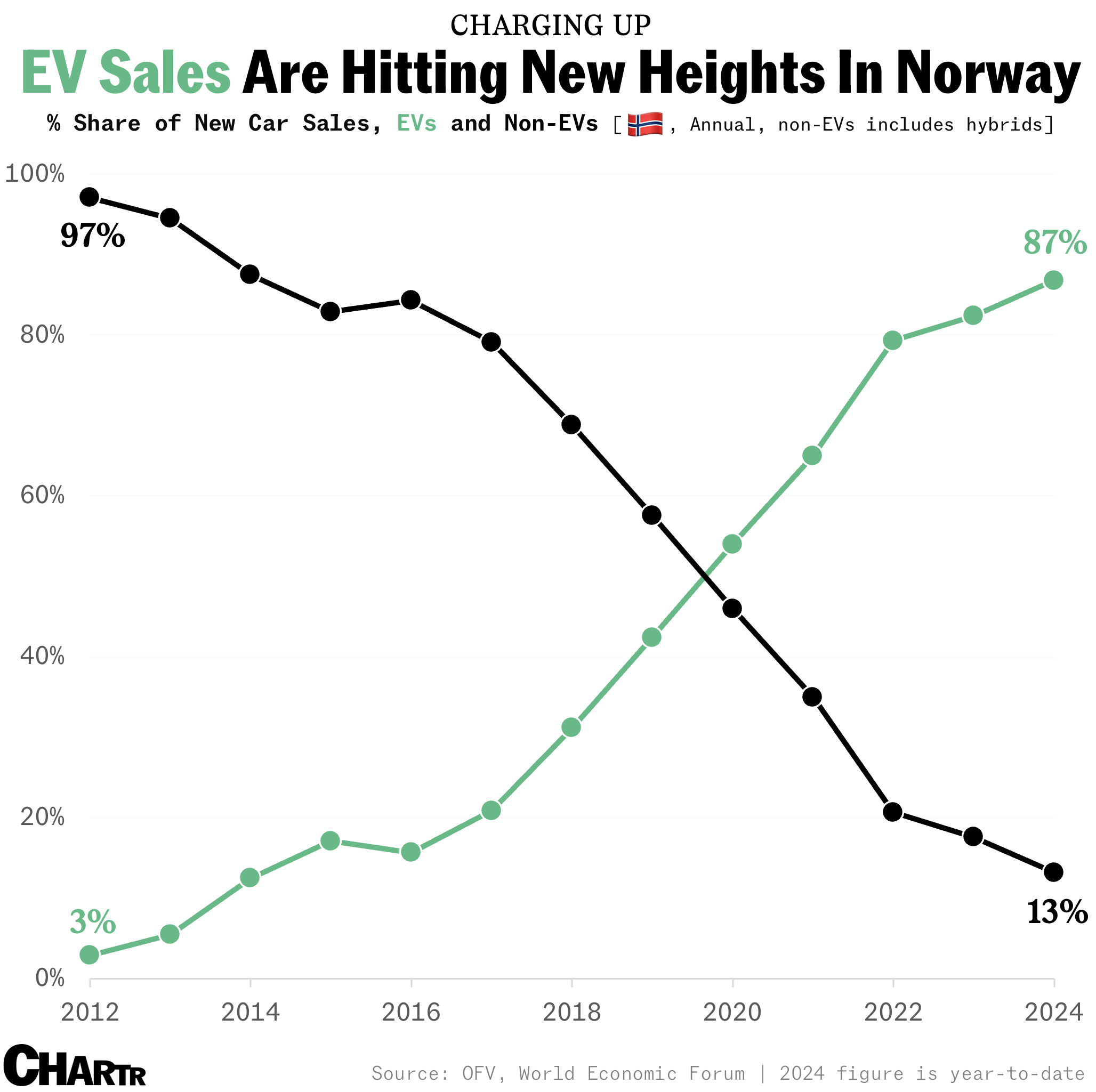
In August, electric vehicles accounted for a genuinely staggering 94.3% share of new car sales in Norway, as the nation’s road users continue to accelerate ahead of the rest of the world when it comes to EV adoption.

There were almost 10,500 electric vehicle sales in the Scandi nation last month, compared to just 634 non-EV sales (including petrol, diesel, and hybrid models), according to the OFV, Norway’s national Road Federation. While electric vehicles have made up the majority of new car sales each year since 2020, the 94% monthly figure marks a new high even by their standards, with the Norwegian government aiming to reach a point in 2025 when every new car sold is electric or hydrogen.
Norway EVs
Sherwood News

Gas out

The adoption has been a long time in the making — since the 1990s, successive governments have introduced a range of policy measures and incentives to get Norwegian nationals onboard with the EV surge. For example, Norway’s electric vehicle drivers have benefitted from perks like free parking, various tax exemptions, cheaper toll fees, the use of bus lanes, and much more besides over the years. It helps that the country is one of the wealthiest on Earth, in part — somewhat ironically — thanks to its huge oil reserves, which have given it a gargantuan wealth fund.

While many of the benefits have been gradually repealed as adoption increased more recently, the figures suggest that Norway could be well on the way to reaching 100% zero-emission vehicle sales by next year, a full decade ahead of the EU goal.

More Tech

See all Tech
tech

Tesla released estimates for Q1 deliveries and they’re lower than analysts expected

Ahead of first quarter earnings next month, Tesla released its own company-compiled Wall Street consensus for deliveries: 365,645 vehicles. While that’s lower than the 382,000 FactSet consensus estimate, it represents a nearly 9% jump from Q1 2025, when Tesla sold 336,681 vehicles.

Tesla started releasing its own consensus estimates to the public — not just institutional investors — for the first time in Q4 2025. The move was seen as a way to temper investor expectations as other estimates were too high. Last quarter, Tesla’s compilation was closer to actual numbers, which fell 16% year over year.

The market-implied odds from event contracts suggest 64% of traders believe Tesla’s Q1 deliveries will be more than 350,000, 44% think it will be higher than 360,000, and just 21% have it at higher than 370,000.

(Event contracts are offered through Robinhood Derivatives, LLC — probabilities referenced or sourced from KalshiEx LLC or ForecastEx LLC.)

ARC-AGI-3

The toughest AI benchmark just got a whole lot tougher

ARC-AGI-3 is the latest version of a clever benchmark that challenges AI models to solve mini video games with no written instructions.

tech

The US leads the world in robotaxi deployments

Every day it seems another robotaxi launches somewhere in the world. But most of them are in the US.

Of the 171 active robotaxi deployments globally, 69 — or 40% — are in the US, according to a new report from the Bank of America Institute. China, the next largest market, accounts for 24% of deployments.

Most of those deployments are still in testing or early commercial stages. Only 10 US cities currently have fully commercial robotaxi operations, defined as services that operate on public roads, carry paying passengers, run fully driverless without a safety driver, and function all day in any weather.

For now, that effectively refers to Alphabet’s Waymo, which operates commercially in Atlanta, Austin, Dallas, Houston, Los Angeles, Miami, Orlando, Phoenix, San Antonio, and the San Francisco Bay Area. That definition excludes competitors like Tesla, whose Robotaxi service uses safety monitors, and Amazon’s Zoox, which has yet to charge customers for rides.

tech

Sen. Sanders and Rep. Ocasio-Cortez introduce data center moratorium bill

Tapping into the growing public pushback surrounding the data center construction boom, Sen. Bernie Sanders, I-Vt., and Rep. Alexandria Ocasio-Cortez, D-NY, have announced The AI Data Center Moratorium Act of 2026. The bill calls for a halt to new data center construction until federal legislation regulating AI is enacted.

Lawmakers in at least 11 states have proposed pauses on data center construction, according to the National Conference of State Legislatures.

In addition to halting new data center construction, the bill also calls for banning the export of advanced AI chips to countries that lack regulations that protect against harms from AI.

In a press release, Ocasio-Cortez said:

“Congress has a moral obligation to stand with the American people and stop the expansion of these data centers until we have a framework to adequately address the existential harm AI poses to our society. We must choose humanity over profit.”

Heading into the midterm elections, data centers are starting to emerge as a political issue following a growing list of projects that have been scuttled due to community opposition. President Trump has pushed AI companies to voluntarily pledge to “pay their way” for the massive energy requirements of data centers.

Lawmakers in at least 11 states have proposed pauses on data center construction, according to the National Conference of State Legislatures.

In addition to halting new data center construction, the bill also calls for banning the export of advanced AI chips to countries that lack regulations that protect against harms from AI.

In a press release, Ocasio-Cortez said:

“Congress has a moral obligation to stand with the American people and stop the expansion of these data centers until we have a framework to adequately address the existential harm AI poses to our society. We must choose humanity over profit.”

Heading into the midterm elections, data centers are starting to emerge as a political issue following a growing list of projects that have been scuttled due to community opposition. President Trump has pushed AI companies to voluntarily pledge to “pay their way” for the massive energy requirements of data centers.

Latest Stories

Sherwood Media, LLC produces fresh and unique perspectives on topical financial news and is a fully owned subsidiary of Robinhood Markets, Inc., and any views expressed here do not necessarily reflect the views of any other Robinhood affiliate, including Robinhood Markets, Inc., Robinhood Financial LLC, Robinhood Securities, LLC, Robinhood Crypto, LLC, Robinhood Derivatives, LLC, or Robinhood Money, LLC. Futures and event contracts are offered through Robinhood Derivatives, LLC.