
Tech
Nvidia campus in Silicon Valley
(Getty Images)
MORE WITH LESS

Nvidia added only 6,400 new employees to its workforce last year

The company grew its revenues by 114% last year, while adding only 20% to its headcount.

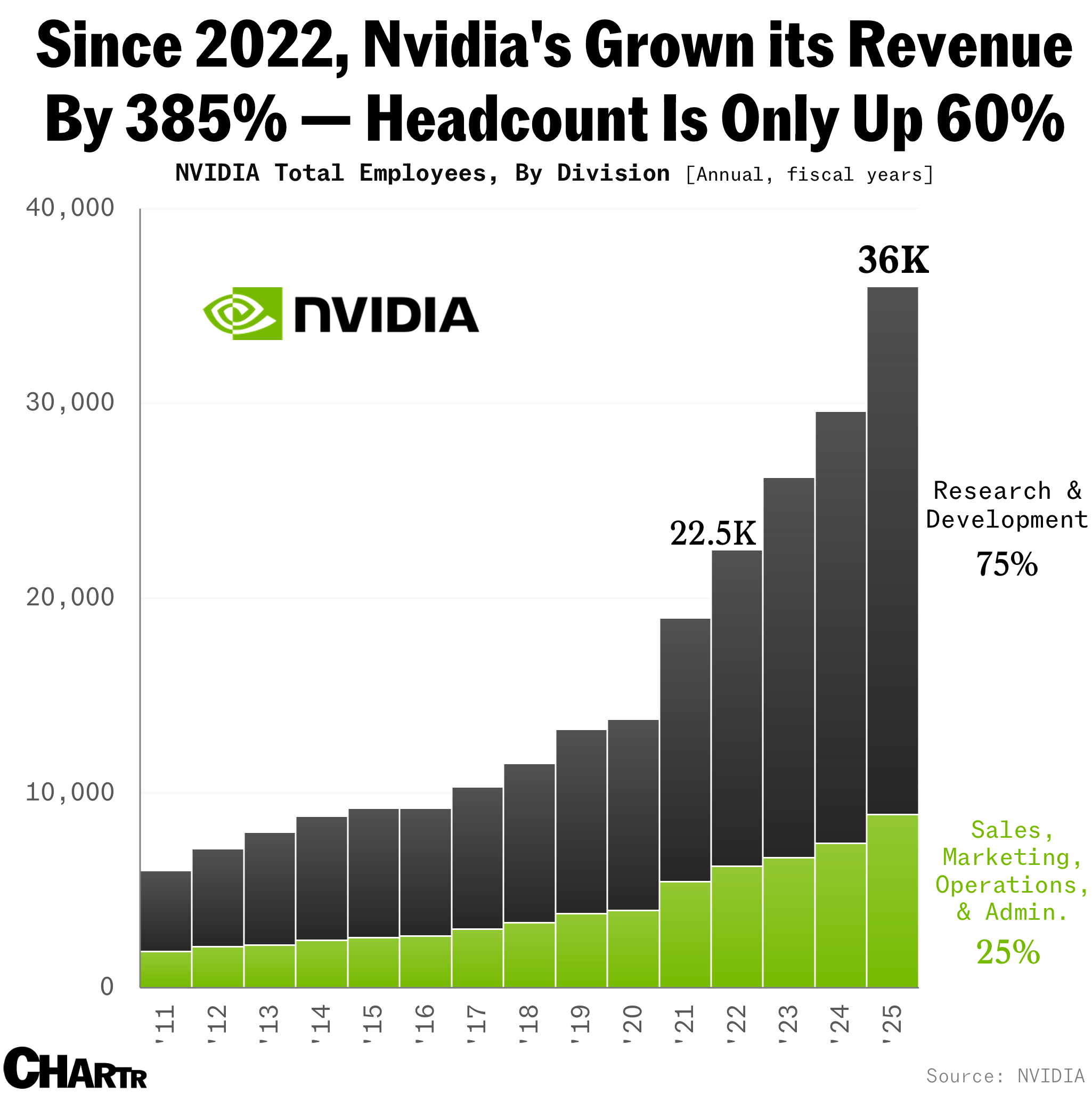
Whether AI brings about the golden era of productivity that many tech leaders endlessly talk about — enabling all of us to do more with less — is still worth arguing about. But the main character of the AI boom itself, Nvidia, is certainly finding ways to squeeze a little more juice out of its employees, with the company’s Q4 earnings revealing not only blockbuster revenues and profits but a remarkable fact: the world’s hottest company employs only 36,000 people, about 20% more than it did last year.

Considering that Nvidia more than doubled its revenue in 2024, from ~$61 billion to an eye-watering ~$130 billion, the fact that the responsibilities of its HR department have grown only 20% is nothing short of remarkable. But, when you look back at the last few years, the divergence between employees and revenue is even more stark.
Nvidia headcount
Sherwood News

Clearly, the kind of highly specialized work that Nvidia chip designers spend their days on isn’t one of those problems that’s aided by simply throwing more cooks into the AI mixer. Indeed, the company reports that 75% of its employees work on “Research & Development,” while less than a quarter are in more generic corporate functions like sales, marketing, or operations.

Last year, Bloomberg reported some employees claimed to be working seven days week in a pressure cooker environment, and CEO Jensen Huang has said previously that he doesn’t fire people — he would rather “torture employees to greatness” than fire them. (He did also add that he was being “tongue in cheek” about the torturing.) But, when looking solely at financial metrics, it’s hard to argue that Huang’s approach isn’t working.

But just how remarkable is Nvidia’s employee efficiency compared to its Big Tech peers?

tech

Nvidia makes $3.6 million of revenue per employee — more than any of its Big Tech rivals

Among the $17 trillion BATMMAAN tech giants (Big Tech’s version of the Avengers), Nvidia is squeezing the most out of every employee.

After reporting blowout earnings, which the market found reasons to dislike anyway as Nvidia tumbled 8% in trading on Thursday, we can now calculate that last year Nvidia pulled in $3.6 million in revenue for each one of its employees.

That’s more than 1.5x that of Apple and Meta, and nearly double that of Alphabet. The gap is even wider when it comes to profit: Nvidia’s net income per employee sits at $2 million, surpassing Apple, Meta, Alphabet, and Amazon.

Of course, this isn’t entirely surprising given that Nvidia had the lowest number of employees among the BATMMAAN group, with its workforce heavy on research and development.

Contrast that with Amazon and Tesla — the least tech-y of the eight behemoths — which rank at the bottom in revenue and profit per employee, and it makes sense. After all, Amazon is the world’s second-largest retailer behind Walmart, relying on a massive workforce to keep its logistics engine running — hence its 1.6 million employees, nearly twice as many as the rest combined. Meanwhile, Tesla, despite its software-heavy ambitions, is still a capital-intensive car company.

Golden handcuffs

Keeping those employees motivated to work long hours, and be tortured into greatness, could be a problem for Nvidia, but it’s one that’s been solved predominantly by the company’s astonishing stock surge. Nvidia leaping more than 1,800% over the last five years has been great news to say the least for its leather-jacket-loving CEO Jensen Huang, its suppliers, institutional shareholders, independent individual investors like Nancy Pelosi, and, of course, Nvidia employees.

With equity grants and employee stock purchase programs par for the course in Silicon Valley, it’s not hard to conclude that many of the workers that joined the high-flying chipmaker five or more years ago are probably millionaires today — assuming that they held on long enough to see the share price soar.

Last year, unsubstantiated reports that 76% of Nvidia employees were millionaires flooded social media. The true number is hard to guess, but the impact of Nvidia’s golden handcuffs are clear to see in its official turnover statistics. And while some employees may not enjoy the intense environment, the company’s low turnover suggests a workforce that’s more than happy to show up every day. The company’s 2024 Sustainability Report reveals that the company’s overall turnover rate was just 2.7% last year — a fraction of the semiconductor industry average of 17.7%.

Put another way:

A 2.7% turnover rate, if maintained, would equate to an average tenure of 37 years at the company.

Chances are that the low turnover rate won’t hold up forever. Some employees will presumably eventually decide that they have enough money to retire, and of course the stock could drop if the insatiable Big Tech capex orgy ever slows down or rivals build GPUs able to compete with Nvidia. But, for now, if you’re an Nvidia employee working seven days a week with a bunch of stock waiting to vest over the next few years, those golden handcuffs are still looking pretty tight.

Go Deeper: Gaming was once Nvidia’s golden goose. Now it’s the most low-key $11 billion business you can imagine.

More Tech

See all Tech
tech

SpaceX filings reportedly show no one can fire Elon Musk except Elon Musk

The only thing stopping Elon Musk from being chairman and CEO of SpaceX is Elon Musk, according to Reuters, which viewed an excerpt of the company’s IPO filing.

The document outlines a dual-class share structure giving Musk control via super-voting stock. The filing says he “can only be removed from our board or these positions by the vote of Class B holders” — shares he’ll control after the listing. It adds that if he keeps those shares, he could “continue to control the election and removal of a majority of our board.”

At a typical public company — even founder-led ones with dual-class structures — a CEO can be fired by the board of directors, which represents shareholders and can vote to remove them over issues such as corporate performance, strategy, or misconduct.

The unusual SpaceX setup means Musk is unlikely to face the kind of CEO succession pressure he’s dealt with at Tesla. Musk, of course, is not a typical CEO, and the value of his companies has long been closely tied to his presence.

To be sure, SpaceXs confidential IPO filing isnt in its final form yet — while the filing is still in the confidential phase, the company will be going back and forth with the SEC, which will review it and suggest or require changes.

At a typical public company — even founder-led ones with dual-class structures — a CEO can be fired by the board of directors, which represents shareholders and can vote to remove them over issues such as corporate performance, strategy, or misconduct.

The unusual SpaceX setup means Musk is unlikely to face the kind of CEO succession pressure he’s dealt with at Tesla. Musk, of course, is not a typical CEO, and the value of his companies has long been closely tied to his presence.

To be sure, SpaceXs confidential IPO filing isnt in its final form yet — while the filing is still in the confidential phase, the company will be going back and forth with the SEC, which will review it and suggest or require changes.

tech
Rani Molla

OpenAI’s models are officially coming to Amazon

Amazon is finally getting in on the hottest ticket in tech.

After Microsoft announced yesterday that it has agreed to give up its exclusive rights to sell OpenAI’s models, Amazon, as expected, will start offering them to customers — something Amazon Web Services CEO Matt Garman says users have been asking for “for a really long time.” Some models are available now in preview, and the most powerful GPT versions will show up “in the coming weeks.”

This is a big shift in the AI cloud wars. Microsoft’s early bet on OpenAI gave Azure an edge by locking up the most in-demand models. Now that exclusivity is gone, Amazon and other competitors can finally offer them too, closing a key gap and competing more directly for AI customers.

This is a big shift in the AI cloud wars. Microsoft’s early bet on OpenAI gave Azure an edge by locking up the most in-demand models. Now that exclusivity is gone, Amazon and other competitors can finally offer them too, closing a key gap and competing more directly for AI customers.

tech

Ship-tracking app surges as Iran war continues

As Middle East peace talks stretch on, with Tehran reportedly offering to reopen the Strait of Hormuz if the US lifts its blockade and the war ends, the owner of shipping intelligence platform MarineTraffic revealed that the app has gained millions of new users since the conflict began.

MarineTraffic’s user count jumped to 8.5 million this April, up from 3.5 million a year ago, the cofounder of its parent company, Kpler, said in an interview with the Financial Times. Paid subscribers, often workers within companies and governments looking for more data on supply chains and commodities trading, rose 11,000 in the same period.

Kpler, which also owns shipping intelligence platform FleetMon, draws its data from a range of sources, including the Automatic Identification System, satellites, and more than 500 people on-site, like port terminal operators.

Per Appfigures data, MarineTraffic is estimated to have raked in almost $1 million across March and April in app revenue (through April 27), more than double the ~$346,500 from the same months last year. Across the full year, Kpler expects to earn between $300 million and $400 million in annual recurring revenues.

Latest Stories

Sherwood Media, LLC produces fresh and unique perspectives on topical financial news and is a fully owned subsidiary of Robinhood Markets, Inc., and any views expressed here do not necessarily reflect the views of any other Robinhood affiliate, including Robinhood Markets, Inc., Robinhood Financial LLC, Robinhood Securities, LLC, Robinhood Crypto, LLC, Robinhood Derivatives, LLC, or Robinhood Money, LLC. Futures and event contracts are offered through Robinhood Derivatives, LLC.
