
Tech
Chatbot speech bubbles
(Getty Images)
out of character

Teens are upset that they can’t speak to Character.AI chatbots anymore

The platform has restricted access for those under 18, as concerns around the tech’s impact grow.

Tom Jones

As far as execs at Character.AI are concerned, (role) playtime’s over for under-18s, as they start to ban teens from using the platform’s chatbots this week

The chatbot company, which clocks about 184 million website visits around the world each month — and millions more app sessions — per data from Similarweb, announced at the end of last month that it would be rolling back access to its open-ended chat feature for minors. Users who are under 18 have been limited to daily two-hour open-ended chats since the late October notice, and access started ramping down for most of those in the age range yesterday.

Indeed, a selection of young “power users,” as The Wall Street Journal termed them in a piece on the anguish some under-18 users are experiencing at being separated from the chatbots, are being given a weeks-long grace period where they can still access hour-long open-ended chats with the characters they’ve been interacting with, to “help minimize disruption” to the teen users.

Clearly, AI-generated conversations with popular characters like Yor Forger, “a loving mom who’s definitely not an assassin,” and Itoshi Rin, who “only loves soccer... and you,” have a lot of (mostly younger) users in the site’s full thrall.
Character.ai demographic chart
Sherwood News

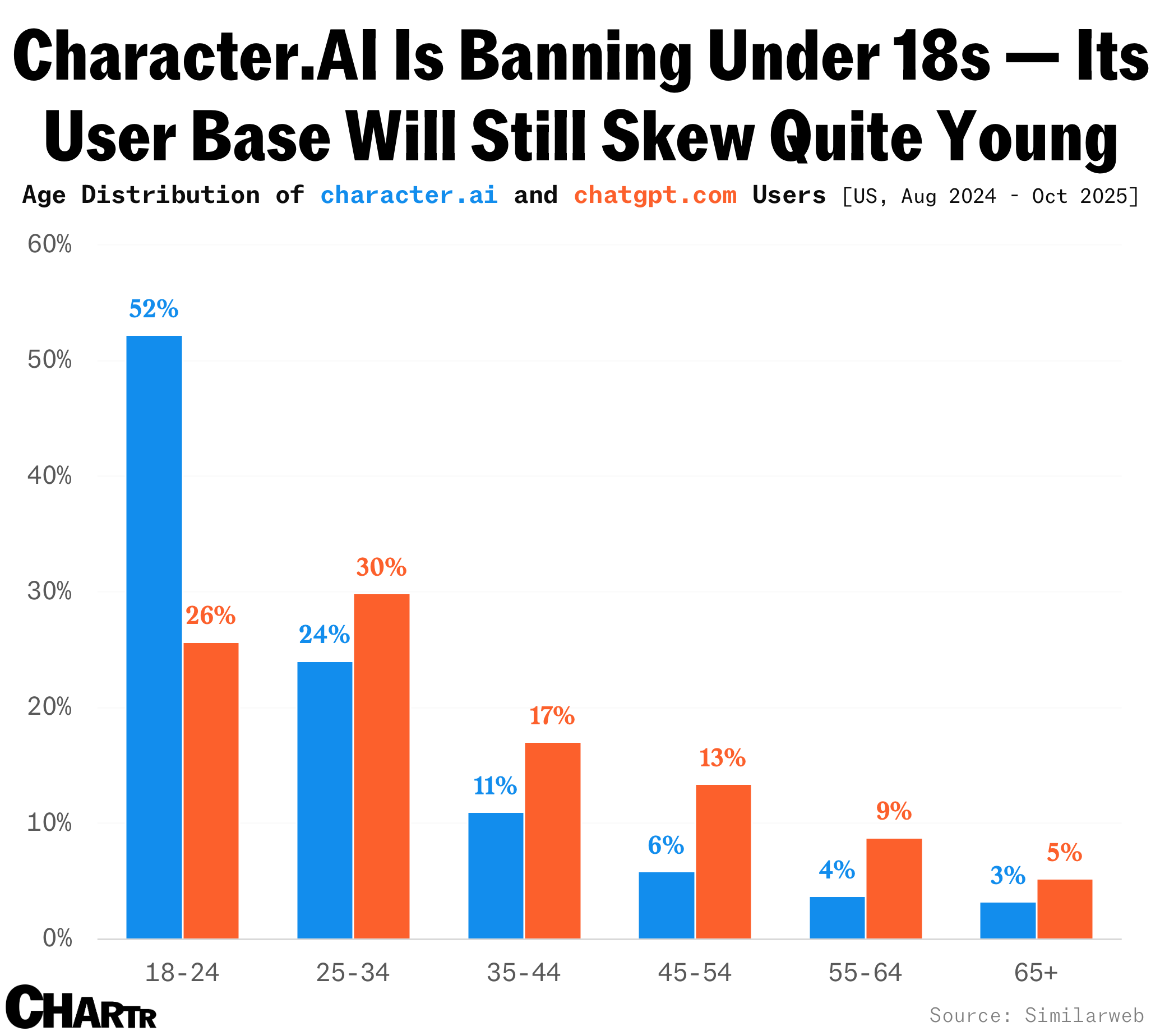
Though traffic-tracking site Similarweb doesn’t break out under-18s in its demographics data, the figures it does disclose already show that Character.AI tends to skew a lot younger than more general competitors like ChatGPT.

According to US-specific figures from Similarweb, of the 1.7 million monthly unique web visitors character.ai notched on average from August to October, some 52% were aged between 18 and 24, compared to a 26% share on chatgpt.com.

A lot to talk about

Character.AI’s younger users tend to be way more locked in, too: per the data, they visited 26 times each month on average and spent 18 minutes in a typical session using Character.AI — much higher than ChatGPT users, who visited the OpenAI chatbot 13 times on average across the month, spending around 6 minutes per visit.

Those sorts of numbers, paired with deaths linked to the platform and increasing concerns around the detrimental effects of chatbots on younger minds more generally, were likely factors in the move to pare back teen user access, which — at least according to Character.AI CEO Karandeep Anand — “wasn’t a very hard decision.”

More Tech

See all Tech
tech

xAI’s revenue is growing, but so are its staggering losses

Good news: xAI’s revenue nearly doubled to $107 million in the third quarter compared to the second.

Bad news: Its net losses grew to $1.46 billion in Q3, up from $1 billion in the first quarter, and more than 13x revenue, Bloomberg reports.

The company, which is currently worth north of $230 billion, is burning through staggering amounts of cash — nearly a billion dollars a month — in service of building data centers and developing what it calls “self-sufficient” AI that can one day power robots like Tesla’s Optimus. Meanwhile, its revenue still looks more like that of a midsize startup than a tech giant.

Despite receiving more yes than no votes, Tesla’s board didn’t approve a shareholder proposal to invest in xAI, leaving a more formal relationship between the companies unresolved, even as xAI continues to burn cash at a pace that will require steady access to outside capital.

Of course, Elon Musk’s AI company is already deeply financially intertwined with his EV company. In 2024, xAI spent nearly $200 million, largely on Tesla Megapack batteries — a figure that appears to have grown significantly in 2025.

The company, which is currently worth north of $230 billion, is burning through staggering amounts of cash — nearly a billion dollars a month — in service of building data centers and developing what it calls “self-sufficient” AI that can one day power robots like Tesla’s Optimus. Meanwhile, its revenue still looks more like that of a midsize startup than a tech giant.

Despite receiving more yes than no votes, Tesla’s board didn’t approve a shareholder proposal to invest in xAI, leaving a more formal relationship between the companies unresolved, even as xAI continues to burn cash at a pace that will require steady access to outside capital.

Of course, Elon Musk’s AI company is already deeply financially intertwined with his EV company. In 2024, xAI spent nearly $200 million, largely on Tesla Megapack batteries — a figure that appears to have grown significantly in 2025.

tech

Apple’s hardware chief is the front-runner to be the next CEO

The New York Times is the latest news organization to cite Apple sources who think the company’s hardware chief, John Ternus, will be the one to fill CEO Tim Cook’s shoes. Citing people close to Apple, the publication reports that Cook is “tired and would like to reduce his workload” and that 50-year-old Ternus is the most likely to take his place, as the company accelerates its succession planning.

The Times is in good company. Both the Financial Times and Bloomberg have previously said Ternus is the top pick to succeed Cook at the helm of the tech giant, and Ternus is currently enjoying the top spot on prediction markets. His market-implied odds of being the next CEO are currently above 60% on both Polymarket and Kalshi event contracts.

The Times is in good company. Both the Financial Times and Bloomberg have previously said Ternus is the top pick to succeed Cook at the helm of the tech giant, and Ternus is currently enjoying the top spot on prediction markets. His market-implied odds of being the next CEO are currently above 60% on both Polymarket and Kalshi event contracts.

tech

Morgan Stanley: Even with Nvidia’s autonomous tech, Tesla is still “years ahead” of other automakers

Nvidia’s latest autonomous tech may help traditional automakers close the distance to manufacturing driverless cars, but not to Tesla, a research note from Morgan Stanley contends. Analyst Andrew Percoco argued that while Nvidia’s tech stack offers a “capital efficient on ramp to advanced autonomy,” that still leaves automakers stuck in a “faster follower strategy.”

According to the analyst, “Tesla is years ahead of competitors when it comes to autonomy with a clear data and scale advantage.” The comment is similar to something Tesla CEO Elon Musk said in the wake of Nvidia’s announcements:

“This is maybe a competitive pressure on Tesla in 5 or 6 years, but probably longer,” Musk posted on X.

Latest Stories

Sherwood Media, LLC produces fresh and unique perspectives on topical financial news and is a fully owned subsidiary of Robinhood Markets, Inc., and any views expressed here do not necessarily reflect the views of any other Robinhood affiliate, including Robinhood Markets, Inc., Robinhood Financial LLC, Robinhood Securities, LLC, Robinhood Crypto, LLC, or Robinhood Money, LLC.