Tech
Tesla Robotaxi
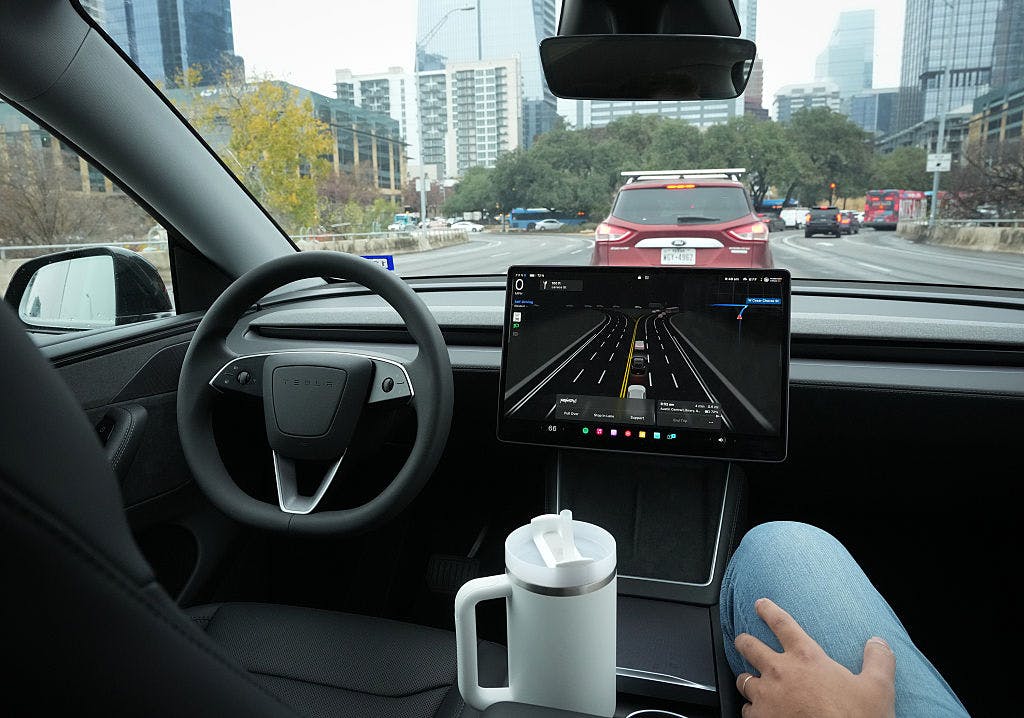
A safety monitor rides in the front passenger seat as a Tesla Robotaxi drives in Austin (Jay Janner/Getty Images)

The vast majority of Tesla Robotaxi rides in Austin still have a safety driver

In January, Tesla announced its Robotaxis would begin operating without safety monitors. It doesn’t appear to have scaled up much.

When Tesla CEO Elon Musk announced in January that Austin Robotaxis were beginning to operate without safety monitors in the front seats, the stock jumped, signaling investor excitement about progress toward full autonomy.

At the time, observers estimated that just two of the roughly 45 Robotaxis in the fleet were without monitors, but Tesla said the ratio would increase quickly.

“We, obviously, are being very cautious about this because we want to have no injuries or serious accidents along the way,” Musk said of removing safety drivers from Austin Robotaxis on the company’s fourth-quarter earnings call a few days later. “But you’ll see the amount of autonomy increase dramatically, I think, every month essentially.”

More than a month later, that increase hasn’t materialized. A report late last week from Jefferies analysts found that just two of the 15 Austin Robotaxi rides they took were without a safety driver. (Separately, they found that while Robotaxis were cheaper than Waymos and regular Ubers operating in the same area, their wait times and trip times were notably longer — consistent with previous reporting from ride-share comparison app Obi.)

Unsupervised Tesla Robotaxis in Austin
Note that just one of these unsupervised Austin Robotaxis has been seen in the past week (Robotaxi Tracker)

Data from Robotaxi Tracker has identified eight unsupervised Tesla Robotaxis. But only one has been spotted in the past week; the rest were last seen roughly three weeks ago. In other words, the number of monitor-less Teslas currently on the road, compared to the time of the initial announcement, appears somewhere in the range of largely unchanged to possibly down.

Tesla said it plans to expand its Robotaxi fleet to a half dozen new markets in the first half of 2026. (It’s currently also in the Bay Area with drivers using supervised Full Self-Driving tech.) As we’ve noted, if Tesla’s Robotaxi expansion goes forward, it will probably look a lot more like a traditional driver-having Uber than an autonomous Waymo.


More Tech

See all Tech
tech

Apple updates Mac chips and amps up AI claims

Apple’s new M5 Pro and M5 Max chips are the latest step in its steady silicon march: faster CPUs, stronger graphics, more memory bandwidth. The 30% CPU performance increase is meaningful but incremental — not the kind of leap that accompanied the original M1 transition from Intel.

What’s more notable is how aggressively Apple is framing this around AI. The company is touting up to 4x higher peak GPU compute for AI workloads and the ability to run larger models locally, leaning hard into the on-device AI narrative as it positions the MacBook Pro as a more capable personal AI development machine.

It may be paying off in unexpected ways, as the explosion of interest in roll-your-own AI agents like Moltbot have made low-cost Macs like the MacMini a hot item.

It may be paying off in unexpected ways, as the explosion of interest in roll-your-own AI agents like Moltbot have made low-cost Macs like the MacMini a hot item.

tech

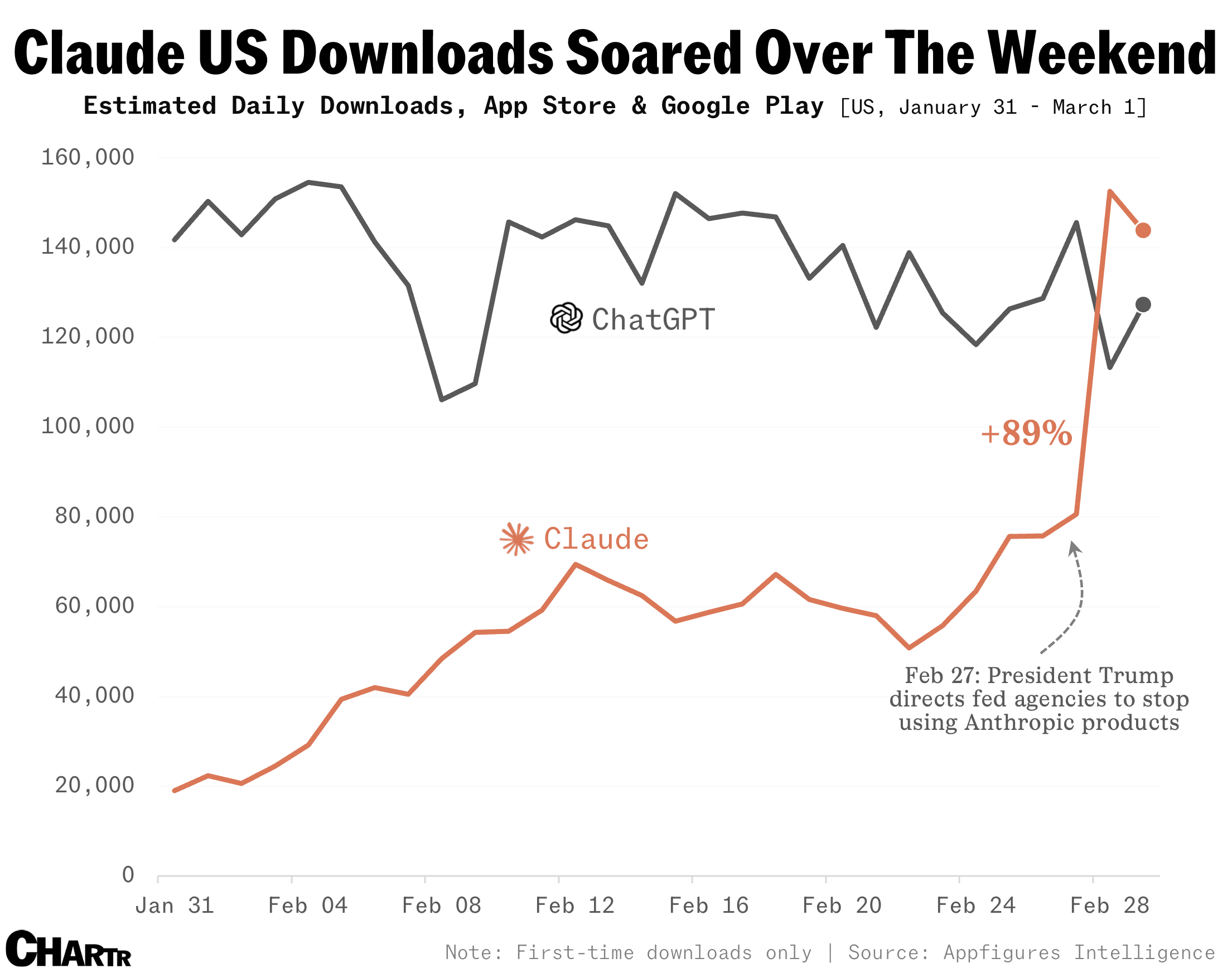
Claude is still top of the US free App Store, as users defect from ChatGPT following Pentagon deal

Last Friday, President Trump directed federal agencies to cease using all Anthropic products owing to its very messy, very public dispute with the Department of War (née Defense), which had centered around the potential US military use of its AI. Just a day later, OpenAI announced that it had made an agreement to supply artificial intelligence to the Pentagon.

It didn’t take long for consumers to respond to news of the deal, which OpenAI CEO Sam Altman has now conceded looked “opportunistic and sloppy” in a post on X. Uninstalls of the ChatGPT mobile app jumped 295% on Saturday from the day before, according to figures from Sensor Tower reported by TechCrunch, as fears around the since-amended agreement’s privacy implications grew.

Claude ChatGPT downloads Feb chart
Sherwood News
tech

After tussle with Pentagon, Anthropic’s $60 billion worth of recent investments might be at risk

The fallout from Anthropic’s dramatic split from the Pentagon is still being measured. For a domestic company to be labeled a “supply-chain risk to national security” by the US defense secretary is unprecedented, as Anthropic noted in a post responding to Defense Secretary Pete Hegseth’s tweet.

Making it even more shocking is the fact that Anthropic appeared to be on track to have one of the largest and most anticipated tech IPOs in American history.

Axios’ Dan Primack writes that the $60 billion in venture capital Anthropic just raised last month could very well be at risk. Primack argues that investors may get cold feet now that the company has run afoul of the Trump administration, and it faces significant uncertainty as the industry waits to see what official acts follow Hegseth’s words.

Making it even more shocking is the fact that Anthropic appeared to be on track to have one of the largest and most anticipated tech IPOs in American history.

Axios’ Dan Primack writes that the $60 billion in venture capital Anthropic just raised last month could very well be at risk. Primack argues that investors may get cold feet now that the company has run afoul of the Trump administration, and it faces significant uncertainty as the industry waits to see what official acts follow Hegseth’s words.

Latest Stories

Sherwood Media, LLC produces fresh and unique perspectives on topical financial news and is a fully owned subsidiary of Robinhood Markets, Inc., and any views expressed here do not necessarily reflect the views of any other Robinhood affiliate, including Robinhood Markets, Inc., Robinhood Financial LLC, Robinhood Securities, LLC, Robinhood Crypto, LLC, or Robinhood Money, LLC.