

Tech
tech
Jon Keegan

Trump rescinds Biden’s executive order on “safe, secure, and trustworthy” AI

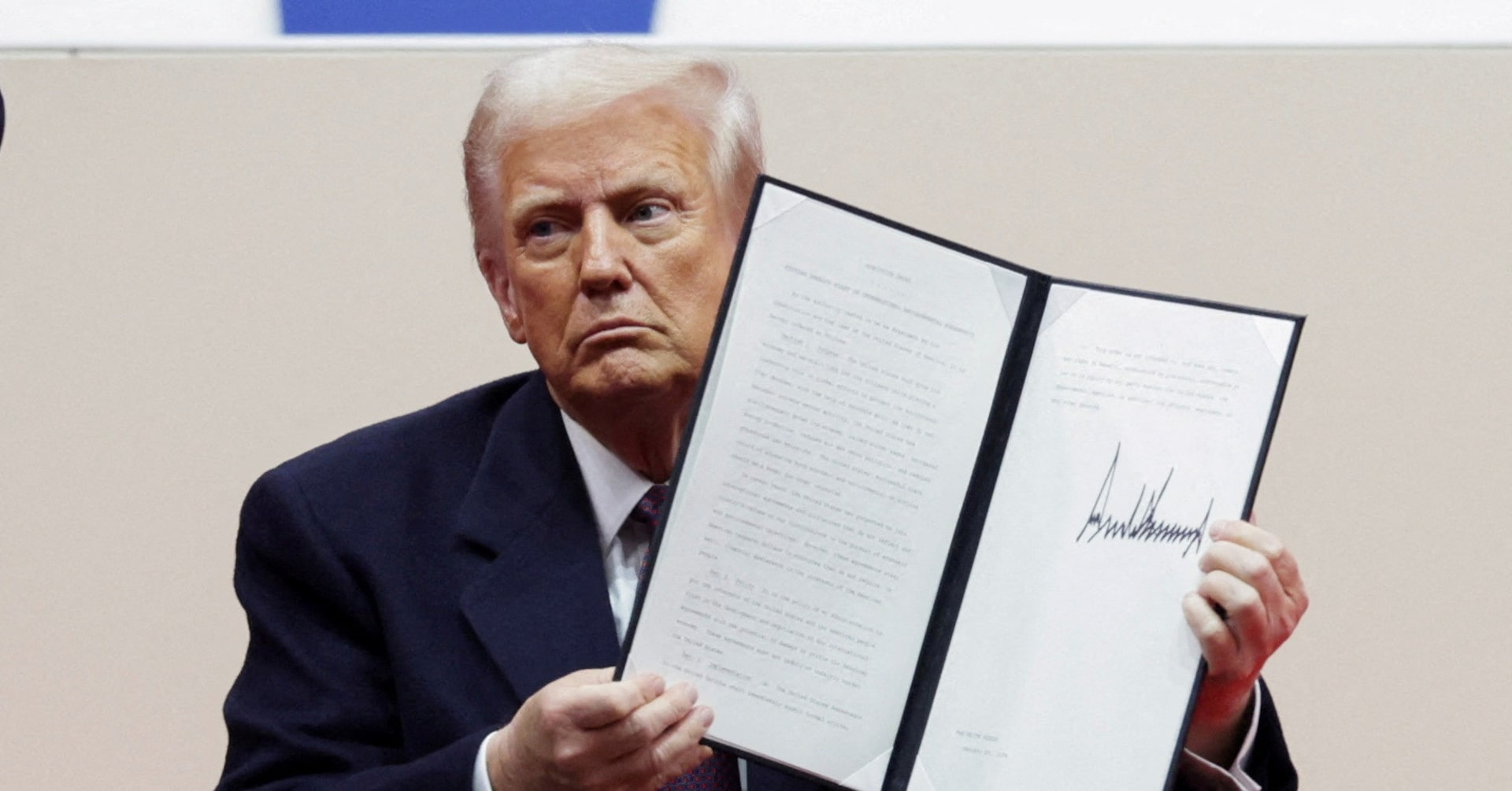
In his first batch of executive orders, President Trump rescinded Biden’s sweeping 2023 executive order on “Safe, Secure, and Trustworthy Artificial Intelligence.”

The press release announcing the revocation of the order, along with dozens of other Biden memoranda and orders, said:

“To commence the policies that will make our Nation united, fair, safe, and prosperous again, it is the policy of the United States to restore common sense to the Federal Government and unleash the potential of the American citizen. The revocations within this order will be the first of many steps the United States Federal Government will take to repair our institutions and our economy.”

Trump has promised to keep the AI industry free of regulations, and has made American domination of the technology a priority. The presence of OpenAI’s Sam Altman, Meta’s Mark Zuckerberg, Amazon’s Jeff Bezos, and Tesla’s Elon Musk on the dais at the inauguration in the US Capitol rotunda yesterday was a visible signal of the heightened role that Big Tech companies might have in this administration.

The most significant change that will come from the reversal of Biden’s order is the elimination of the requirement for the developers of very large, powerful models to share the results of safety tests with government regulators and grant access to those models before releasing them to the public.
“To commence the policies that will make our Nation united, fair, safe, and prosperous again, it is the policy of the United States to restore common sense to the Federal Government and unleash the potential of the American citizen. The revocations within this order will be the first of many steps the United States Federal Government will take to repair our institutions and our economy.”

Trump has promised to keep the AI industry free of regulations, and has made American domination of the technology a priority. The presence of OpenAI’s Sam Altman, Meta’s Mark Zuckerberg, Amazon’s Jeff Bezos, and Tesla’s Elon Musk on the dais at the inauguration in the US Capitol rotunda yesterday was a visible signal of the heightened role that Big Tech companies might have in this administration.

The most significant change that will come from the reversal of Biden’s order is the elimination of the requirement for the developers of very large, powerful models to share the results of safety tests with government regulators and grant access to those models before releasing them to the public.
More Tech

See all Tech
tech

Google reaches record high and crosses $4 trillion market cap after major wins for Gemini

Google parent Alphabet closed yesterday at a record-high stock price of $331.86, giving the company a market capitalization just above $4 trillion, as investors reward a string of wins for its Gemini AI model, including high-profile partnerships with Apple and Walmart.

After months of speculation, Apple announced a multiyear partnership to use Gemini to power its AI assistant, Siri, a major endorsement of Google’s AI prowess. That same day, Walmart said it would partner with Google to let customers purchase products directly through the Gemini chatbot, a move that would put Gemini in front of millions of Walmart shoppers and test whether AI chatbots can drive real commerce at scale rather than isolated queries. (Amazon, OpenAI, and Microsoft are experimenting with similar AI shopping tools.)

The stock is up nearly 1% again in premarket trading today. While Microsoft and Apple have both crossed $4 trillion in the past, they’ve since dipped below it, leaving Google and Nvidia as the only companies currently valued above the threshold.

tech

Meta reportedly plans to cut about 10% of employees in Reality Labs metaverse business

Meta is planning to cut roughly 10% of its Reality Labs employees, according to a report from The New York Times. The division is home to products related to the namesake of the company — the metaverse — which includes virtual and augmented reality glasses and headsets. Employees working on the metaverse are the target of the cuts, per the report.

Reality Labs has been bleeding cash and struggling to build significant revenue, racking up losses of around $70 billion since the company started reporting its numbers in 2020. Other than Meta Ray-Ban glasses, the group’s products have not been popular with consumers, and the idea of the metaverse that CEO Mark Zuckerberg evangelized never took off.

The company has since pivoted to a focus on building AI “superintelligence.”

Reality Labs has been bleeding cash and struggling to build significant revenue, racking up losses of around $70 billion since the company started reporting its numbers in 2020. Other than Meta Ray-Ban glasses, the group’s products have not been popular with consumers, and the idea of the metaverse that CEO Mark Zuckerberg evangelized never took off.

The company has since pivoted to a focus on building AI “superintelligence.”

tech

Tesla’s Elon Musk says AI deal with Apple gives Google “unreasonable concentration of power”

Apple has selected Google’s Gemini AI model to power the next generation of Siri — and Tesla and xAI CEO Elon Musk is not pleased. Responding on X to Google’s announcement, Musk wrote that the deal “seems like an unreasonable concentration of power for Google,” pointing to the company’s control of Android and Chrome.

Musk has previously sued Apple, accusing the company of unfairly favoring OpenAI’s ChatGPT — with which Apple also has a more limited AI partnership — in its App Store. Musk’s xAI, which works closely with Tesla, develops a competing AI model, Grok. Long considered the AI front-runner, OpenAI, which was also in the running to power Siri, has been facing increased competition from Google.

In a monopoly case last September, a judge ruled that agreements such as Apple’s deal to preload Google Search on Safari were permissible as long as they were not exclusive — a decision that may have helped clear the path for the companies’ new multiyear AI partnership.

tech
Jon Keegan

Apple selects Google’s Gemini to power Siri, CNBC reports

Apple has selected Google’s Gemini model as part of a multiyear partnership to power its revamped, AI-powered Siri, set to launch this year.

Per a statement seen by CNBC, Apple said: “After careful evaluation, we determined that Google’s technology provides the most capable foundation for Apple Foundation Models and we’re excited about the innovative new experiences it will unlock for our users.”

Apple first announced a revamped AI Siri back in June 2024 but failed to execute on many of its promises of personalized features and deep system integration. The newest iteration of Siri was expected this spring. Bloomberg previously reported that Apple plans to pay Google $1 billion a year to use its AI model to power Siri.

With this news, the iPhone maker has ticked one of the four boxes that Wedbush Securities analyst Dan Ives said would be integral to the stock’s success in 2026.

“This is what the Street has been waiting for with the elephant in the room for Cupertino revolving around its invisible AI strategy,” Ives wrote in a follow-up note, calling the move a “major validation moment for Google as a premier foundation model and for Apple as a stepping stone to accelerate its AI strategy into 2026 and beyond.”

Google, which has been riding high on the the stellar reception of its latest Gemini model, briefly notched a $4 trillion market cap on the news. Apple hit the notable milestone in 2025 but has since fallen and is currently worth $3.8 trillion.

Apple first announced a revamped AI Siri back in June 2024 but failed to execute on many of its promises of personalized features and deep system integration. The newest iteration of Siri was expected this spring. Bloomberg previously reported that Apple plans to pay Google $1 billion a year to use its AI model to power Siri.

With this news, the iPhone maker has ticked one of the four boxes that Wedbush Securities analyst Dan Ives said would be integral to the stock’s success in 2026.

“This is what the Street has been waiting for with the elephant in the room for Cupertino revolving around its invisible AI strategy,” Ives wrote in a follow-up note, calling the move a “major validation moment for Google as a premier foundation model and for Apple as a stepping stone to accelerate its AI strategy into 2026 and beyond.”

Google, which has been riding high on the the stellar reception of its latest Gemini model, briefly notched a $4 trillion market cap on the news. Apple hit the notable milestone in 2025 but has since fallen and is currently worth $3.8 trillion.

Latest Stories

Sherwood Media, LLC produces fresh and unique perspectives on topical financial news and is a fully owned subsidiary of Robinhood Markets, Inc., and any views expressed here do not necessarily reflect the views of any other Robinhood affiliate, including Robinhood Markets, Inc., Robinhood Financial LLC, Robinhood Securities, LLC, Robinhood Crypto, LLC, or Robinhood Money, LLC.