

Tech
tech
Rani Molla

Trump to push Big Tech to fund new power plants as AI drives up electricity costs

President Donald Trump is expected to announce a plan Friday morning that would require Big Tech companies to bid on 15-year contracts for new electricity generation capacity. The move would effectively force companies to help fund new power plants in the PJM region as soaring demand from AI data centers pushes up electricity costs across the US power grid.

Earlier this week, Trump called on tech giants to “pay their own way,” arguing that households and small businesses should not bear the cost of power infrastructure needed to support energy-hungry data centers.

Microsoft quickly responded, saying it would “pay utility rates that are high enough to cover our electricity costs,” along with committing to other changes aimed at easing pressure on the grid. Other major tech companies are expected to follow suit, though Wedbush Securities analyst Dan Ives warned the added costs could slow the pace of data center build-outs.

As we’ve noted, forcing tech companies to shoulder higher electricity costs is likely to hit some firms harder than others. Companies like Microsoft, Google, and Amazon can pass at least some of those costs on to customers by selling data center capacity downstream. Meta, in contrast, does not have a cloud business, meaning its AI ambitions lack a direct revenue stream to offset rising power costs.

So far tech stocks don’t appear to be affected much in premarket trading. However utility companies most levered to the AI boom certainly are, with Vistra, Constellation Energy, and Talen Energy deep in the red ahead of the open as analysts at Jefferies warn that these firms face risks from this plan.

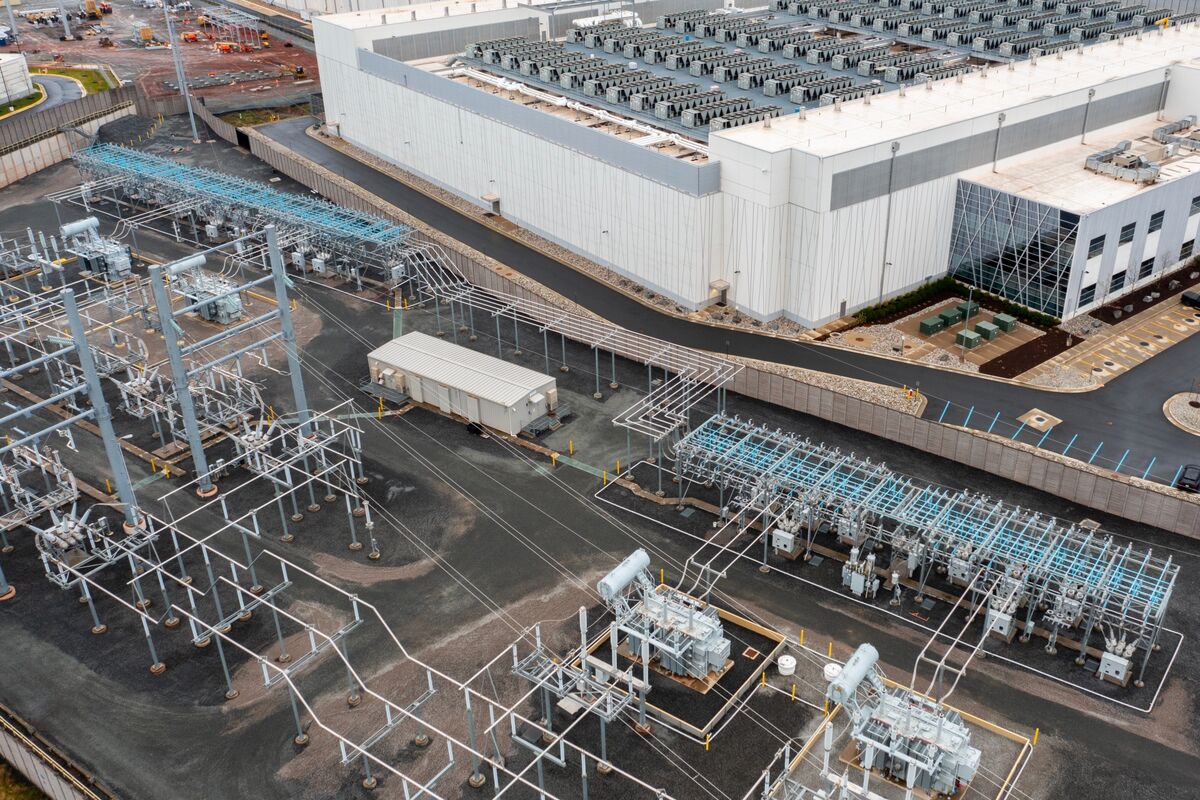
Earlier this week, Trump called on tech giants to “pay their own way,” arguing that households and small businesses should not bear the cost of power infrastructure needed to support energy-hungry data centers.

Microsoft quickly responded, saying it would “pay utility rates that are high enough to cover our electricity costs,” along with committing to other changes aimed at easing pressure on the grid. Other major tech companies are expected to follow suit, though Wedbush Securities analyst Dan Ives warned the added costs could slow the pace of data center build-outs.

As we’ve noted, forcing tech companies to shoulder higher electricity costs is likely to hit some firms harder than others. Companies like Microsoft, Google, and Amazon can pass at least some of those costs on to customers by selling data center capacity downstream. Meta, in contrast, does not have a cloud business, meaning its AI ambitions lack a direct revenue stream to offset rising power costs.

So far tech stocks don’t appear to be affected much in premarket trading. However utility companies most levered to the AI boom certainly are, with Vistra, Constellation Energy, and Talen Energy deep in the red ahead of the open as analysts at Jefferies warn that these firms face risks from this plan.

More Tech

See all Tech
ChatGPT Is Down

Is OpenAI on its way to becoming Lyft?

Once nearly synonymous with AI, it just got surpassed in valuation by Anthropic. Now it looks like it’s also going to get beaten to the IPO starting line.

tech

Palo Alto Networks surges after it beats revenue and earnings estimates

Cybersecurity firm Palo Alto Networks jumped more than 10% in postmarket trading after reporting fiscal third-quarter results that beat analyst revenue and earnings expectations.

The company posted adjusted earnings per share of $0.85, versus the FactSet analyst consensus estimate of $0.79 on $3 billion in revenue. (Wall Street had expected $2.94 billion.)

The company also boosted its guidance for the full fiscal year. The company now expects non-GAAP EPS in the range of $3.77 to $3.79, compared to its previous projection of $3.65 to $3.70 (and analysts’ expectations of $3.68). It also forecast revenue of $11.415 billion to $11.425 billion, representing year-over-year growth of 24%, compared to previous growth expectations of 22% to 23%.

Through Tuesday’s close, the stock had risen more than 60% in the past month.

tech

Microsoft releases 7 new models, next-gen quantum chip at Build conference

Microsoft is making it clear it can stand on its own as a competitor in the AI arena.

Today at its annual Microsoft Build developer conference, the company made a flurry of announcements that move it further away from the shadow of its complicated relationship with partner OpenAI.

Among the products announced:

  • New Nvidia-powered Windows PCs: the Surface Laptop Ultra and Surface RTX Spark Dev Box.

  • Seven new homegrown AI models: MAI Image-2.5, MAI Image-2.5-Flash, MAIN Transcribe-1.5, MAI Thinking-1, MAI Voice-2, MAIN Voice-2-Flash, and MAI Code-1-Flash.

  • Majorana 2, the company’s next-gen quantum chip.

  • Microsoft Scout, an integrated always-on agent built on OpenClaw.

  • Project Solara, an AI gadget operating system.

Investors were unimpressed, however, as shares were down over 4% after the announcements.

  • New Nvidia-powered Windows PCs: the Surface Laptop Ultra and Surface RTX Spark Dev Box.

  • Seven new homegrown AI models: MAI Image-2.5, MAI Image-2.5-Flash, MAIN Transcribe-1.5, MAI Thinking-1, MAI Voice-2, MAIN Voice-2-Flash, and MAI Code-1-Flash.

  • Majorana 2, the company’s next-gen quantum chip.

  • Microsoft Scout, an integrated always-on agent built on OpenClaw.

  • Project Solara, an AI gadget operating system.

Investors were unimpressed, however, as shares were down over 4% after the announcements.

Latest Stories

Sherwood Media, LLC and Chartr Limited produce fresh and unique perspectives on topical financial news and are fully owned subsidiaries of Robinhood Markets, Inc., and any views expressed here do not necessarily reflect the views of any other Robinhood affiliate, including Robinhood Markets, Inc., Robinhood Financial LLC, Robinhood Securities, LLC, Robinhood Crypto, LLC, Robinhood Money, LLC, Robinhood U.K. Ltd, Robinhood Derivatives, LLC, Robinhood Gold, LLC, Robinhood Asset Management, LLC, Robinhood Credit, Inc., Robinhood Ventures DE, LLC and, where applicable, its managed investment vehicles.
