
Tech
Google’s Waymo in NYC near Freedom Tower
Rani Molla/Sherwood News

Where Morgan Stanley thinks autonomous taxis will be in 2032

Google’s Waymo and Tesla will still be in the lead.

Recently we laid out the current autonomous ride-share landscape, which is mostly a battle between Google’s Waymo and Tesla. According to a new report from Morgan Stanley’s research team that looks forward to the next half decade, robotaxis’ future — while expected to grow rapidly — might not be so different.

In 2032, the Morgan Stanley research team expects Waymo and Tesla to command about 70% (~38% and ~29%, respectively) of autonomous miles driven in the US.
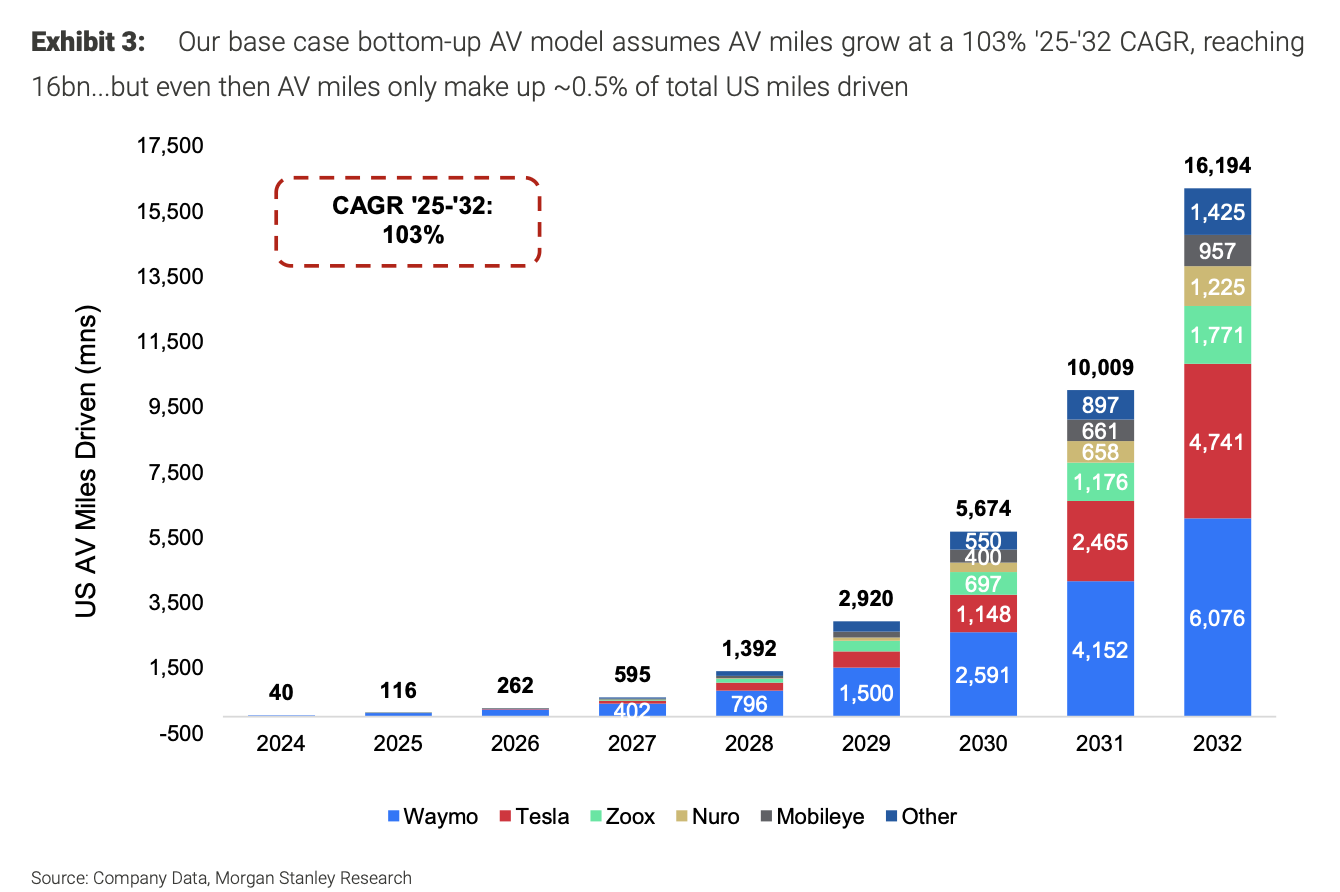
AV miles driven
Morgan Stanley

In turn, the firm believes autonomous miles will represent about 30% of all ride-share miles in the US.
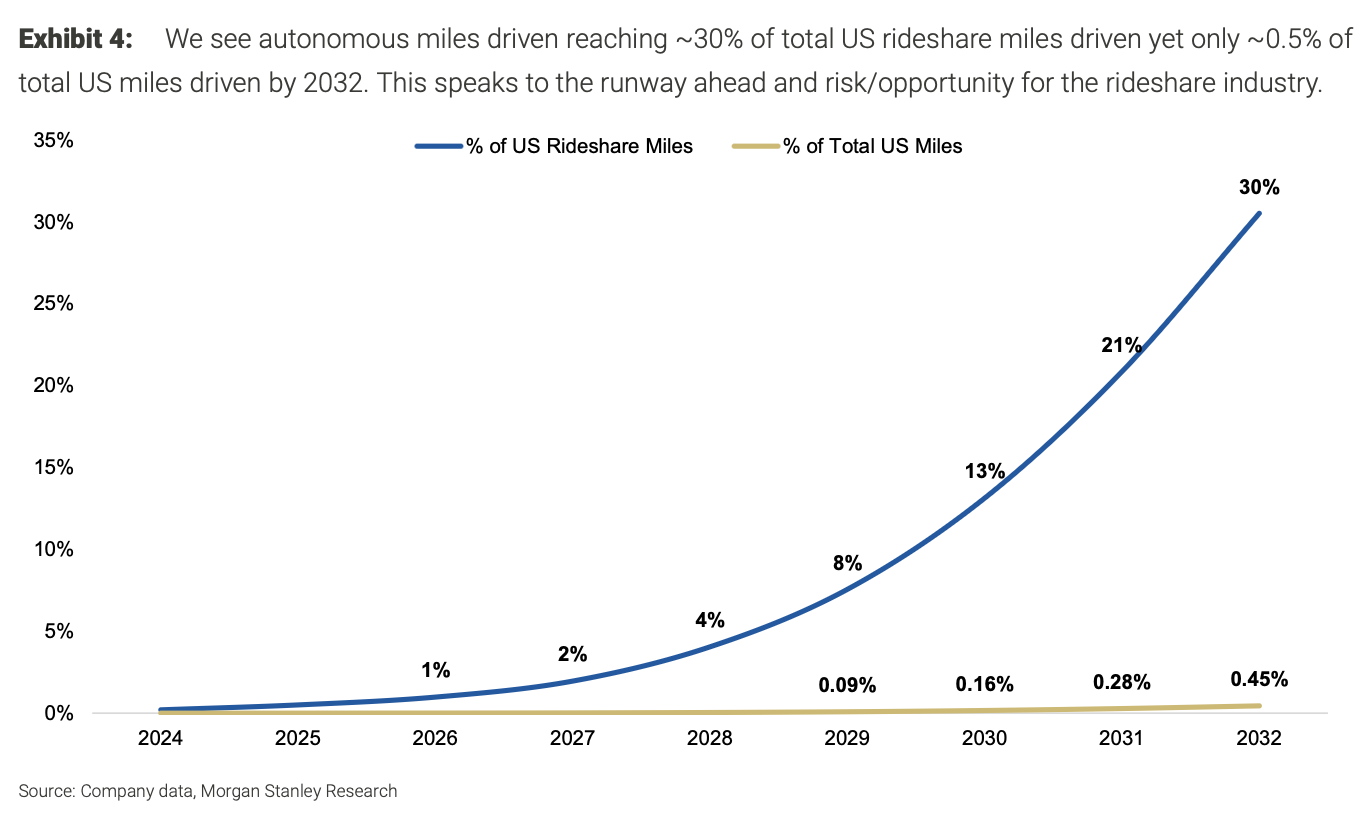
% of US autonomous ride-share miles
Morgan Stanley

Looking at that from the perspective of trips and the apps that controls them, and using the current partnership mix, Uber and Lyft will capture just about 30% of all AV trips, down from basically controlling the entire ride-share market now.
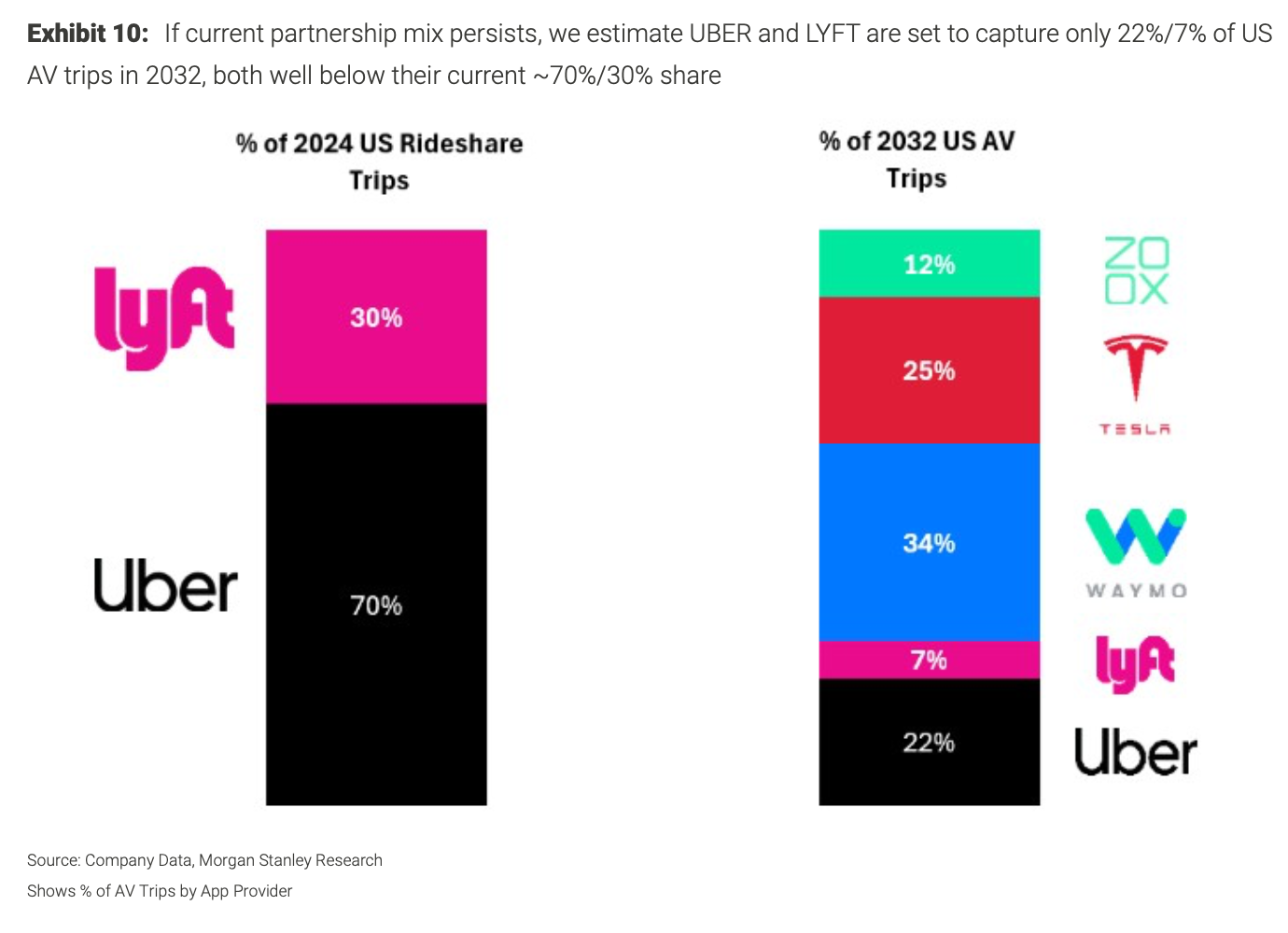
Share of AV trips by app provider
Morgan Stanley

As these companies scale their autonomous efforts and improve their tech, costs are widely expected to decline. Morgan Stanley believes cost per mile for Waymo, which is currently nearly double Tesla’s cost, will drop from $1.43 to $0.99 by 2028. Meanwhile, the cost per mile for Tesla ride-sharing will dip below the cost of car ownership, which is growing.
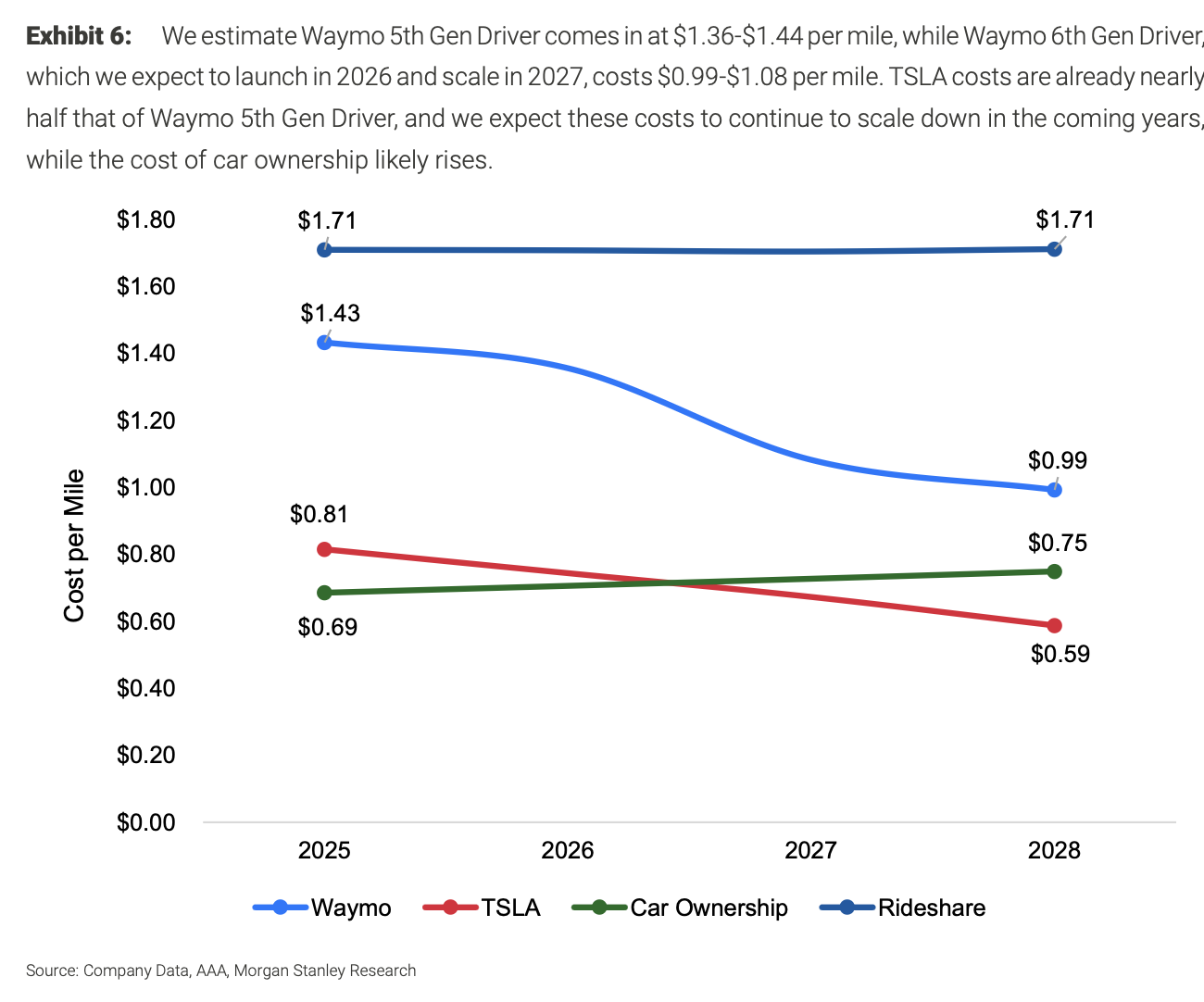
autonomous cost per mile
Morgan Stanley

Much of the future of ride-sharing, according to Morgan Stanley, hinges on whether or not robotaxis create more demand or take from current demand.

“AV incrementality remains critical for Uber/Lyft, who will likely lose significant share of the rideshare industry as autonomous platform disruption grows,” the researchers wrote.

More Tech

See all Tech
tech

OpenAI races to release updated ChatGPT in response to Gemini, the WSJ reports

OpenAI could release an updated GPT-5.2 as soon as this week as it races to respond to Google’s Gemini 3 chatbot. Last week, OpenAI CEO Sam Altman declared a “code red” in response to the threat, as Google appeared to leap to the front of the pack with its high-scoring AI model.

Altman has directed OpenAI teams to pause work on its quest for AGI and the Sora 2 video generation app, and double down on its core flagship product, ChatGPT, as it faces new pressure from competitors, The Wall Street Journal reports.

Altman seems to be panicking that if the company’s core product falls out of favor, it may not be able to generate the cash needed to pay for the $1.4 trillion worth of deals it has signed, according to the report.

Altman has directed OpenAI teams to pause work on its quest for AGI and the Sora 2 video generation app, and double down on its core flagship product, ChatGPT, as it faces new pressure from competitors, The Wall Street Journal reports.

Altman seems to be panicking that if the company’s core product falls out of favor, it may not be able to generate the cash needed to pay for the $1.4 trillion worth of deals it has signed, according to the report.

900M

OpenAI’s ChatGPT is nearing 900 million weekly active users, according to a new report from The Information, up from 800 million in October. The Microsoft-backed chatbot has notably higher usership than Google’s Gemini, which as of its last earnings call had 650 million monthly active users. (ChatGPT’s monthly number is likely much higher than its weekly stats.)

Still, The Information notes that thanks to the success of Google’s latest AI model, app downloads have jumped and visits to its website are growing much more swiftly than those to ChatGPT’s — stats that have contributed to a “code red” situation at OpenAI.

tech

Falling behind its rivals and facing internal tension, Meta reportedly preps new “Avocado” AI model

2025 turned out to be quite a chaotic year for Meta’s big AI dreams.

This year was supposed to be all about Llama 4, Meta’s open-source AI model that never fully launched.

In a frenzied pivot to get back in the race, Mark Zuckerberg undertook an AI all-star hiring spree for his new Meta Superintelligence Labs, spending oodles of cash on NBA-sized pay packages to lure recruits.

So how’s it all going within the company? Things aren’t exactly humming along, according to CNBC.

It reports that the new team has encountered friction within Meta’s corporate structure. The cloistered team is apparently working on a new frontier AI model code-named “Avocado,” which, despite Mark Zuckerberg’s passionate open-source AI manifesto, might turn out to be a proprietary, closed-source model.

Per the report, the plan was to have released Avocado before the end of this year, but it’s now planned for Q1 2026.

In a frenzied pivot to get back in the race, Mark Zuckerberg undertook an AI all-star hiring spree for his new Meta Superintelligence Labs, spending oodles of cash on NBA-sized pay packages to lure recruits.

So how’s it all going within the company? Things aren’t exactly humming along, according to CNBC.

It reports that the new team has encountered friction within Meta’s corporate structure. The cloistered team is apparently working on a new frontier AI model code-named “Avocado,” which, despite Mark Zuckerberg’s passionate open-source AI manifesto, might turn out to be a proprietary, closed-source model.

Per the report, the plan was to have released Avocado before the end of this year, but it’s now planned for Q1 2026.

tech

Microsoft invests tens of billions for AI infrastructure in India and Canada

In two separate announcements this morning, Microsoft committed to investing tens of billions on AI infrastructure in India and Canada. In India, the company said it will invest $17.5 billion — its largest-ever investment in Asia — from 2026 to 2029, “to advance the country’s cloud and artificial intelligence (AI) infrastructure, skilling, and ongoing operations.”

Microsoft also said it’s adding to its investments in Canada for a total of CA$19 billion (roughly $13.73 billion) between 2023 and 2027 to “build new digital and AI infrastructure needed for the nation’s growth and prosperity.” This includes more than CA$7.5 billion in outlays over the next two years.

Latest Stories

Sherwood Media, LLC produces fresh and unique perspectives on topical financial news and is a fully owned subsidiary of Robinhood Markets, Inc., and any views expressed here do not necessarily reflect the views of any other Robinhood affiliate, including Robinhood Markets, Inc., Robinhood Financial LLC, Robinhood Securities, LLC, Robinhood Crypto, LLC, or Robinhood Money, LLC.