
Tech
Vr Ecosystem
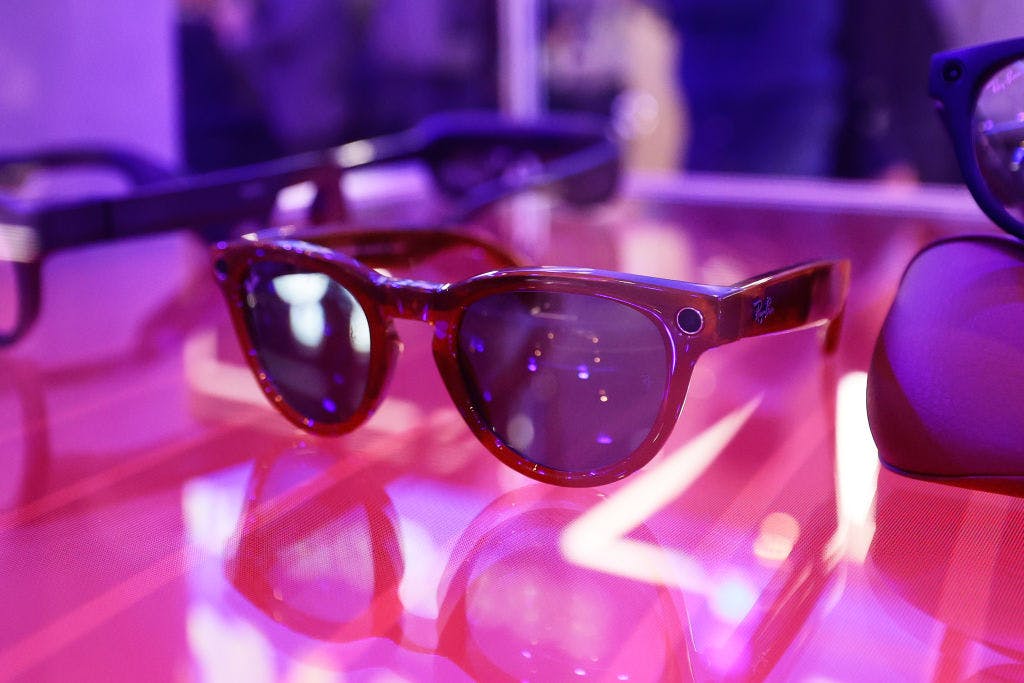
Meta Ray-Ban glasses (Getty Images)

Will Meta’s latest collab with Ray-Ban finally bring smart glasses into the mainstream?

No — because they will cost at least $1,000.

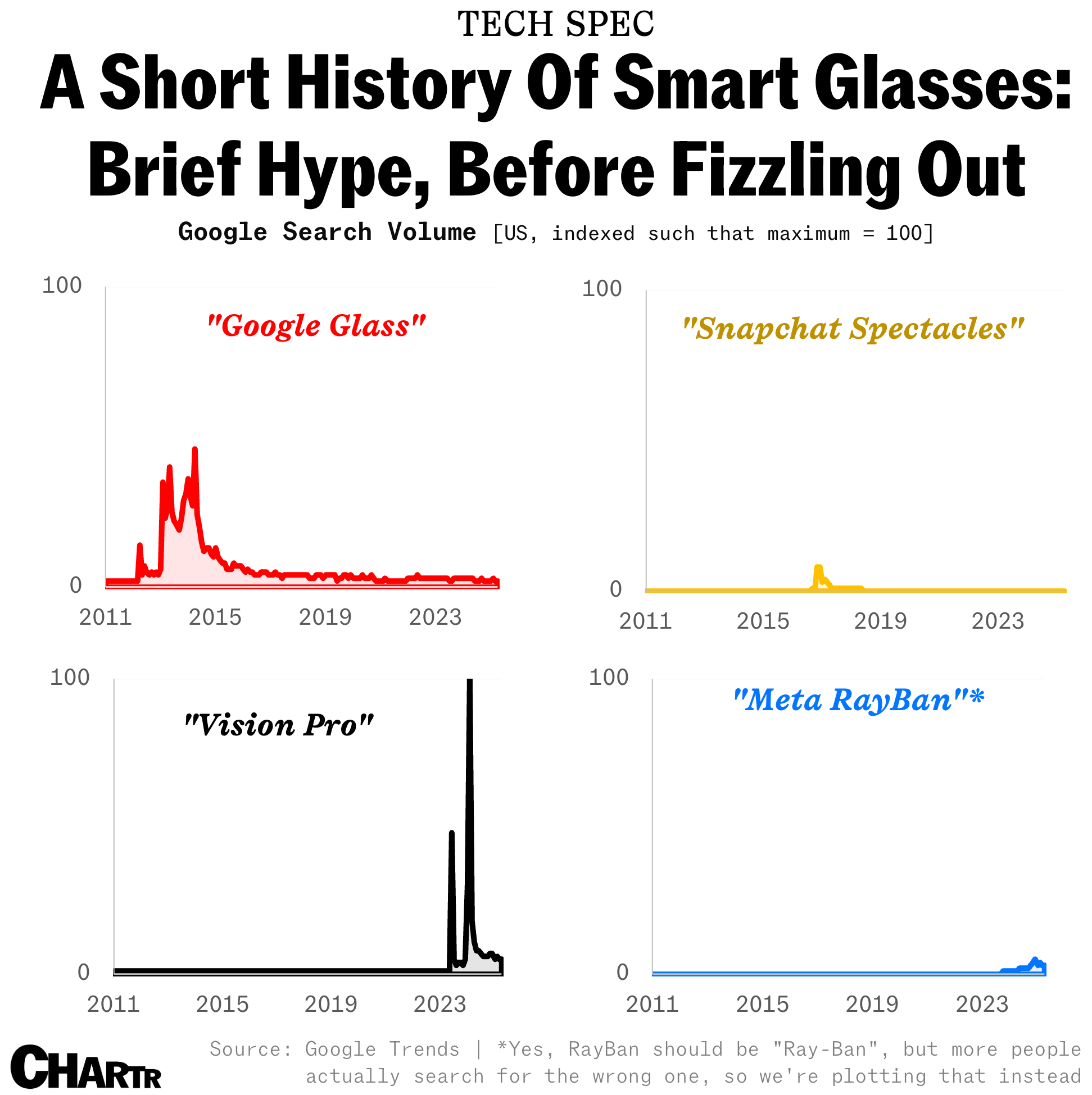
For years, tech companies have been trying to sell us on the idea of putting technology into stuff to put on our face. But historically, the hype for products like smart glasses has been short-lived.

First came Google, with its “Glass” product proving all the way back in 2012 that people mostly wanted glasses to help them see. Then came the small spark of Snapchat’s Spectacles, a product whose first iteration ended up costing the company millions but since evolved into one that a tech reviewer called “amazing. And extremely goofy.” More recently, we’ve had efforts from Apple and Meta.
Smart glasses history
Sherwood News

Apple’s take on the concept has been more about full immersion. But demand for its bulky VR/AR $3,500 Vision Pro has been disappointing, with unconfirmed reports in January that the company may not have just slowed but actually entirely ceased production of its headset.

Despite a litany of cautionary tales before it, Meta’s boss, Mark Zuckerberg, isn’t giving up on the category just yet, with the social media giant on track to introduce a deluxe version of its popular Ray-Ban Meta Glasses, per Bloomberg. With a price point expected to be north of $1,000 and the ability to run apps, display photos, and control the device using hand gestures, the glasses are designed to build on the modest success of Meta’s cheaper Ray-Ban glasses, which reportedly sold over a million units last year.

For now, Meta’s glasses business is still a cash drain for the company, with the company’s total losses from its VR and AR business topping more than $60 billion since 2020.

More Tech

See all Tech
tech

Meta reportedly strikes multibillion-dollar AI chip deal with Google as it struggles to design its own

Meta has signed a deal with Google to rent tensor processing units to develop new AI models and is in talks to buy the chips for its data centers, The Information reports.

The agreement comes on top of a recently announced “multi-generational” partnership with Nvidia and a chip supply deal with Advanced Micro Devices that could be worth more than $100 billion, as Meta scrapped its most advanced in-house AI training chip amid design challenges.

A Meta deal with Google, which has been rumored since November, would position the search giant more directly as a competitor to Nvidia in its core business of AI processors. Some analysts have said selling its custom chips to outside customers could become a business worth hundreds of billions of dollars for Google.

A Meta deal with Google, which has been rumored since November, would position the search giant more directly as a competitor to Nvidia in its core business of AI processors. Some analysts have said selling its custom chips to outside customers could become a business worth hundreds of billions of dollars for Google.

tech
Jon Keegan

Delays in permitting, power, and zoning cause first drop in data center construction since 2020

Despite incredible demand, the number of data centers under construction in North America fell for the first time since 2020, according to new research from CBRE.

Total data center capacity under construction dropped about 5.6% year on year from 6.35 megawatts in 2024 to 5.99 megawatts by the end of 2025.

What’s causing the delay? Slow permitting, constrained supply chains, and growing public engagement with how deals are approved at the local level. Labor constraints also were cited in the report; a tight supply of skilled workers will increase costs.

What’s causing the delay? Slow permitting, constrained supply chains, and growing public engagement with how deals are approved at the local level. Labor constraints also were cited in the report; a tight supply of skilled workers will increase costs.

-13%📱
Rani Molla

Smartphone shipments are expected to decline 13% — the biggest drop ever — to 1.12 billion in 2026, according to new data from IDC, as the memory shortage drives up costs and prices for phones. The firm expects the average smartphone selling price to jump 14% to a record $523 this year.

The shortfall will mostly affect makers of lower-end smartphones, whose customers are more cost-conscious, while higher-end manufacturers like Samsung and Apple are likely to be more insulated from the pressure.

“The memory crisis will cause more than a temporary decline; it marks a structural reset of the entire market, fundamentally reshaping long‑term TAM (Total Addressable Market), the vendor landscape, and the product mix,” said Nabila Popal, senior research director with IDCs Worldwide Quarterly Mobile Phone Tracker. “We expect consolidation as smaller players exit, and low-end vendors to face sharp shipment declines amid supply constraints and lower demand at higher price points.”

tech
Jon Keegan

Google drops new Nano Banana

Google is hoping to recapture the viral boost it received when it released its Nano Banana image generation model. Nano Banana 2 arrives today, which Google has rolled into its Gemini app.

The new model promises more accurate text rendering and translation and “advanced world knowledge,” which “pulls from Gemini’s real-world knowledge base, and is powered by real-time information and images from web search to more accurately render specific subjects,” according to the company’s press release.

New creative controls let users keep groups of characters consistent across scenes, render images with higher resolution, and parse complex prompts.

The first version of Nano Banana became popular for making action figures out of users, and helped catapult the Gemini AI app to the top of the charts, bumping ChatGPT from its perch.

New creative controls let users keep groups of characters consistent across scenes, render images with higher resolution, and parse complex prompts.

The first version of Nano Banana became popular for making action figures out of users, and helped catapult the Gemini AI app to the top of the charts, bumping ChatGPT from its perch.

tech
Rani Molla

Tesla’s ride-hailing service is looking a lot more like Uber’s than Waymo’s

Despite numerous promises about amassing a giant network of driverless cars, so far it seems like Tesla’s Robotaxis are a lot more similar to Uber’s plain old ride-hailing service than Waymo’s expanding autonomous fleet.

In California, where Tesla has its largest ride-hailing service, the company has taken no formal steps to gain approval for a truly driverless car service, according to Reuters. Throughout 2025, Tesla failed to log a single mile of autonomous test driving on state roads, and has not applied for the necessary permits to test or deploy vehicles without a human present. Currently, Tesla holds only a basic permit that requires a human safety monitor to remain in the driver’s seat at all times.

Currently, Tesla’s California Robotaxi service consists of roughly 300 Teslas operated by human drivers using the company’s supervised Full Self-Driving tech. In Austin, where the company has about 45 vehicles, Tesla made a big show earlier this year of announcing it was removing the safety monitors sitting in the front seats during rides. However, to date, only a handful of those vehicles have been reported to be actually operating without a safety monitor onboard.

In other words, it’s performing a service more akin to a tech-heavy Uber ride than the one operated by Alphabet subsidiary Waymo, which earlier this week announced it now has driverless rides available to the public in 10 markets. Even Uber is trying to put space between itself and the old driver-having Ubers of yore: this week its autonomous software partner said the company plans to launch a driverless service in London this year, with plans for 10 markets.

During its earnings report last month, Tesla said it planned to offer Robotaxi service in a half dozen new cities in the first half of this year, including Phoenix, Miami, and Las Vegas. Judging by Tesla’s progress so far, it’s likely those services will also feature a human in the front seat.

In California, where Tesla has its largest ride-hailing service, the company has taken no formal steps to gain approval for a truly driverless car service, according to Reuters. Throughout 2025, Tesla failed to log a single mile of autonomous test driving on state roads, and has not applied for the necessary permits to test or deploy vehicles without a human present. Currently, Tesla holds only a basic permit that requires a human safety monitor to remain in the driver’s seat at all times.

Currently, Tesla’s California Robotaxi service consists of roughly 300 Teslas operated by human drivers using the company’s supervised Full Self-Driving tech. In Austin, where the company has about 45 vehicles, Tesla made a big show earlier this year of announcing it was removing the safety monitors sitting in the front seats during rides. However, to date, only a handful of those vehicles have been reported to be actually operating without a safety monitor onboard.

In other words, it’s performing a service more akin to a tech-heavy Uber ride than the one operated by Alphabet subsidiary Waymo, which earlier this week announced it now has driverless rides available to the public in 10 markets. Even Uber is trying to put space between itself and the old driver-having Ubers of yore: this week its autonomous software partner said the company plans to launch a driverless service in London this year, with plans for 10 markets.

During its earnings report last month, Tesla said it planned to offer Robotaxi service in a half dozen new cities in the first half of this year, including Phoenix, Miami, and Las Vegas. Judging by Tesla’s progress so far, it’s likely those services will also feature a human in the front seat.

Latest Stories

Sherwood Media, LLC produces fresh and unique perspectives on topical financial news and is a fully owned subsidiary of Robinhood Markets, Inc., and any views expressed here do not necessarily reflect the views of any other Robinhood affiliate, including Robinhood Markets, Inc., Robinhood Financial LLC, Robinhood Securities, LLC, Robinhood Crypto, LLC, or Robinhood Money, LLC.