


Big Tech is pivoting to nuclear energy. Will the rest of the world follow?
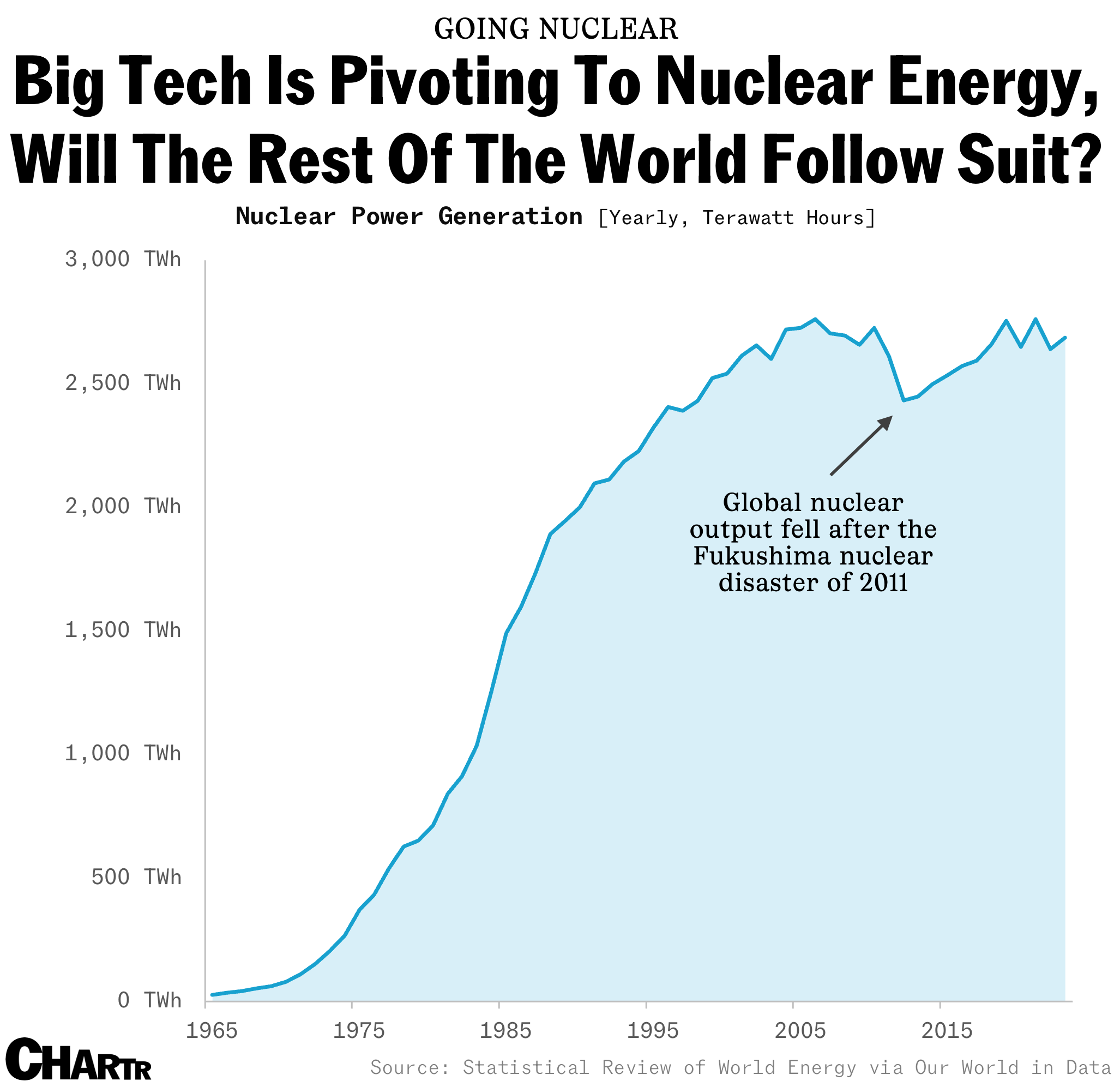
Global nuclear output has stagnated for much of the 21st century.
Big Tech is going big on nuclear, with Amazon becoming the newest addition to the club with a $500 million deal, joining Microsoft, Google, and Oracle by investing in nuclear projects to support surging data center energy demand.
With powerful advances in generative AI, the US has become the fastest-growing market for data centers, according to McKinsey, which forecasts demand to more than triple by 2030 to 80 gigawatts. The boom has sent stock prices of nuclear energy companies soaring, briefly making utilities the best-performing sector of the S&P 500 Index this year.
Going nuclear
As commercial nuclear power plants went global in the 1970s and ’80s, you’d have been forgiven for forecasting that nuclear output would’ve continued to grow, but globally it has plateaued for much of the 21st century, with disasters like Fukushima diminishing the appetite for new reactors.
Now companies like Amazon and Google are turning to nuclear for its reliability and scale. Unlike wind and solar, nuclear power generates clean energy around the clock, and a single nuclear plant provides energy equivalent to having millions of solar panels, offering the gigawatts of power required for AI data centers and simultaneously fulfilling Big Tech’s ambitious green promises.
But Big Tech isn’t building giant nuclear power plants; instead, it’s turning to what are known as small modular reactors, which need less space, are cheaper, and can be deployed incrementally to meet rising electricity demand, according to the IAEA.
In the US there was essentially a halt in new facility constructions for more than 30 years, until 2013. The question now is whether Big Tech’s leadership will kickstart a new age for nuclear. Pointing to renewed attention following the growing demand from AI, Mohamed Al Hammadi, head of the Emirates Nuclear Energy Corp., said, “We have witnessed a step change in momentum across the nuclear sector.”
Related reading: America’s 54 nuclear power plants, mapped.


