
World
Protests Against Mass Tourism Take Place In Spain And Portugal
An antitourist protest in Lisbon, Portugal (Horacio Villalobos/Getty Images)

Europeans hit back against overtourism

Last summer, record numbers of tourists visited Europe’s top attractions. Now, many residents have had enough.

On Sunday, a string of planned overtourism protests took place across some of Europe’s most beloved tourist destinations — with locals in popular southern European cities and islands rallying against the swaths of summer travelers that descend on their neighborhoods.

As reported by The New York Times, residents in Barcelona sprayed tourists with water guns; protestors in Lisbon carried an effigy of the city’s patron saint to the planned site of a new hotel; people in Genoa rolled suitcases through the streets in what they called a noisy stroll.” One day later, staff at the Louvre, which sees ~20,000 people visit just the room where the Mona Lisa is kept every single day, went on an impromptu strike against overcrowding.

DEL-EU-GE

The protesters might have a point.

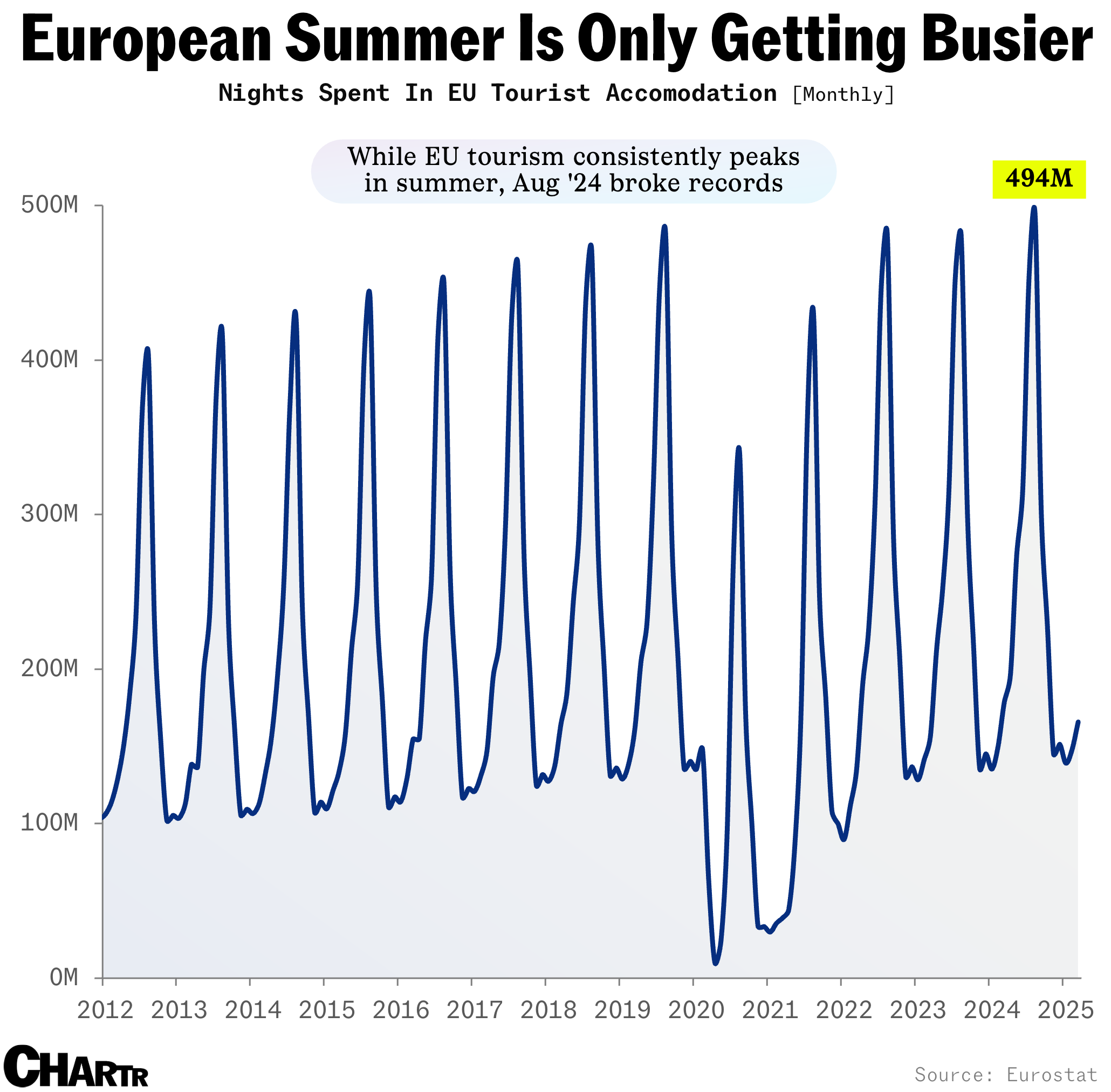
Indeed, Europe recorded ~747 million international tourist arrivals in 2024, per the UN, while data from Eurostat shows that last year was the biggest tourism summer on record for the EU, with August alone recording 494 million tourism nights, up 16% from the same month a decade prior. The countries that saw the highest number of nights spent in EU tourist accommodation were Spain (~500 million), Italy (~458 million), and France (~451 million).
European visitors
Sherwood News

In some of the most popular destinations, authorities are taking heed. Daytrippers to Venice now face higher tourism taxes, Greece is limiting visitor numbers to the Acropolis, and Spain continues to clamp down on unlicensed short-term accommodation rentals — much to Airbnb’s chagrin.

But will the protests be enough to deter Europhiles from visiting? Unlikely. Summer travel from the US to Europe is forecast to increase 10% this year.

More World

See all World
world

Google searches for “roman numerals” hit a new peak this Super Bowl

Following on from last year’s Super Bowl LIX, and Super Bowl LVIII before that, you’d be forgiven for thinking that the title “Super Bowl LX” might have created less confusion than previous iterations.

But it seems that the archaic notation denoting this year’s Big Game was no exception: monthly search volumes for “roman numerals” in the US were at the highest volume seen in over two decades this February, according to Google Trends data.

Roman numerals super bowl
Sherwood News

If people in shoulder pads throwing around a weirdly shaped ball is your Roman Empire, one thing you have to know is Roman numerals — or join the millions who turn to Google to work out how to read them every Super Bowl season.

Ironically, according to the NFL, the numbering system was adopted for clarity, as the game is played at the start of the year “following a chronologically recorded season.” And so, over its 60-year history, the NFL has labeled almost every Super Bowl with a selection of capital letters like X’s, I’s, and V’s — one of the rare exceptions being Super Bowl 50 in 2016, when the NFL ad designers felt Super Bowl L was too unmarketable.

At least stumped football fans in 2026 will be faring much better than those in the year 12,965 would be, who’d have to refer to the Big Game as Super Bowl (breathes in) MMMMMMMMMMDCCCCLXXXXVIIII.

Latest Stories

Sherwood Media, LLC produces fresh and unique perspectives on topical financial news and is a fully owned subsidiary of Robinhood Markets, Inc., and any views expressed here do not necessarily reflect the views of any other Robinhood affiliate, including Robinhood Markets, Inc., Robinhood Financial LLC, Robinhood Securities, LLC, Robinhood Crypto, LLC, or Robinhood Money, LLC.