
World
The Port of Los Angeles
(Allen J. Schaben/Getty Images)

Imports are about to collapse at America’s busiest port

A steep drop in the scheduled arrival of cargo ships is expected in the coming weeks.

This is like watching a car crash in slow motion.

President Trump’s 145% tariffs on Chinese imports to the US are still hurting businesses, though his stance on how long they’ll be in place may be softening.

Despite the chaotic tariff rollout, companies are turning off the China-to-US trade spigot. But like a garden hose that wraps halfway around the world, it takes some time before the water stops flowing on our end.

A typical cargo ship filled with goods manufactured in China needs two to three weeks to travel to the Port of Los Angeles. After a flurry of panicked pre-tariff imports to fill warehouses, we are about to see what it looks like when most imports from China stop arriving at US ports.
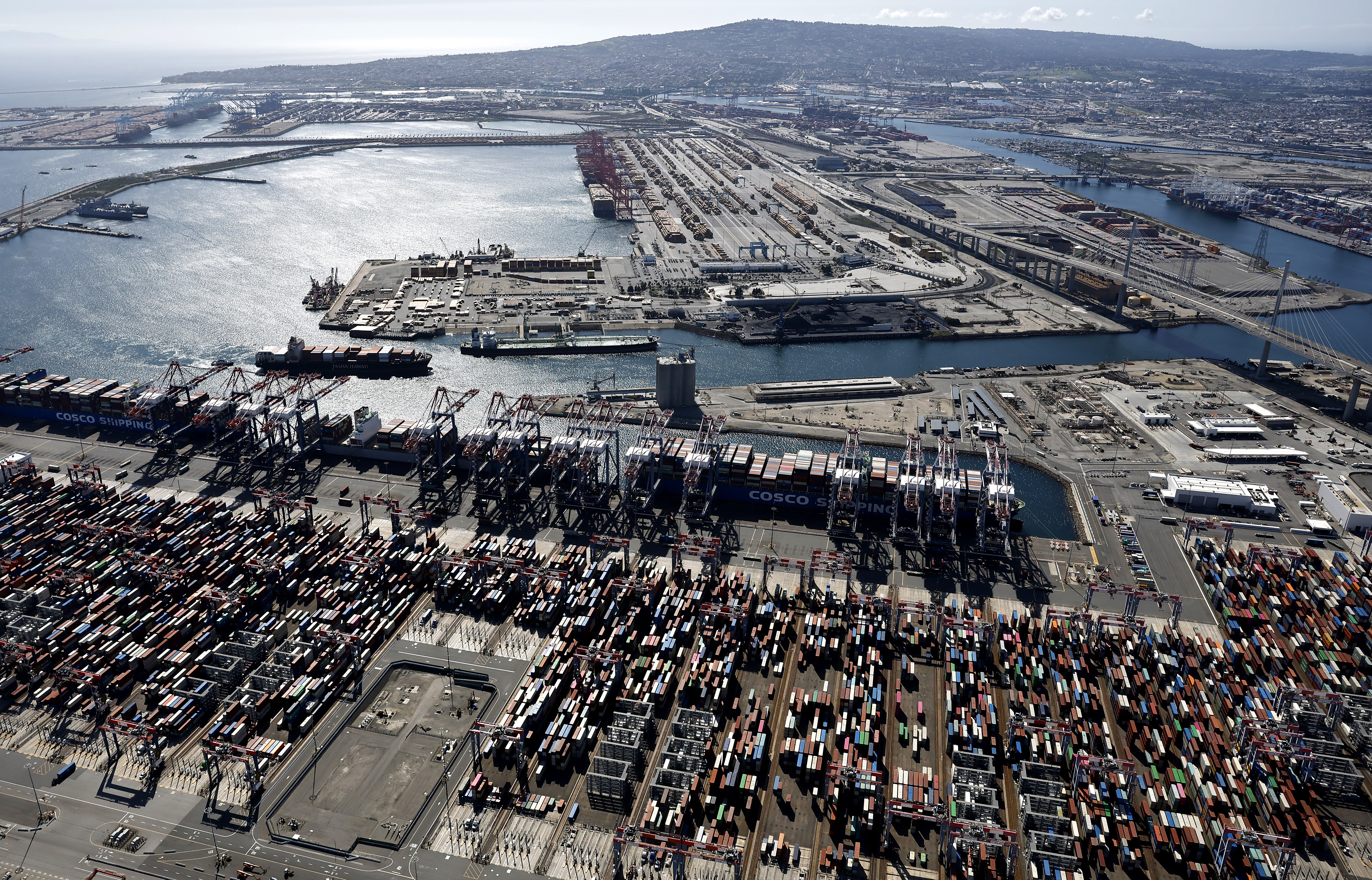
Aerial view of the Port of Los Angeles
Aerial view of the Port of Los Angeles (Mario Tama/Getty Images)

The Port of Los Angeles is the largest port in the US. Sitting on San Pedro Bay, the 7,500-acre facility sprawls across 43 miles of waterfront, filled with cargo and passenger terminals, warehouses, and rail- and truck-based cargo loading. According to the port, about 40% of the imports arriving there originate from China.

Gene Seroka, the executive director of the Port of Los Angeles, said in a recent briefing that the tariffs will pinch incoming shipments to the port.

“I expect we’ll see cargo decline in the second half of the year at least 10% compared to 2024,” he said.

Since the announcement of the tariffs, a surge of imports flowed into the port.

“Many importers have already brought their goods in early, and as prices begin to rise, consumers will think twice about many purchases,” Seroka said.

A recent Goldman Sachs research note said that US retailers are expecting a 20% to 30% drop in exports in Q2, which lines up with what Seroka said he was hearing from suppliers in China. “The reports I got out of China and Southeast Asia yesterday is that some really famous brands have put a pause on shipments for the time being,” he said.

In a few short weeks, significant drops are expected in the number of vessels arriving at the port. The week ending May 10 currently has only 12 vessels scheduled to arrive, a 44% drop from the same time last year.

The effects of such a slowdown will be significant, and will likely hurt the local economy. “Here in Los Angeles, tariffs will affect port related jobs, because as we know fewer containers mean fewer jobs here at the port,” Seroka said.

More World

See all World
world
Tom Jones

The UAE’s OPEC exit will hit the group in the barrels

After just shy of 60 years in OPEC, its membership even predating its status as a nation-state, the United Arab Emirates yesterday announced its shocking departure from the oil production group, effective May 1, as the knock-on effects of the Iran war continue to play out across the Middle East and the energy landscape.

For context, the UAE produces the third-highest amount of oil in the group, per April data and OPEC’s latest set of annual statistics.

According to the cartel’s 2025 Annual Statistical Bulletin, the OPEC group was collectively exporting some 19 million barrels of crude oil a day last year, with the United Arab Emirates accounting for some 14% of that daily output.

UAExit means UAExit

The nation, whose energy minister told Reuters yesterday that the decision was taken “after a careful look at current and future policies related to level of production” and wasn’t made following discussions with any other country, made up a healthy share of the group’s total confirmed crude oil reserves, as well.

OPEC exports chart
Sherwood News

Of the 12 nations in the core group, which was founded by just five oil superpowers back in September 1960, only two (Iraq and Saudi Arabia) exported more barrels of crude oil daily, pumping out 3.36 million and 6.05 million barrels, respectively, each day to nations around the world.

For its part, the UAE said it will “continue its responsible role by gradually and thoughtfully increasing production, in line with demand and market conditions,” per the official state news agency. Clearly, the nation now wants a little more control of just how much oil it can pump around the world, with the UAE having to eat a large proportion of lost revenues due to its healthy abundance and OPEC restrictions.

According to the cartel’s 2025 Annual Statistical Bulletin, the OPEC group was collectively exporting some 19 million barrels of crude oil a day last year, with the United Arab Emirates accounting for some 14% of that daily output.

UAExit means UAExit

The nation, whose energy minister told Reuters yesterday that the decision was taken “after a careful look at current and future policies related to level of production” and wasn’t made following discussions with any other country, made up a healthy share of the group’s total confirmed crude oil reserves, as well.

OPEC exports chart
Sherwood News

Of the 12 nations in the core group, which was founded by just five oil superpowers back in September 1960, only two (Iraq and Saudi Arabia) exported more barrels of crude oil daily, pumping out 3.36 million and 6.05 million barrels, respectively, each day to nations around the world.

For its part, the UAE said it will “continue its responsible role by gradually and thoughtfully increasing production, in line with demand and market conditions,” per the official state news agency. Clearly, the nation now wants a little more control of just how much oil it can pump around the world, with the UAE having to eat a large proportion of lost revenues due to its healthy abundance and OPEC restrictions.

Latest Stories

Sherwood Media, LLC produces fresh and unique perspectives on topical financial news and is a fully owned subsidiary of Robinhood Markets, Inc., and any views expressed here do not necessarily reflect the views of any other Robinhood affiliate, including Robinhood Markets, Inc., Robinhood Financial LLC, Robinhood Securities, LLC, Robinhood Crypto, LLC, Robinhood Derivatives, LLC, or Robinhood Money, LLC. Futures and event contracts are offered through Robinhood Derivatives, LLC.