Business
Bronzed: Germany overtakes Japan to become the 3rd largest global economy

Bronzed: Germany overtakes Japan to become the 3rd largest global economy

Pay a visit

Following the devastating wildfires seen across Hawaii last August, the island state is considering a new tourist tax to fund conservation and restoration projects in hard-hit regions such as Maui.

Gov. Josh Green proposed a $25 “climate impact fee” for vacationers in his second State of the State Address. The tariff is projected to bring in tens of millions a year — with half earmarked for disaster insurance to encourage investment in high-risk areas, as well as fire breaks to shield vulnerable communities.

Paradise lost

This isn’t the first time Hawaii has attempted to pass a similar bill: in April, lawmakers debated a $50 annual green fee that would grant visitors access to parks and beaches; however, that proposal failed in the final hours of a legislative session. Since then, last summer’s wildfires — the worst disaster in Hawaii state history — have caused an estimated $4-6 billion in economic losses, burning thousands of acres of land.

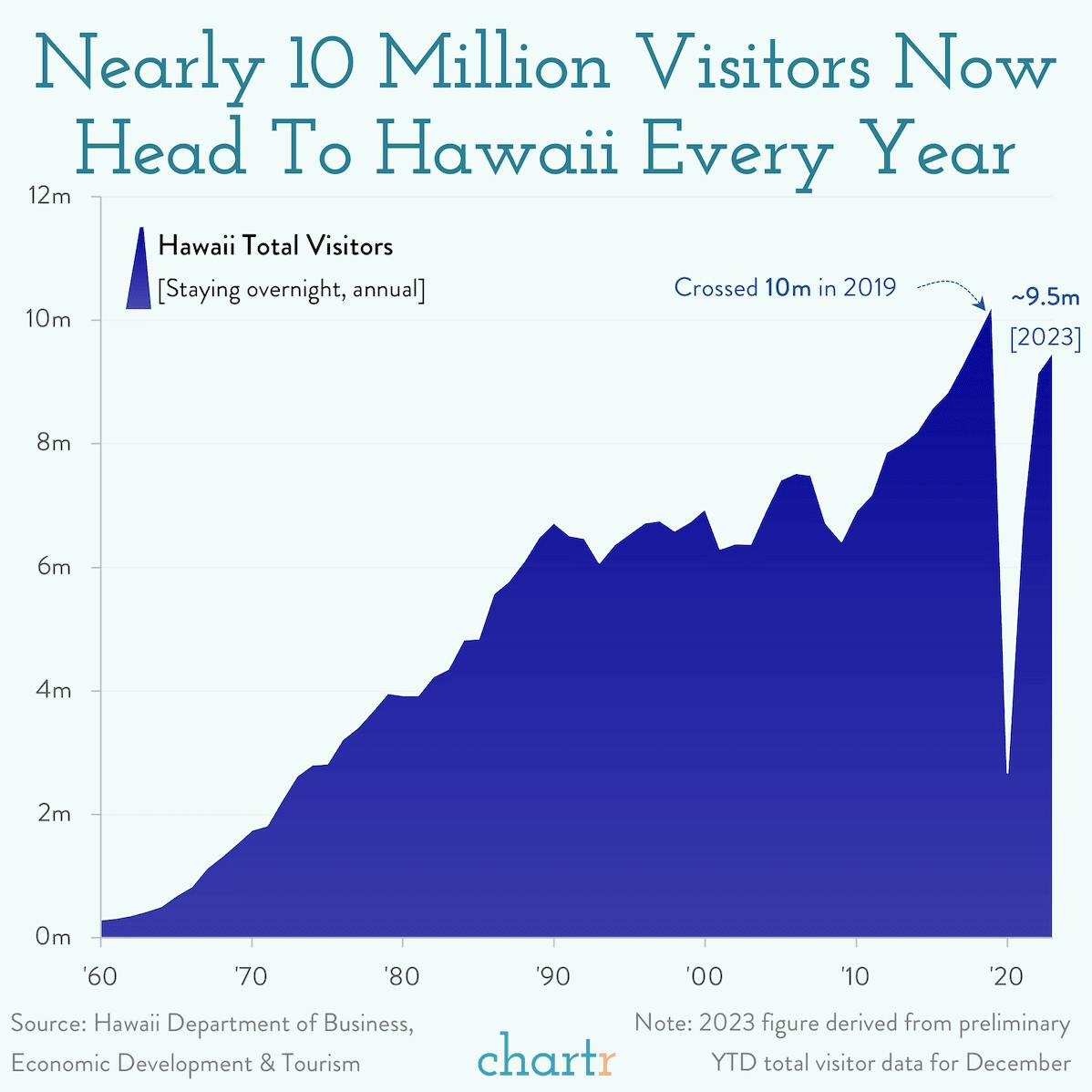
The urgency to protect Hawaii’s natural assets comes as tourist numbers have soared, recording around 10 million visitors in 2019, roughly 7x the state’s ~1.4 million residents. Although the vacationer count hasn’t quite recovered since the pandemic, the state’s reliance on tourism means that the loss of its renowned scenery comes with both ecological and economic consequences — in 2022, tourism was estimated to make up ~18% of Hawaii’s GDP.

Zooming out: Many tourist hotspots are enacting similar legislation: from this spring, Venice is charging a €5 day rate to mitigate damage; Bali recently introduced a $10 sustainability fee; and in Greece, which was also ravaged by wildfires in 2023, a “climate resilience fee” is now added onto lodging bills.

More Business

See all Business
Family Watching Baseball On Tv

Netflix and Disney+ probably only added ad-tier subscribers this year, says Morgan Stanley

As streaming prices climb, ad-free subscribers are becoming a rarity.

Aldi Grand Opening

Discount stores are having a moment in America, drawing high- and low-income consumers alike

Everyone loves a deal in 2025 — and Aldi, Walmart, and Dollar Tree are all cashing in.

Millie Giles12/17/25
business

Report: OpenAI won’t pay a dime in cash for its 3-year licensing deal for Disney IP

More financial details behind the landmark deal that will grant OpenAI three years of access to Disney intellectual property are coming out, and they’re pretty surprising.

The deal will reportedly see OpenAI pay zero dollars in licensing fees, instead compensating Disney in stock warrants. It was previously reported that Disney would invest $1 billion into OpenAI as part of the agreement.

It’s very abnormal for Disney to grant anyone access to its massive IP library without a cash payment, and the entertainment juggernaut has been known to strike down even crocheted Etsy Yodas for infringing on its turf. In its fiscal year 2025, Disney booked more than $10 billion in revenue from licensing fees across merchandising, television, and theatrical distribution.

It’s very abnormal for Disney to grant anyone access to its massive IP library without a cash payment, and the entertainment juggernaut has been known to strike down even crocheted Etsy Yodas for infringing on its turf. In its fiscal year 2025, Disney booked more than $10 billion in revenue from licensing fees across merchandising, television, and theatrical distribution.

business

Ford says it will take $19.5 billion in charges in a massive EV write-down

The EV business has marked a long stretch of losing for Ford, and today the automaker announced it will take $19.5 billion in charges tied, for the most part, to its EV division.

Ford said it’s launching a battery energy storage business, leveraging battery plants in Kentucky and Michigan to “provide solutions for energy infrastructure and growing data center demand.”

According to Ford, the changes will drive Ford’s electrified division to profitability by 2029. The company will stop making its electric F-150, the Lightning, and instead shift to an “extended-range electric vehicle” that includes a gas-powered generator.

The Detroit automaker also raised its adjusted earnings before interest and taxes outlook to “about $7 billion” from a range of $6 billion to $6.5 billion.

Ford’s write-down is one of the largest taken by a company as legacy automakers scale back on EVs, giving EV-only automakers a market share boost.

Latest Stories

Sherwood Media, LLC produces fresh and unique perspectives on topical financial news and is a fully owned subsidiary of Robinhood Markets, Inc., and any views expressed here do not necessarily reflect the views of any other Robinhood affiliate, including Robinhood Markets, Inc., Robinhood Financial LLC, Robinhood Securities, LLC, Robinhood Crypto, LLC, or Robinhood Money, LLC.