Business
Strive Pharmacy recently broke ground on a new facility in Mesa, Arizona. (Strive Pharmacy)
Strive Pharmacy recently broke ground on a new facility in Mesa, Arizona (Strive Pharmacy)

Before Hims’ GLP-1 pill fallout, its pharmacy partner was already drawing scrutiny from state regulators

Strive has already been probed over the timing of its GLP-1 compounding. Now, Arizona regulators are looking into complaints about ketamine misuse and improper distribution of prescription drugs.

Arizona state regulators had already raised concerns about the compounding practices of the pharmacy behind Hims & Hers’ short-lived copy of Novo Nordisk’s Wegovy pill. Now, state officials are looking into two complaints against the pharmacy, one involving alleged ketamine misuse.

Documents obtained by Sherwood News through public records requests show that Arizona regulators documented concerns about Strive Pharmacy’s compounding of GLP-1 weight-loss drugs as recently as September. The Arizona Board of Pharmacy is also taking up complaints alleging misuse of ketamine at its facilities and providing prescription drugs to a clinic that was selling them over the counter, according to pharmacy board proceedings this week.

State pharmacy boards police compounding pharmacies, whose products are often sold nationwide. Strive is one of the country’s largest compounders, providing GLP-1s for several telehealth companies, including Hims & Hers. The company recently broke ground on a new 350,000-square-foot compounding facility in Mesa, Arizona, to “meet growing demand.”

Records show the Arizona BOP found that Strive began compounding Eli Lilly and Novo Nordisk’s blockbuster weight-loss drugs before they were added to the Food and Drug Administration’s shortage list, and later flagged what appeared to be templated clinical rationales for prescriptions of compounded GLP-1s.

Outside of a drug shortage, compounding pharmacies are permitted to dispense patient-specific medications — such as customized dose sizes or doses with additives — when prescribed by a physician. Lilly and Novo have argued that telehealth companies and compounders are stretching that exemption to mass-produce cheaper copycat versions of their weight-loss drugs.

Lilly sued Strive last year, accusing it of false and deceptive online marketing. In January, Strive sued Lilly and Novo, alleging the drugmakers used exclusive telehealth deals and other tactics to squeeze compounding pharmacies out of the GLP-1 market.

Hims announced February 5 that it would sell compounded oral semaglutide, a product similar to Novo’s Wegovy pill launched weeks earlier. It stopped offering the product two days later after coming under scrutiny from the federal government, and is now also facing a patent infringement lawsuit from Novo Nordisk. Hims did not immediately respond to a request for comment for this story. 

Questions also arose about whether the Wegovy pill copy sold by Hims and made by Strive would work without Novo’s patented coating. Hims and Strive directed questions to information on Strive’s website describing its “liposomal technology.” The method has not been proven in clinical trials to be effective on humans. 

One of several now-deleted social media post from Strive Pharmacy the day Hims & Hers announced that it would offer a semaglutide pill. (Sherwood News)
One of several now deleted social media posts from Strive Pharmacy the day Hims & Hers announced that it would offer a semaglutide pill (Sherwood News)

Strive has since removed those pages and deleted related posts on X, saying the language was “being misunderstood” and that it is updating its descriptions. 

“Strive stands behind its solid-state lipid tablet formulation,” a spokesperson said in a statement to Sherwood.

GLP-1 compounding

In a February 2024 consent agreement, the Arizona BOP stated that Strive began compounding injectable semaglutide, the active ingredient in Novo’s Ozempic and Wegovy, in August 2021 — about seven months before the drugs were added to the FDA’s drug shortage list. Strive agreed to pay a $1,000 fine.

Strive told Sherwood the board did not discipline the company for the original allegation that it had improperly compounded a commercially available product. Instead, the company said the February 2024 consent agreement addressed a documentation issue identified during the inspection.
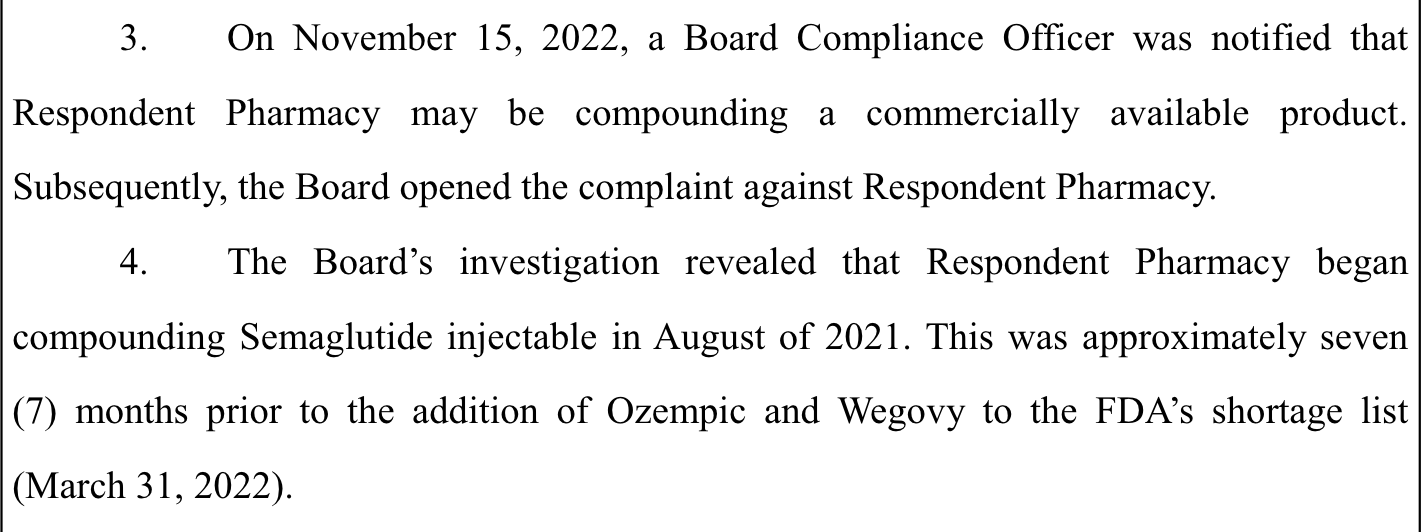
A February 7, 2024 consent agreement pertaining to Strive from the Arizona Board of Pharmacy. (Sherwood News)
A February 7, 2024, consent decree pertaining to Strive from the Arizona Board of Pharmacy (Sherwood News)

More recently, a September 4, 2025, inspection found that Strive continued to compound and dispense single-ingredient versions of semaglutide and tirzepatide (the key ingredient in Eli Lilly’s weight-loss shot) even after the federal shortage exemption period ended earlier that year.

Strive and Hims have maintained that their GLP-1 products are tailored to individual patients, which is allowed even when branded versions aren’t in a shortage. 

But an inspector wrote that Strive produced “large amounts of odd strengths/doses in anticipation of prescriptions.” They also wrote that different providers whose prescriptions were fulfilled by Strive used identical language to justify the compounding of what regulators described as “essential copies” of commercially available, FDA-approved GLP-1 drugs.
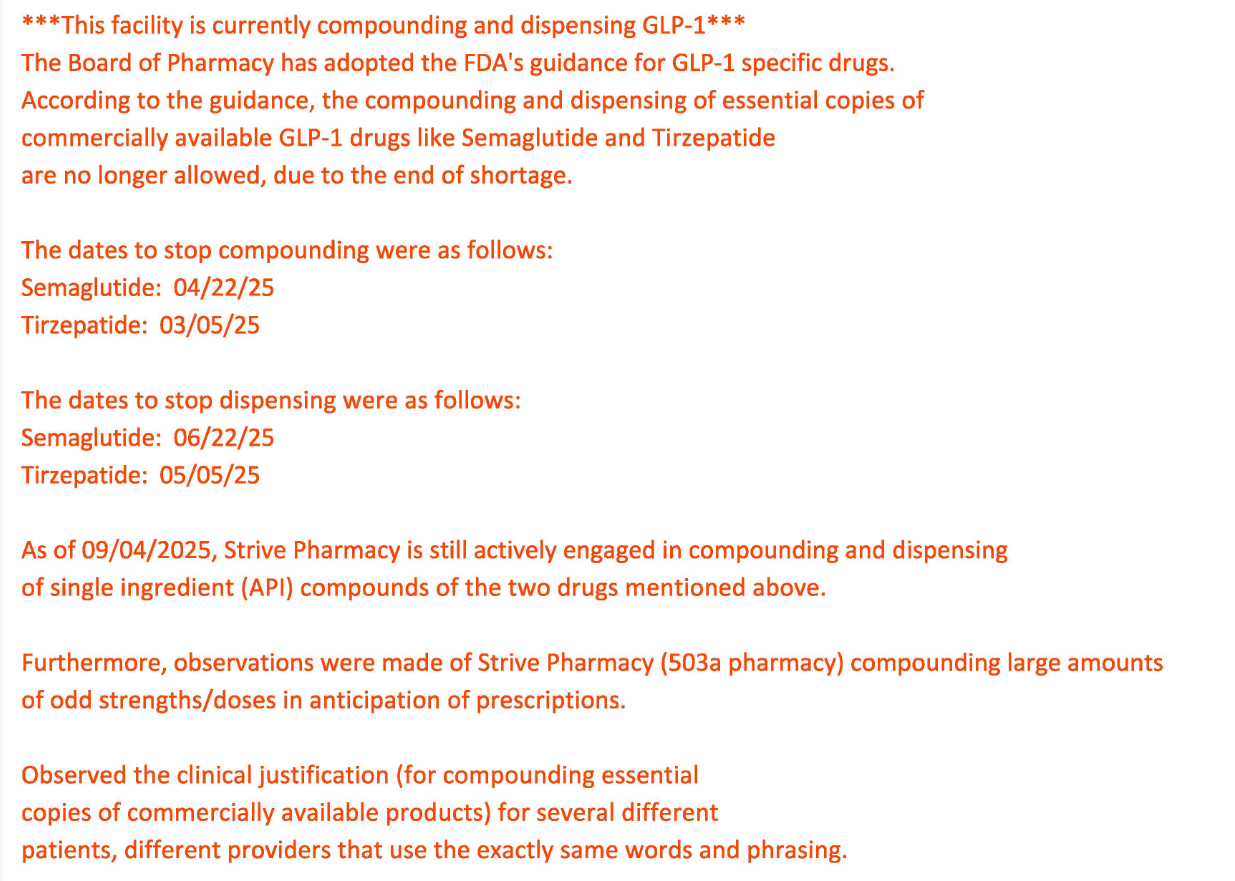
Notes from a September 4, 2025 inspection at Strive's Gilbert, Arizona facility. (Arizona Board of Pharmacy via Sherwood News)
Notes from a September 4, 2025, inspection at Strive’s Gilbert, Arizona, facility (Arizona Board of Pharmacy via Sherwood News)

Strive told Sherwood that it “respectfully disagrees with that characterization of Strive’s GLP-1 compounding activities in the September 4, 2025 inspection report and does not believe it accurately reflects Strive’s compliance with applicable guidance and compounding law.” 

“Strive has requested that the Board amend or update the report to correct the inaccuracies in the inspector’s notes,” a spokesperson said. 

New complaints

At a December 2 meeting, the Arizona BOP’s Complaint Review Committee voted to advance two complaints investigated by board staff alleging that Strive “inappropriately compounded and tested ketamine patches on an employee” and “knowingly provided prescription medication to a provider that was selling them over the counter.” 
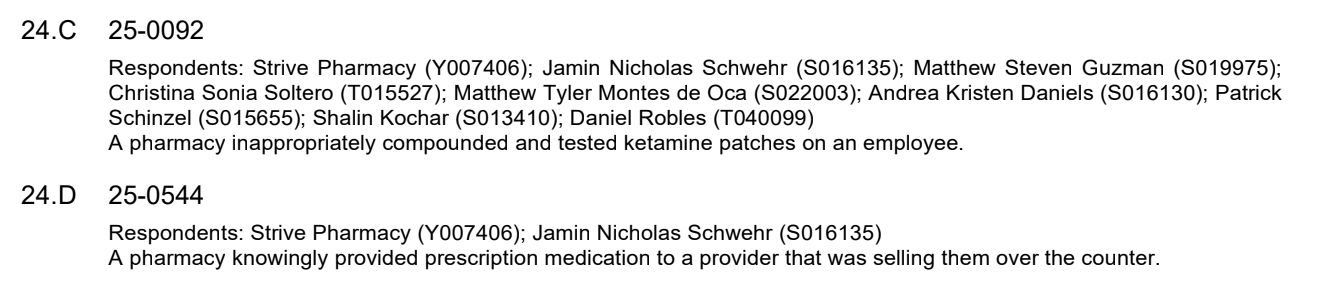
Agenda items for an Arizona Board of Pharmacy meeting. (Sherwood News)
Agenda items for an Arizona Board of Pharmacy meeting (Sherwood News)

Complaints are investigated by staff before the board votes on next steps. The board has not yet made findings in either case, and details of the complaints remain limited; the agency declined to release documents related to the complaints in response to a public records request. 

“Strive Pharmacy takes these allegations very seriously and is committed to fully cooperating with the AZ BOP to address these allegations,” the company said. 

At the live-streamed December 2 complaint review meeting, Stephanie Spark, a member of the board, said her briefing materials mentioned technicians were “leaving the ketamine patches in the office for others to use.” 

“It indicated to me that there’s something a lot more broader that’s going on,” she said. 

Arizona BOP Compliance Officer Max Jacobson told the board he believed senior leadership was involved, stating, “There’s no way this technician acted alone.”

At a full board meeting on Thursday, the board did not discuss that case, which is being jointly investigated with California officials, and voted to revisit it at a later meeting. 

Slimming Grace

The second complaint centers on allegations that Strive supplied prescription drugs to a weight-loss clinic, Slimming Grace, which was selling them over the counter rather than dispensing them to specific patients.

The complaint originated from a notification by the Arizona Attorney General’s Office, which later issued a notice warning of expired medications being sold at the clinic. (Strive said that it is not under investigation by the attorney general.)

Jacobson told the board on Thursday that Strive took 30 days to stop dispensing to Slimming Grace after being tipped off that it wasn’t selling the drugs to specific patients. Strive leadership, sitting with their attorneys, told the board its compliance department has grown and its policies have changed in the year since the incident. 

The board also voted to revisit this issue, saying they needed more information about how Strive’s sales team is compensated. The evidence discussed included a text from a Strive sales representative to Slimming Grace, acknowledging that the company’s compliance team called her about the issue the same day more than 80 prescriptions were sent. 

“I want to make sure there isn’t a culture inside of this organization to just get more sales when they could be knowingly breaking the law,” said Lorri Walmsley, president of the Arizona BOP. 

More Business

See all Business
business
Tom Jones

Prime Day is here again and Amazon’s subscription service has never been more popular

Well, it’s that time of year again: many have made their wish lists, people are scraping together the money they’ve saved to pick out a perfect gift, some are presumably leaving out refreshments for the weary delivery drivers and, more and more, drones.

It’s Amazon Prime Day — meaning that it’s the second day of the four-day promotional event that Amazon still calls Prime Day — of course, and it’s even come early this year, with the company bringing the period into late June from July, when it’s been traditionally held for the last five years.

The Prime Age

Alongside the eyes and endless clicks that the arbitrary stream of listicles on “The Best Prime Day Deals” that almost every media outlet pours into, Amazon will also be cheering the fact that there’s now more Prime users than ever before to devour the retailer and its sellers’ sometimes-contested “discounts.” Indeed, according to the latest annual estimates from Consumer Intelligence Research Partners (CIRP), there were just over 200 million American shoppers using Amazon’s massive subscription service at the end of 2025.

business

Electronic Arts launches a platform to put more ads in its games

Video game publishing giant EA launched a new platform on Monday designed to make the process of selling immersive ad space in its popular games easier.

The company says the platform, called EA Advertising, allows brands to “integrate directly into gameplay through dynamic, real-time placements, from stadium signage to custom in-game content.”

More so than other studios, EA has incorporated advertising into its most popular titles. As Kotaku points out, the company’s ad efforts stretch as far back as 2006. Several of its sports franchises already feature partnerships with brands like Visa, Lowe’s, Red Bull, and PepsiCo.

In-game advertising hasn’t exactly been embraced by fans, but industry experts expect it to ramp up as companies seek more revenue to offset higher games budgets and surging memory costs. EA rival Take-Two has taken a different approach, with CEO Strauss Zelnick recently saying the company was “not at risk of doing brand partnerships” in the forthcoming “Grand Theft Auto VI,” and that ads in full-price games seems “unfair.”

The $55 billion deal to take EA private, led by Saudi Arabia’s Public Investment Fund, is set to close at the end of this month. Being the largest leveraged buyout in history, EA will likely look for more ways to boost revenue to cover interest payments.

More so than other studios, EA has incorporated advertising into its most popular titles. As Kotaku points out, the company’s ad efforts stretch as far back as 2006. Several of its sports franchises already feature partnerships with brands like Visa, Lowe’s, Red Bull, and PepsiCo.

In-game advertising hasn’t exactly been embraced by fans, but industry experts expect it to ramp up as companies seek more revenue to offset higher games budgets and surging memory costs. EA rival Take-Two has taken a different approach, with CEO Strauss Zelnick recently saying the company was “not at risk of doing brand partnerships” in the forthcoming “Grand Theft Auto VI,” and that ads in full-price games seems “unfair.”

The $55 billion deal to take EA private, led by Saudi Arabia’s Public Investment Fund, is set to close at the end of this month. Being the largest leveraged buyout in history, EA will likely look for more ways to boost revenue to cover interest payments.

business

JM Smucker says it sold $1 billion worth of Uncrustables in FY2026

After years of booming sandwich sales, JM Smucker has finally earned a billion-dollar crust.

On Tuesday, the company reported results for fiscal year 2026, highlighting better-than-expected profits driven by higher prices for coffee and sweet baked goods. However, at another point on the earnings call, CEO Mark Smucker pointed to one particularly jammy figure: in line with previous forecasts, the company sold $1 billion worth of its (almost always) crustless sandwiches, Uncrustables, in the last year alone.

business

Paramount reportedly offers concessions to resolve multistate antitrust investigation

Paramount has reportedly offered up some concessions in an effort to prevent an antitrust lawsuit by California and about 10 other states, according to Bloomberg reporting on Monday.

Reuters first reported on the potential suit from a group of unnamed states last week, which could throw a wrench in Paramount’s plans to buy rival Warner Bros. Discovery in a Hollywood megamerger.

The list of concessions is unknown, though Bloomberg previously reported that Paramount is open to divesting some of its kids TV assets to appease EU regulators.

Late last month, reports said US regulators appeared likely to approve the $110 billion merger, following a meeting between Paramount CEO David Ellison and DOJ antitrust staffers.

The list of concessions is unknown, though Bloomberg previously reported that Paramount is open to divesting some of its kids TV assets to appease EU regulators.

Late last month, reports said US regulators appeared likely to approve the $110 billion merger, following a meeting between Paramount CEO David Ellison and DOJ antitrust staffers.

$98B ⛽

The IATA released its latest financial outlook for the airline industry over the weekend, forecasting a $98 billion jump in the sector’s collective fuel bill. The world’s largest trade group representing airlines expects the oil spike to halve profits by 49% from last year to $23 billion.

The group also expects profit margins to halve year over year, falling from 2025’s 4.2% to 2%. Still, revenue is expected to climb to $1.17 trillion from $1.07 trillion.

A surge in the cost of jet fuel has rocked US and global airlines this year, leading Delta Air Lines, United Airlines, American Airlines, Southwest Airlines, JetBlue, and others to raise fares and ancillary charges like bag fees. Low-cost carriers, which operate on smaller margins, have been squeezed the hardest, resulting in Spirit’s shutdown.

“It’s a tough year for all airlines, especially those whose balance sheets had not yet recovered from COVID. And, of course, for those operating in the Gulf,” said IATA Director General Willie Walsh, who added that demand is holding up and about half of passengers expect to spend more on travel this year. “That bodes well for a strong northern summer peak season. The big unknown is how long travelers and shippers can tolerate the higher costs of connectivity.”

Latest Stories

Sherwood Media, LLC and Chartr Limited produce fresh and unique perspectives on topical financial news and are fully owned subsidiaries of Robinhood Markets, Inc., and any views expressed here do not necessarily reflect the views of any other Robinhood affiliate, including Robinhood Markets, Inc., Robinhood Financial LLC, Robinhood Securities, LLC, Robinhood Crypto, LLC, Robinhood Money, LLC, Robinhood U.K. Ltd, Robinhood Derivatives, LLC, Robinhood Gold, LLC, Robinhood Asset Management, LLC, Robinhood Credit, Inc., Robinhood Ventures DE, LLC and, where applicable, its managed investment vehicles.