Business
Gap To Layoff Hundreds Of Corporate Employees During Latest Round Of Cutbacks
Getty Images

The Gap’s stock is soaring, back to where it was in 1998... and 2012, and 2017, and 2020, and 2024

After years of store closures and slumping sales, the ’90s mall staple may finally be finding its footing.

The Y2K mall brand might be cool again — at least on Wall Street.

Yesterday, Gap reported operating profits for its fiscal year 2024 of $1.1 billion, up more than 80% on last year’s efforts, sending its shares up 13% in trading this morning.

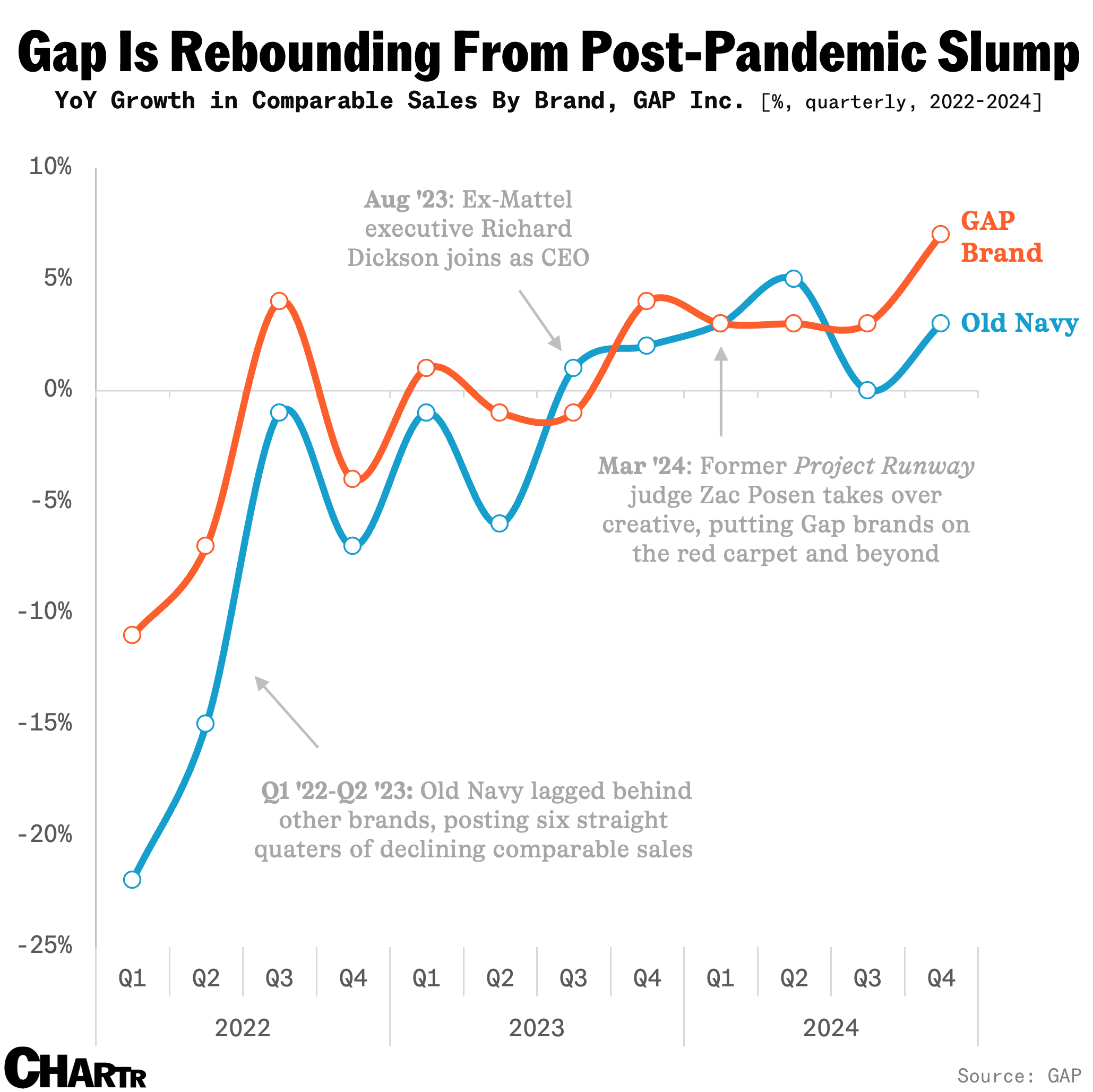
It’s a sharp turnaround for the iconic but often struggling American retailer, which shrunk its footprint by closing over 340 stores and cutting 2,300 corporate jobs since 2020. At the heart of Gap’s struggles was Old Navy, which is actually the company’s largest brand, accounting for 56% of its sales. The label has lagged in recent years — first by being slow to pivot away from the pandemic-era comfort wear, then stumbling on an ambitious inclusive sizing rollout that left stores overloaded with XXLs and XSs while running out of core medium sizes, per the WSJ.

Sales were consistently slipping until August 2023, when ex-Mattel exec Richard Dickson, the man behind Barbie’s revival, took the top job. Then came Zac Posen, the Project Runway-famous designer, as Gap’s creative director, bringing the ’90s fashion staple back into the spotlight — from celebrities gracing Met Gala red carpet in a Gap gown to Timothée Chalamet rocking Gap at an Oscars dinner.
GAP renaissance
Sherwood News

The results are starting to show: Old Navy just delivered one of its highest annual net sales ever, while the Gap brand posted a 7% jump in comparable sales, now “back in the cultural conversation,” Dickson said in yesterday’s earnings call.

Gap also isn’t sweating tariffs. According to the CFO, the company sources less than 10% from China and under 1% from Mexico and Canada combined.

Of course, even with Gap soaring this morning, the company’s stock remains stuck in the $10 to $30 range that it’s been in for much of the last three decades.

Go Deeper: Boom, bust, back from the dead: Why are mall retailers the most interesting stocks on the market?

More Business

See all Business
The entrance of Allbirds seen from Hayes St. in San Francisco, Calif.

Allbirds, the once buzzy multibillion-dollar sneaker startup, is selling up for $39 million

That’s less than 1% of its peak market cap about four years ago.

Tom Jones3/31/26
business

JetBlue is raising its bag fees as fuel costs squeeze airlines

JetBlue will reportedly hike its bag fees, as the cost of jet fuel continues to climb amid the war in Iran. It’s the latest example of carriers finding ways to push rising costs onto travelers.

Last week, United Airlines CEO Scott Kirby said that if fuel prices remain elevated, fares would need to rise another 20% for his airline to break even this year.

As CNBC reported, when one airline raises fees, others tend to follow.

Earlier this month, JetBlue hiked its first-quarter outlook for operating revenue per seat mile to between 5% and 7%, saying that strong Q1 demand helped “partially offset additional expenses realized from operational disruptions and rising fuel costs.” Now, the carrier appears to be making moves to further boost revenue to offset those costs.

Earlier on Monday, JetBlue rival Alaska Air lowered its Q1 profit forecast. The refining margins for the carrier’s cheapest fuel option — sourced from Singapore and representing about 20% of Alaska’s overall supply — have spiked 400% since February.

JetBlue did not immediately respond to a request for comment.

As CNBC reported, when one airline raises fees, others tend to follow.

Earlier this month, JetBlue hiked its first-quarter outlook for operating revenue per seat mile to between 5% and 7%, saying that strong Q1 demand helped “partially offset additional expenses realized from operational disruptions and rising fuel costs.” Now, the carrier appears to be making moves to further boost revenue to offset those costs.

Earlier on Monday, JetBlue rival Alaska Air lowered its Q1 profit forecast. The refining margins for the carrier’s cheapest fuel option — sourced from Singapore and representing about 20% of Alaska’s overall supply — have spiked 400% since February.

JetBlue did not immediately respond to a request for comment.

Latest Stories

Sherwood Media, LLC produces fresh and unique perspectives on topical financial news and is a fully owned subsidiary of Robinhood Markets, Inc., and any views expressed here do not necessarily reflect the views of any other Robinhood affiliate, including Robinhood Markets, Inc., Robinhood Financial LLC, Robinhood Securities, LLC, Robinhood Crypto, LLC, Robinhood Derivatives, LLC, or Robinhood Money, LLC. Futures and event contracts are offered through Robinhood Derivatives, LLC.