
Business
This is a hot topic

IT’S A MALL WORLD AFTER ALL

Mall header gif
(James Nielsen, Ricardo Dearatanha, Bill Pugliano, Kathryn Osler, Lisa Hornak via Getty Images)

Boom, bust, back from the dead: Why are mall retailers the most interesting stocks on the market?

Malls defined a generation. Those mall rats grew up. Guess what stocks they’re buying.

Over the years, writers have spilled pages of ink discussing the decline of the American mall. Yes, the mall of yore has been kneecapped — 228 malls in the US have closed their doors since the turn of the century, leaving 1,141 still surviving today, according to analytics firm Green Street Advisors. Many of the buildings have been abandoned, repurposed or even bulldozed. 

But sometimes the parts are worth more than the whole. The concept of malls may be worn out, but even in 2024, malls live on in our consciousness, in our behaviors, and in our brokerage accounts. Whether they’ve gone up or down, mall companies have some of the most interesting stock-market stories to tell, ranging from GameStop to American Eagle to Barnes & Noble to Crocs. 

So we decided to pick up a few of our friends, grab lunch at Panda Express, and head to the escalator for a fun tour through the most interesting companies in mall lore. So get in loser, we’re going shopping.

Smells like teen spirit

Back in 2005, Abercrombie & Fitch was at the top of teen retail, with its signature distressed denim and iconic moose-emblem polos and sweaters. Alongside its Cali-based sister brand Hollister, Abercrombie posted double-digit sales growth, bringing in $2.7 billion that year. 

Abercrombie wasn’t just selling clothes — it was selling a lifestyle. Shirtless models with washboard abs greeted shoppers at the door, dimly lit stores blasted pop hits, and its signature fragrance created an air of exclusivity. 

But by the mid-2010s, Abercrombie was on the verge of obscurity. Sales tanked as backlash grew over its exclusionary advertising and hiring practices. Lawsuits piled up over allegations of racial and size discrimination and its strict employee “look policy.”

In 2005, American Eagle was flying high, hitting over $2 billion in annual revenue for the first time as teens flocked to its signature knits and jeans. But the real game-changer came in 2006 with the launch of Aerie, its intimates brand. Targeting the 15- to 25-year-old crowd, Aerie became a trailblazer for body positivity, ditching the airbrushed look of competitors like Victoria’s Secret in favor of celebrating real bodies — stretch marks, scars, and all.

Today, American Eagle is still a cornerstone of mall fashion, consistently ranking among the top brand picks for teens over the past five years. The brand has embraced digital innovation to keep pace with its tech-savvy, younger audience, from launching augmented reality try-on tools to investing in fulfillment centers for super-fast delivery.

Department stores retool

Department stores have long been the anchor of American malls — and conveniently the best spot to park your car. But with more retailers in the mix and the rise of online shopping and speedy delivery options, the legacy brands have struggled to return to their Y2K glory days. 

Shares of Macy’s, Nordstrom, and Kohl’s (the only notable department stores that are still publicly traded) have lost over half their value since the peak 2000s. In fact, major department store chains now make up less than half of mall anchors today.

The food court was an unexpected brand incubator

Malls’ food courts weren’t just the spot to grab an oily slice of Sbarro. They were also an important brand incubator for companies like Chick-fil-A, Auntie Anne’s, and Orange Julius.

Check out our full feature on how brands evolved out of the mall food court, written by restaurant guru Adam Chandler.
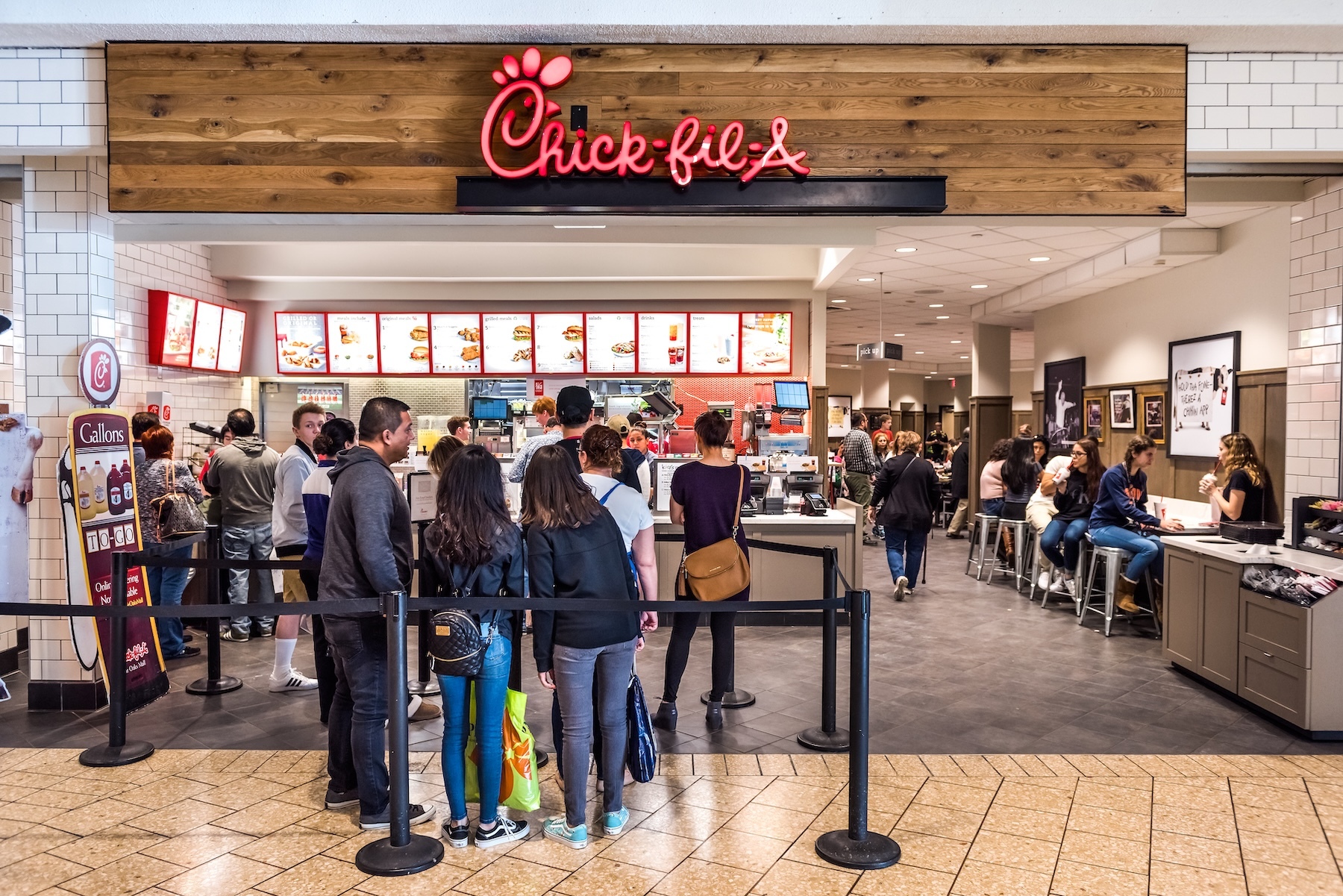
Chick Fil A in mainbar
People line up for Chick-fil-A (Shutterstock)

Bookstores found themselves in a bind

Once a prime spot to grab a coffee, couch, and the latest bestseller, mall bookstores were a staple of the ’90s and 2000s shopping experience. For years, Barnes & Noble and Borders dominated the space, offering sprawling stores filled with books, music, and DVDs (remember those?). By 2000, the book retailers had over 1,200 combined locations across the US, becoming go-to destinations for both book lovers and casual shoppers.

But as bookstores thrived in the physical world, the digital age was quickly catching up. In 2007, Amazon made waves by launching its e-reader, the Kindle, allowing readers to carry entire libraries in the palm of their hand. It sold out less than six hours after its debut. Two years later, Barnes & Noble launched its own e-reader, the Nook, hoping to grab a slice of the market. But despite a strong debut, the Nook couldn’t overtake the Kindle’s dominance. 

The future of malls

Mall closures are expected to continue for the foreseeable future, but the pace has slowed significantly in recent years. Some will sit abandoned and slowly decay, others will undoubtedly get bulldozed, and some will actually get turned into something useful. See our feature “What can you do with an abandoned mall?” written by John Kell.

Competition from e-commerce also continues to heat up, estimated to grow at double the rate of brick and mortar in the coming years. Despite this, a new wave of shoppers are bringing the mall back to life. According to a recent ICSC survey, 60% of Gen Z say that even if they don’t need to shop, they still like to hit up malls to hang with friends and socialize.

Meanwhile, overall visits to indoor malls have jumped nearly 9% since last year. Bolder predictions suggest that in coming years we could see a hybrid mall transformation, with more AR/VR-enhanced shopping experiences, immersive beauty salons, medical centers, and fitness zones.

With retailers continuously reinventing ways to bridge the digital and physical shopping gap, the future of malls could still be bright — even if it looks different than the past.

Nate Becker and Luke Kawa contributed to this article.

More Business

See all Business
business
Tom Jones

Prime Day is here again and Amazon’s subscription service has never been more popular

Well, it’s that time of year again: many have made their wish lists, people are scraping together the money they’ve saved to pick out a perfect gift, some are presumably leaving out refreshments for the weary delivery drivers and, more and more, drones.

It’s Amazon Prime Day — meaning that it’s the second day of the four-day promotional event that Amazon still calls Prime Day — of course, and it’s even come early this year, with the company bringing the period into late June from July, when it’s been traditionally held for the last five years.

The Prime Age

Alongside the eyes and endless clicks that the arbitrary stream of listicles on “The Best Prime Day Deals” that almost every media outlet pours into, Amazon will also be cheering the fact that there’s now more Prime users than ever before to devour the retailer and its sellers’ sometimes-contested “discounts.” Indeed, according to the latest annual estimates from Consumer Intelligence Research Partners (CIRP), there were just over 200 million American shoppers using Amazon’s massive subscription service at the end of 2025.

business

Electronic Arts launches a platform to put more ads in its games

Video game publishing giant EA launched a new platform on Monday designed to make the process of selling immersive ad space in its popular games easier.

The company says the platform, called EA Advertising, allows brands to “integrate directly into gameplay through dynamic, real-time placements, from stadium signage to custom in-game content.”

More so than other studios, EA has incorporated advertising into its most popular titles. As Kotaku points out, the company’s ad efforts stretch as far back as 2006. Several of its sports franchises already feature partnerships with brands like Visa, Lowe’s, Red Bull, and PepsiCo.

In-game advertising hasn’t exactly been embraced by fans, but industry experts expect it to ramp up as companies seek more revenue to offset higher games budgets and surging memory costs. EA rival Take-Two has taken a different approach, with CEO Strauss Zelnick recently saying the company was “not at risk of doing brand partnerships” in the forthcoming “Grand Theft Auto VI,” and that ads in full-price games seems “unfair.”

The $55 billion deal to take EA private, led by Saudi Arabia’s Public Investment Fund, is set to close at the end of this month. Being the largest leveraged buyout in history, EA will likely look for more ways to boost revenue to cover interest payments.

More so than other studios, EA has incorporated advertising into its most popular titles. As Kotaku points out, the company’s ad efforts stretch as far back as 2006. Several of its sports franchises already feature partnerships with brands like Visa, Lowe’s, Red Bull, and PepsiCo.

In-game advertising hasn’t exactly been embraced by fans, but industry experts expect it to ramp up as companies seek more revenue to offset higher games budgets and surging memory costs. EA rival Take-Two has taken a different approach, with CEO Strauss Zelnick recently saying the company was “not at risk of doing brand partnerships” in the forthcoming “Grand Theft Auto VI,” and that ads in full-price games seems “unfair.”

The $55 billion deal to take EA private, led by Saudi Arabia’s Public Investment Fund, is set to close at the end of this month. Being the largest leveraged buyout in history, EA will likely look for more ways to boost revenue to cover interest payments.

business

JM Smucker says it sold $1 billion worth of Uncrustables in FY2026

After years of booming sandwich sales, JM Smucker has finally earned a billion-dollar crust.

On Tuesday, the company reported results for fiscal year 2026, highlighting better-than-expected profits driven by higher prices for coffee and sweet baked goods. However, at another point on the earnings call, CEO Mark Smucker pointed to one particularly jammy figure: in line with previous forecasts, the company sold $1 billion worth of its (almost always) crustless sandwiches, Uncrustables, in the last year alone.

business

Paramount reportedly offers concessions to resolve multistate antitrust investigation

Paramount has reportedly offered up some concessions in an effort to prevent an antitrust lawsuit by California and about 10 other states, according to Bloomberg reporting on Monday.

Reuters first reported on the potential suit from a group of unnamed states last week, which could throw a wrench in Paramount’s plans to buy rival Warner Bros. Discovery in a Hollywood megamerger.

The list of concessions is unknown, though Bloomberg previously reported that Paramount is open to divesting some of its kids TV assets to appease EU regulators.

Late last month, reports said US regulators appeared likely to approve the $110 billion merger, following a meeting between Paramount CEO David Ellison and DOJ antitrust staffers.

The list of concessions is unknown, though Bloomberg previously reported that Paramount is open to divesting some of its kids TV assets to appease EU regulators.

Late last month, reports said US regulators appeared likely to approve the $110 billion merger, following a meeting between Paramount CEO David Ellison and DOJ antitrust staffers.

$98B ⛽

The IATA released its latest financial outlook for the airline industry over the weekend, forecasting a $98 billion jump in the sector’s collective fuel bill. The world’s largest trade group representing airlines expects the oil spike to halve profits by 49% from last year to $23 billion.

The group also expects profit margins to halve year over year, falling from 2025’s 4.2% to 2%. Still, revenue is expected to climb to $1.17 trillion from $1.07 trillion.

A surge in the cost of jet fuel has rocked US and global airlines this year, leading Delta Air Lines, United Airlines, American Airlines, Southwest Airlines, JetBlue, and others to raise fares and ancillary charges like bag fees. Low-cost carriers, which operate on smaller margins, have been squeezed the hardest, resulting in Spirit’s shutdown.

“It’s a tough year for all airlines, especially those whose balance sheets had not yet recovered from COVID. And, of course, for those operating in the Gulf,” said IATA Director General Willie Walsh, who added that demand is holding up and about half of passengers expect to spend more on travel this year. “That bodes well for a strong northern summer peak season. The big unknown is how long travelers and shippers can tolerate the higher costs of connectivity.”

Latest Stories

Sherwood Media, LLC and Chartr Limited produce fresh and unique perspectives on topical financial news and are fully owned subsidiaries of Robinhood Markets, Inc., and any views expressed here do not necessarily reflect the views of any other Robinhood affiliate, including Robinhood Markets, Inc., Robinhood Financial LLC, Robinhood Securities, LLC, Robinhood Crypto, LLC, Robinhood Money, LLC, Robinhood U.K. Ltd, Robinhood Derivatives, LLC, Robinhood Gold, LLC, Robinhood Asset Management, LLC, Robinhood Credit, Inc., Robinhood Ventures DE, LLC and, where applicable, its managed investment vehicles.
