


Magnum, the world’s largest ice cream maker, just went public at a ~$9.2 billion valuation
Unilever’s newly spun-off ice cream arm says its business is far from “volatile” and that GLP-1s may dent demand less than feared.
Ice cream may be the ultimate summer treat, but Magnum, the world’s largest ice cream maker, which went public today, is trying to convince investors that it’s not a fair-weather business.
On Monday, shares of The Magnum Ice Cream Company — which was spun off from Unilever and is home to Magnum, Ben & Jerry’s, Cornetto, and more — opened at €12.20 in Amsterdam, valuing it at around €7.9 billion ($9.2 billion), slightly below analysts’ expectations. The stock also began trading in London, with a New York listing to follow.
The ice cream business had been its parent company’s least profitable unit for years, dragged down by high cold-chain costs (tied to over 3 million freezers globally) and its weather-dependent nature, with even a one-degree temperature rise “substantially” impacting sales forecasts.
Yet according to Magnum execs, that seasonality doesn’t necessarily make its business volatile — and they might have a point: while sales do see a boost in warmer months, the seasonal revenue splits are pretty predictable.
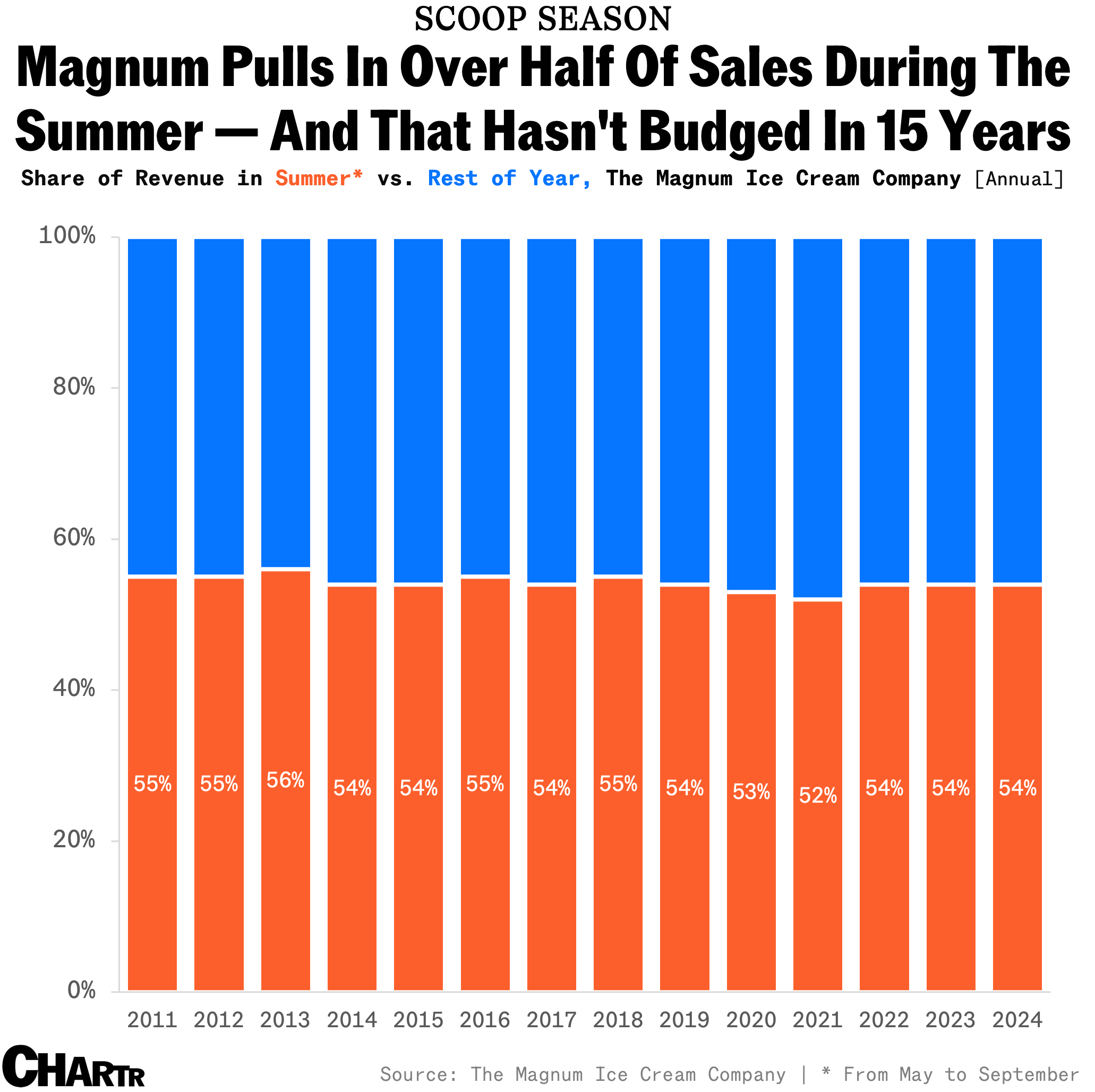
Over the past 15 years, more than half of the division’s annual sales have consistently come between May and September, the company recently disclosed at its Capital Markets Day — while from 2019 to 2024, its second-quarter revenues actually showed less growth volatility than several beverage peers.
Sundae scaries
Still, the bigger question is how the ice cream giant will grow in a world where Americans are eating less ice cream than ever and GLP-1 drugs are reshaping their appetite. Magnum said its internal modeling shows rising US GLP-1 use would, at worst, trim ice cream volumes by just ~0.5% — though the company is doubling down on “premiumization” to counter the trend. That includes portion-controlled formats, such as bite-sized Bon Bons or Ben & Jerry’s expansion from pints to stick products, as well as high-protein, low-calorie offerings through brands like Yasso.
Now free from the need to fit into a conglomerate that juggles Dove soap, Hellmann’s mayo, and household cleaning products, the pure-play ice cream business aims to grow revenues 3% to 5% annually from 2026 — thanks to an operating model built with “people who wake up and go to bed only thinking about ice cream,” in the words of CEO Peter ter Kulve.



