The owner of Ben & Jerry’s and Magnum is ditching its sweetest business as America falls out of love with ice cream
Unilever’s entire ice cream empire is being scooped up and spun off.
We haven’t ditched our Sunday sundaes, weeknight binges with Ben & Jerry’s, or our Monday Magnums entirely, but the data is irrefutable: America is eating less ice cream. And consumer giants like British powerhouse Unilever are well aware.
The conglomerate’s foray into frozen treats dates back to the 1920s, when it began selling ice cream to offset its slumping sausage sales in the summer. What started as a seasonal side hustle laid the foundation for what would become the world’s largest ice cream manufacturer, with Unilever now responsible for roughly 20% of the licks and scoops of the global market.
But that’s a title it won’t hold for much longer.
After decades of dominating freezer aisles, Unilever is planning to part ways with its $8.7 billion ice cream empire, home to Magnum, Wall’s, and Ben & Jerry’s.
The breakup comes as Unilever undergoes a major upheaval of its own. Hein Schumacher, the CEO who spearheaded the ice cream spin-off deal, was abruptly ousted last month after just 20 months on the job, reportedly for failing to turn the struggling company around fast enough.
But even without the man who orchestrated the split, the plan seems to be moving forward: after a lackluster Q4 earnings release, Unilever confirmed that its ice cream business will be a stand-alone company, headquartered in Amsterdam with secondary listings in New York and London.
So, why is Unilever walking away from this multibillion-dollar unit packed with household name brands? For starters, it might not want to swim against the tide in its largest market, the US.
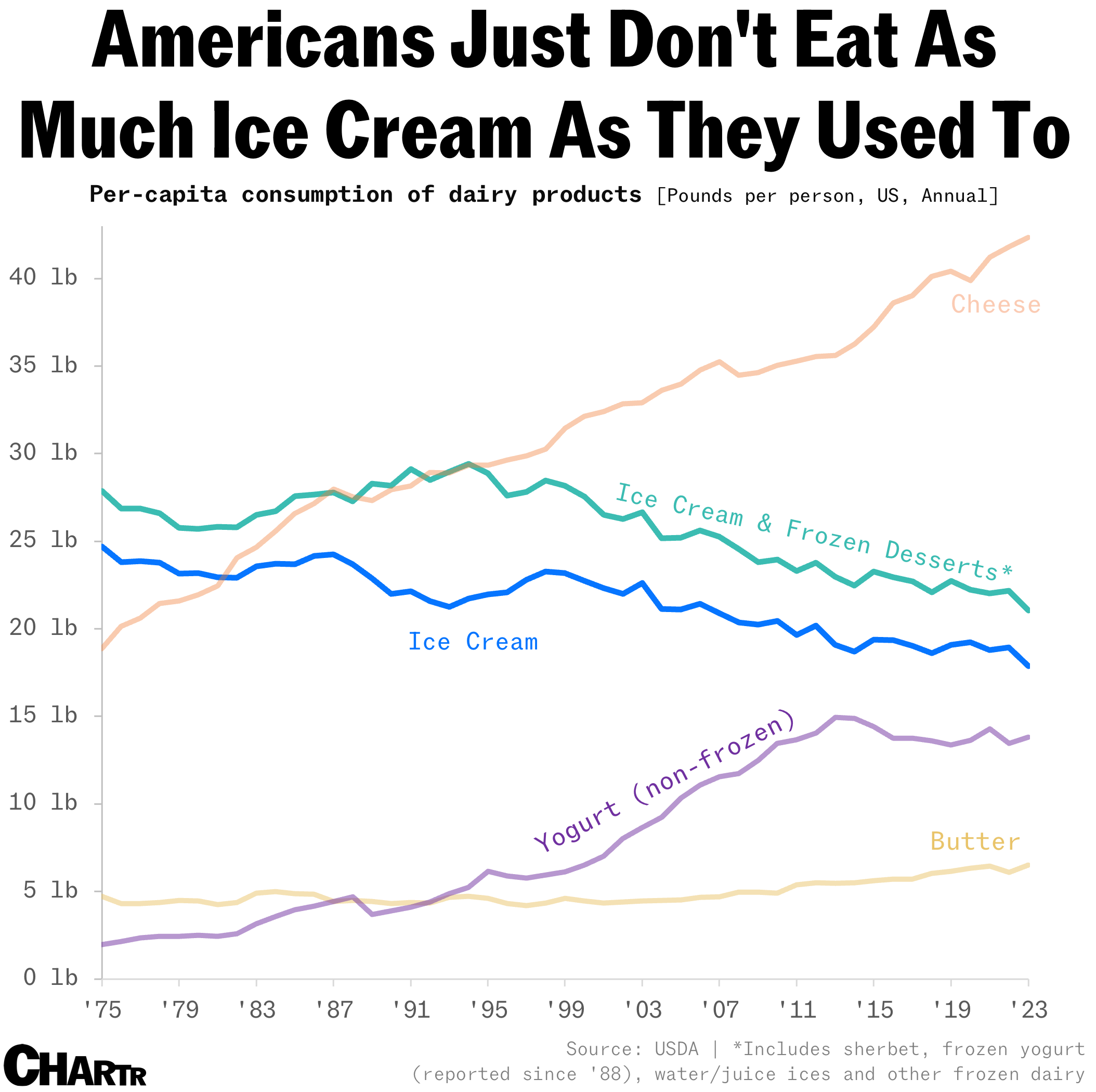
According to data from the US Department of Agriculture, per-capita consumption of ice cream and frozen desserts has been shrinking for nearly 50 years.
Interestingly, this decline lines up with a drop in caloric sweetener consumption, which has fallen ~20% over the past two decades — a sign that Americans are becoming more calorie conscious, cutting back on indulgences, or opting for healthier alternatives. The yogurt scene has certainly boomed as ice cream has melted away.
More recently, of course, there is the Ozempic wave to contend with, ice cream’s newest — and potentially its biggest — threat yet. A 2024 Morgan Stanley study forecast that because of the growing use of GLP-1 medications (already taken by one in eight US adults as of last May), ice cream consumption could fall a further 5.3% by 2035, the largest expected decline among all food categories analyzed, including confections, soda, and alcohol.
The margin meltdown
Ice cream makes up 13% to 14% of Unilever’s revenue, but it’s been dragging down profits for years. While higher-margin segments like personal care (with brands like Dove) and foods (home to mayo giant Hellmann’s) have been more lucrative, ice cream has consistently posted the lowest — or second-lowest — underlying operating margin of all five product segments since 2019.
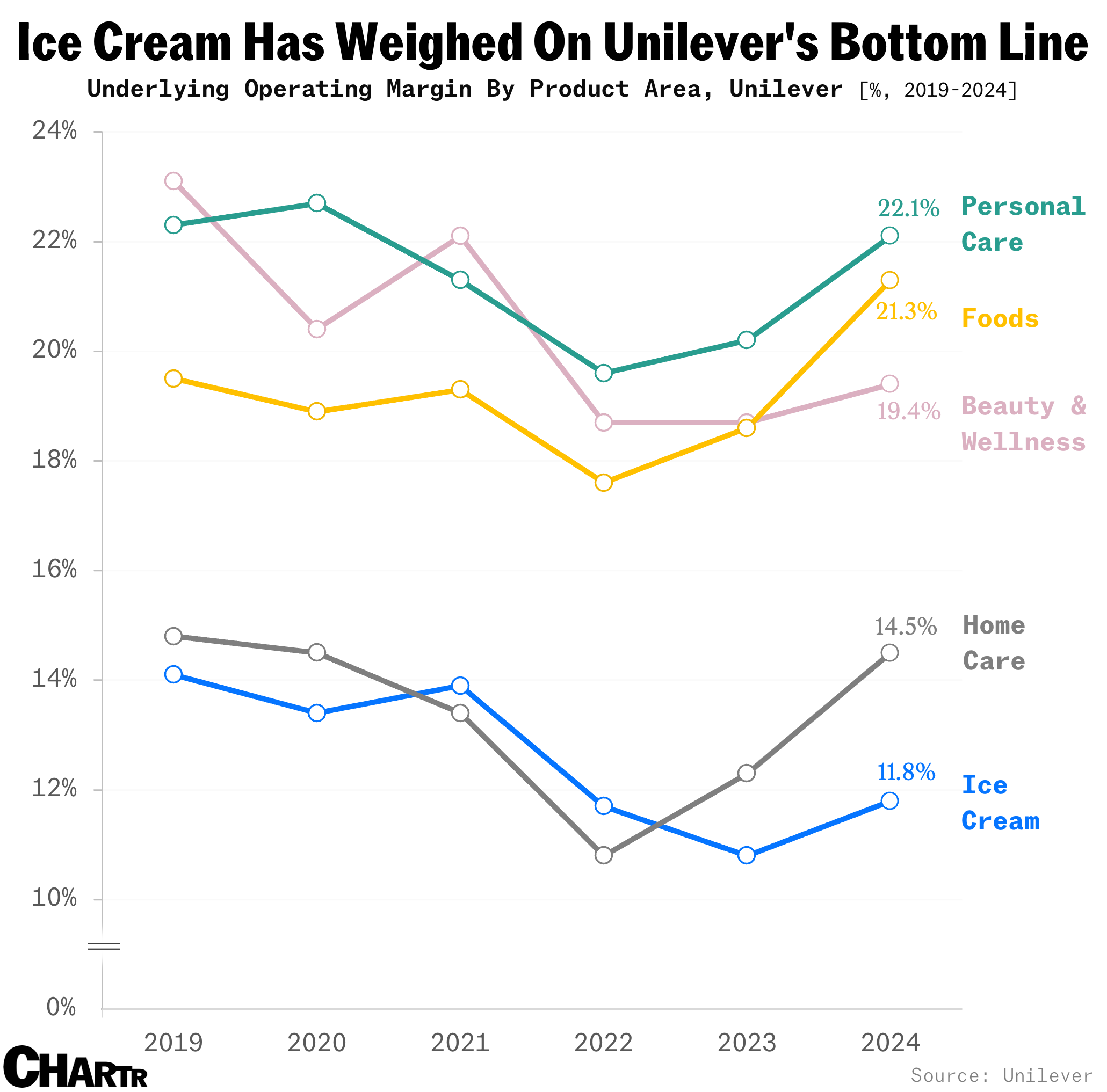
Of course, it isn’t hard to see why — running an ice cream business is expensive. Unilever operates over 3 million freezers in 60 countries, a massive fixed cost that only pays off if sales can keep up. But there’s a catch: ice cream is also brutally seasonal. As Schumacher once put it, “You make your money in five months a year,” with even a one-degree temperature swing throwing off sales projections.
Were sales strong enough to justify this scale? For a while, yes. During the pandemic, the company’s home delivery business boomed as cooped-up consumers loaded up on comfort food like never before. But once the lockdown era ended, demand took a different turn.
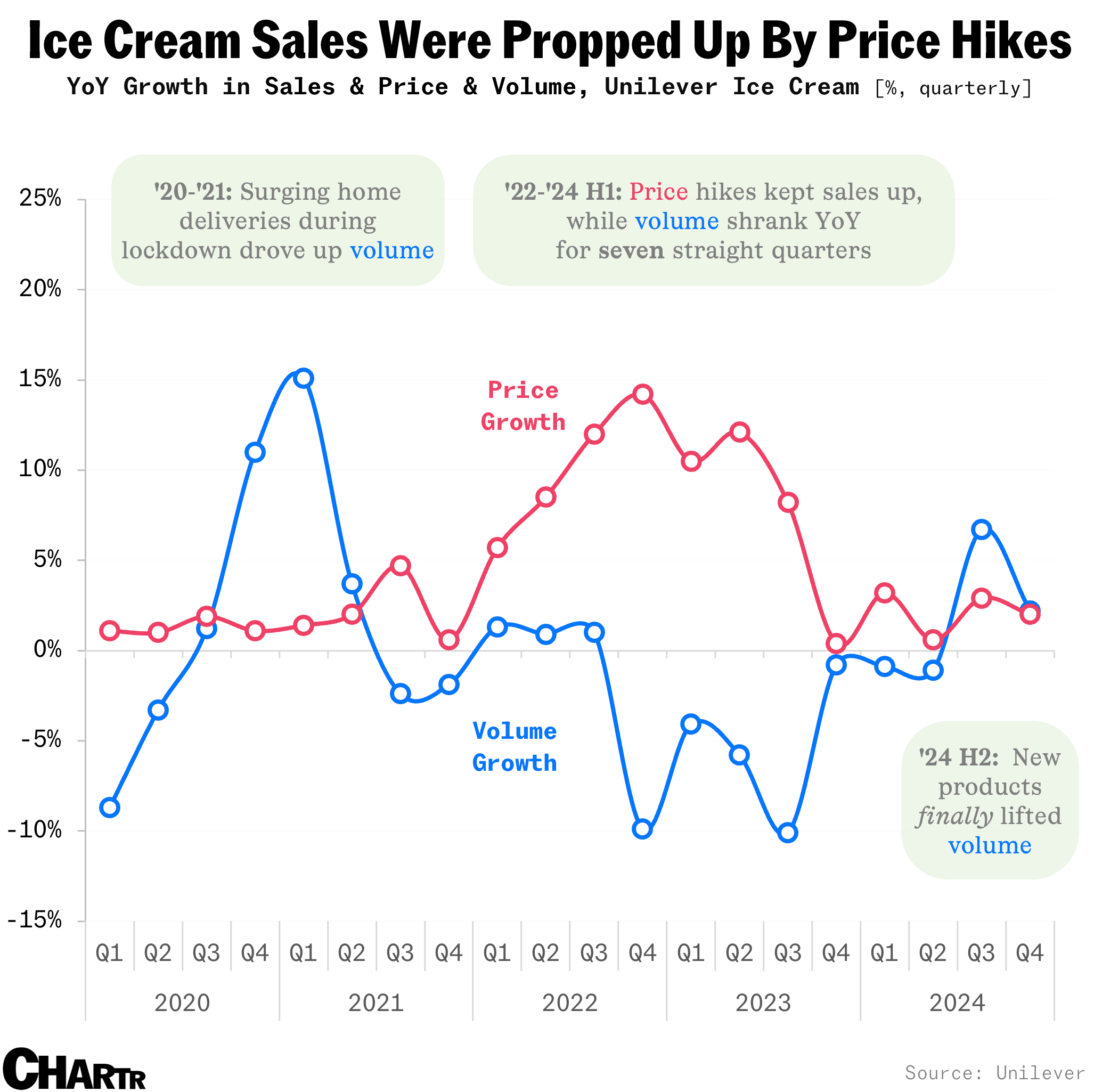
Since 2022, nearly all of Unilever’s ice cream revenue growth has been driven by price hikes, while the actual volume of ice cream sold declined year over year for seven consecutive quarters. The streak only broke in late 2024, when new product launches finally helped Unilever regain some lost ground.
With margins already tighter than its other divisions, Unilever was clearly keen to pass on price increases for key ingredients like dairy, cocoa, and sugar to consumers. But, with ice cream being the company’s “most discretionary category,” consumers weren’t willing to keep paying more. Sales tumbled in Europe and China, Unilever’s two key markets, as more shoppers cut back or traded down to cheaper private-label brands.
Furthermore, each region had its own challenges. China’s economic slowdown has driven people away from premium labels like Unilever’s Magnum — just look at the country’s booming $1 ice-cream-and-tea chain that now has more stores than McDonald’s worldwide. In Europe, extreme heat waves dented demand because, apparently, when it’s too hot, people opt for cold drinks over ice cream, Unilever’s CFO said.
But falling demand isn’t Unilever’s only headache.
Churn of events
Internally, Unilever executives have long clashed over corporate control and political messaging with Ben & Jerry’s, a brand known almost as much for its activism as for its iconic cookie-dough ice cream.
According to The Wall Street Journal, Ben & Jerry’s founders believe this tension may have played a role in the spin-off decision. When asked during a shareholder meeting last May whether the Ben & Jerry’s feud factored into the move, Schumacher didn’t fully address the question.
“We love Ben & Jerry’s. We think it’s a great brand,” he said, adding that Unilever has endorsed the brand’s social mission and the agreements set “at the time of the acquisition.” Ben & Jerry’s corporate website discusses issues that the company cares about, including “Social & Economic Justice” and “Environmental Protection, Restoration, & Regeneration,” and the company’s YouTube channel is similar:
Bought in 2000 for about $326 million, Ben & Jerry’s is run as an independent subsidiary, with sales hitting €1 billion ($1.1 billion) for the first time in 2021, per the company’s report. The brand also outpaced its parent’s broader ice cream sales growth in three of the past five years, the WSJ reported.
With Unilever looking to shed its ice cream business, Ben & Jerry’s founders are reportedly exploring ways to buy back their namesake company.
Meanwhile, outside competition is also heating up in the space.
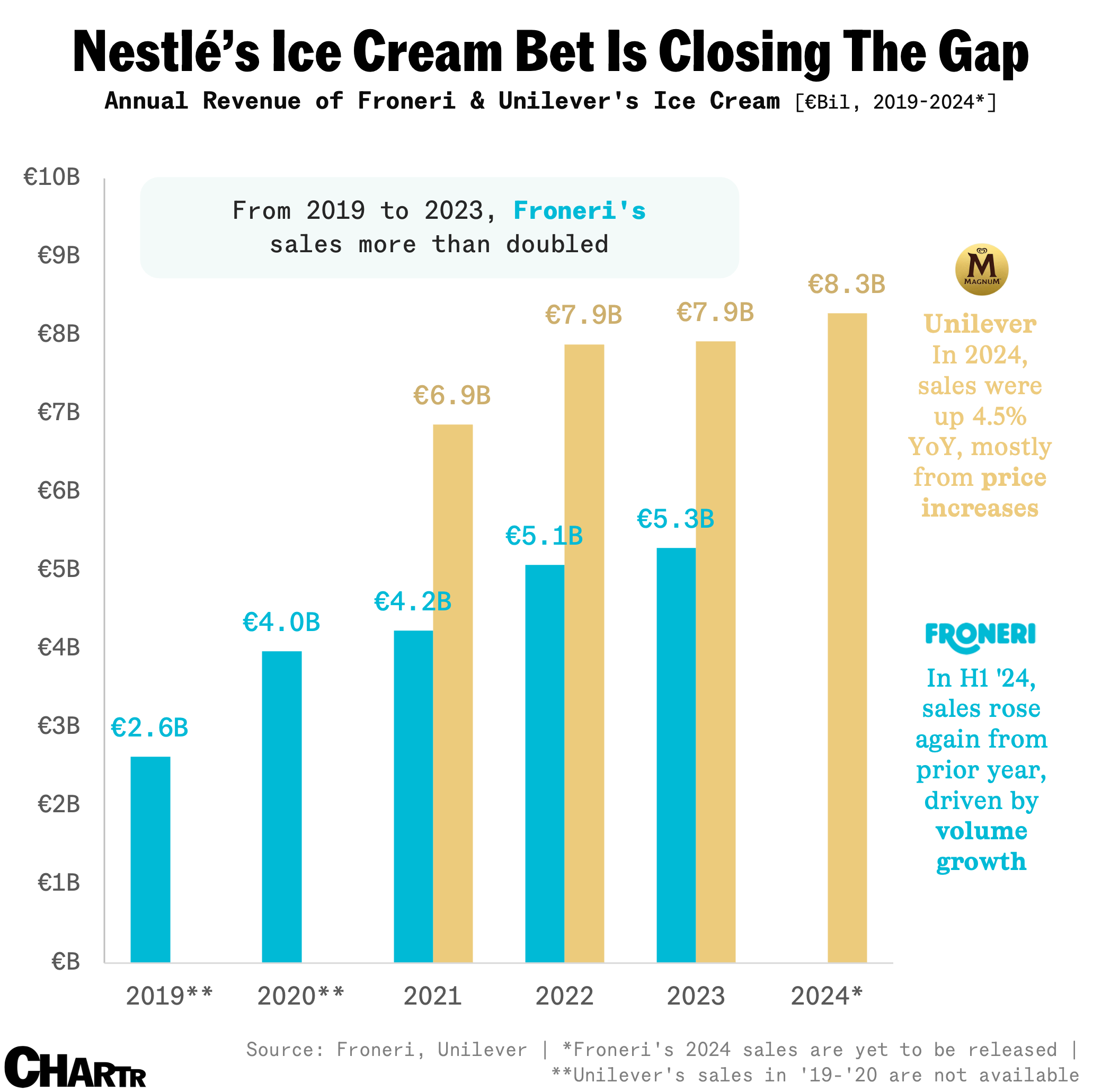
Nestle’s Froneri, a joint venture founded in 2016 between the food giant and a private equity firm, is catching up fast. Since acquiring Häagen-Dazs for $4 billion and expanding into the US, Froneri has more than doubled its revenue, from €2.6 billion in 2019 to €5.3 billion in 2023, its annual reports show. In 2019, Froneri was less than half the size of Unilever’s ice cream business. Now, it’s closing in, generating more than two-thirds of Unilever’s revenue.
Smaller scoop
Even with the challenges ahead, Unilever’s new spin-off may still be able to carve out a sweet spot.
One major trend working in its favor is the continued rise of small-portion snacking habits. According to Nielsen, sales of bite-sized snacks jumped 14% year over year in Europe in 2023, and a 2022 study by market research firm Mintel found that 62% of US ice cream consumers “would rather eat a small amount of indulgent ice cream than more low-cal ice cream.”
Unilever has already tapped into this space, launching mini-sized ice creams last fall, which helped reverse nearly two years of volume declines in the past two quarters.
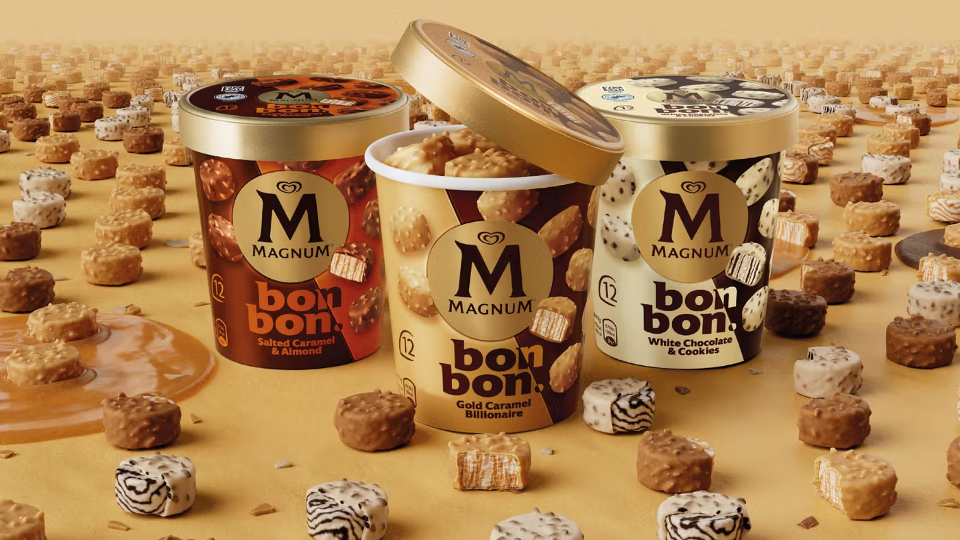
If anything can hold its ground against the weight-loss drug craze, the ice cream behemoth seems to think this is it. As then CFO (now CEO) Fernando Fernandez said at November’s investor event, referring to Magnum’s new micro-bite treats: “There is no Ozempic that can stop that one, I can promise you. I have become addicted.”