Crypto
A Bitcoin ATM
(S3studio/Getty Images)

Bitcoin options market signaling “smart money is still paying up for downside protection rather than chasing the pump”

Bitcoin is heading toward its worst February since 2020 and its fifth consecutive month in the red.

Yaël Bizouati-Kennedy

Bitcoin is about to close its fifth consecutive month in the red, down 16.3% for the month — its worst February since 2020, according to CoinGlass, and a far cry from the average 11% February return. On Friday morning, Bitcoin was around $65,800. Going into March, which has a 12.2% historical average increase, the overall sentiment remains bearish.

The options market is also guarded, or, as Jean-David Péquignot, chief commercial officer at Deribit, told Sherwood News, it remains “notably unimpressed.”

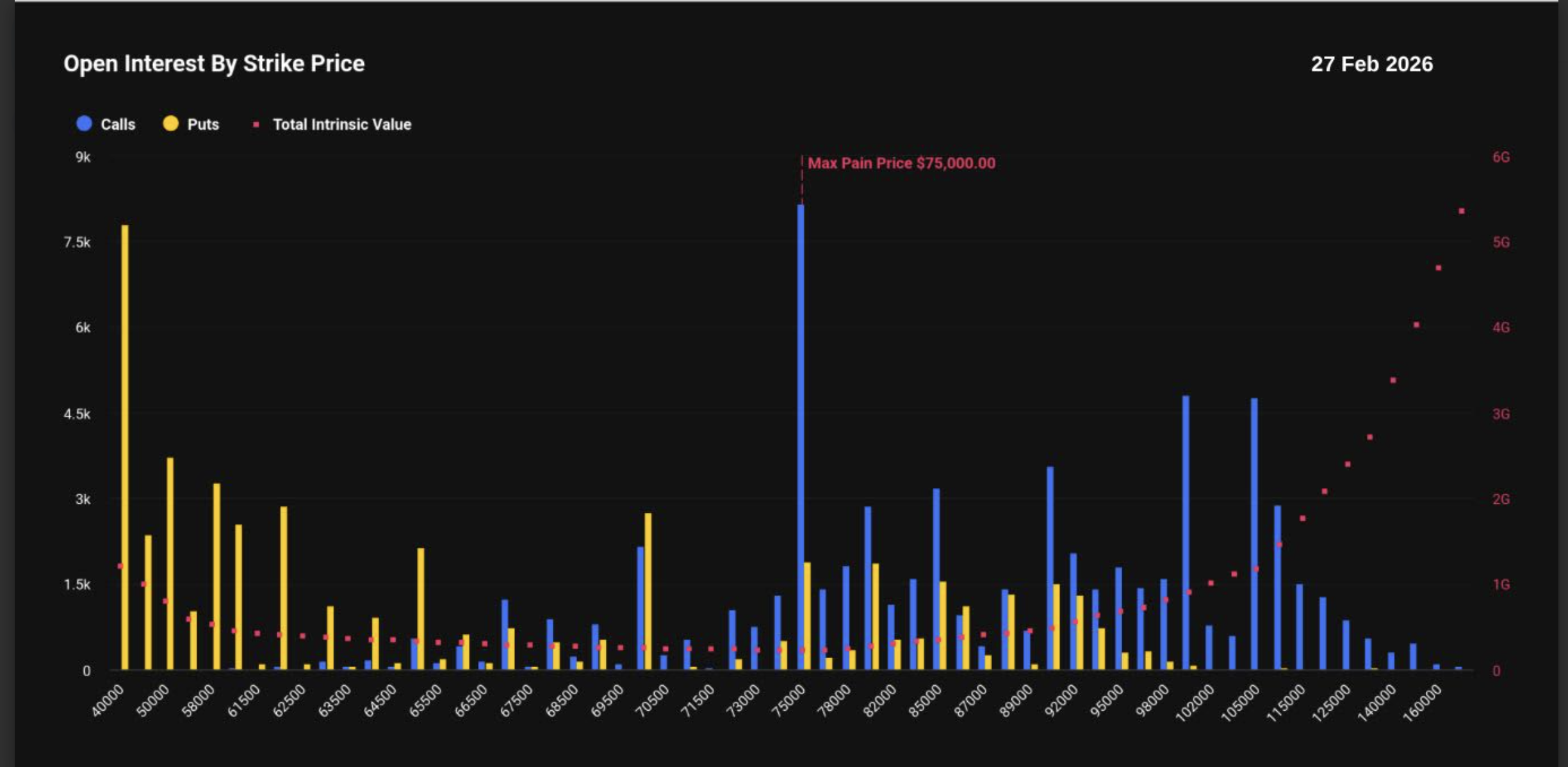
Péquignot said that the February 27 monthly expiry looms large, representing roughly 24% of the total BTC options open interest (116,000 of 489,000 contracts) at Deribit.

“While spot price climbed, the 25-delta risk reversal remained stubborn. 30-day puts are still trading at a ~7% volatility premium over calls, signaling that smart money is still paying up for downside protection rather than chasing the pump,” he said.

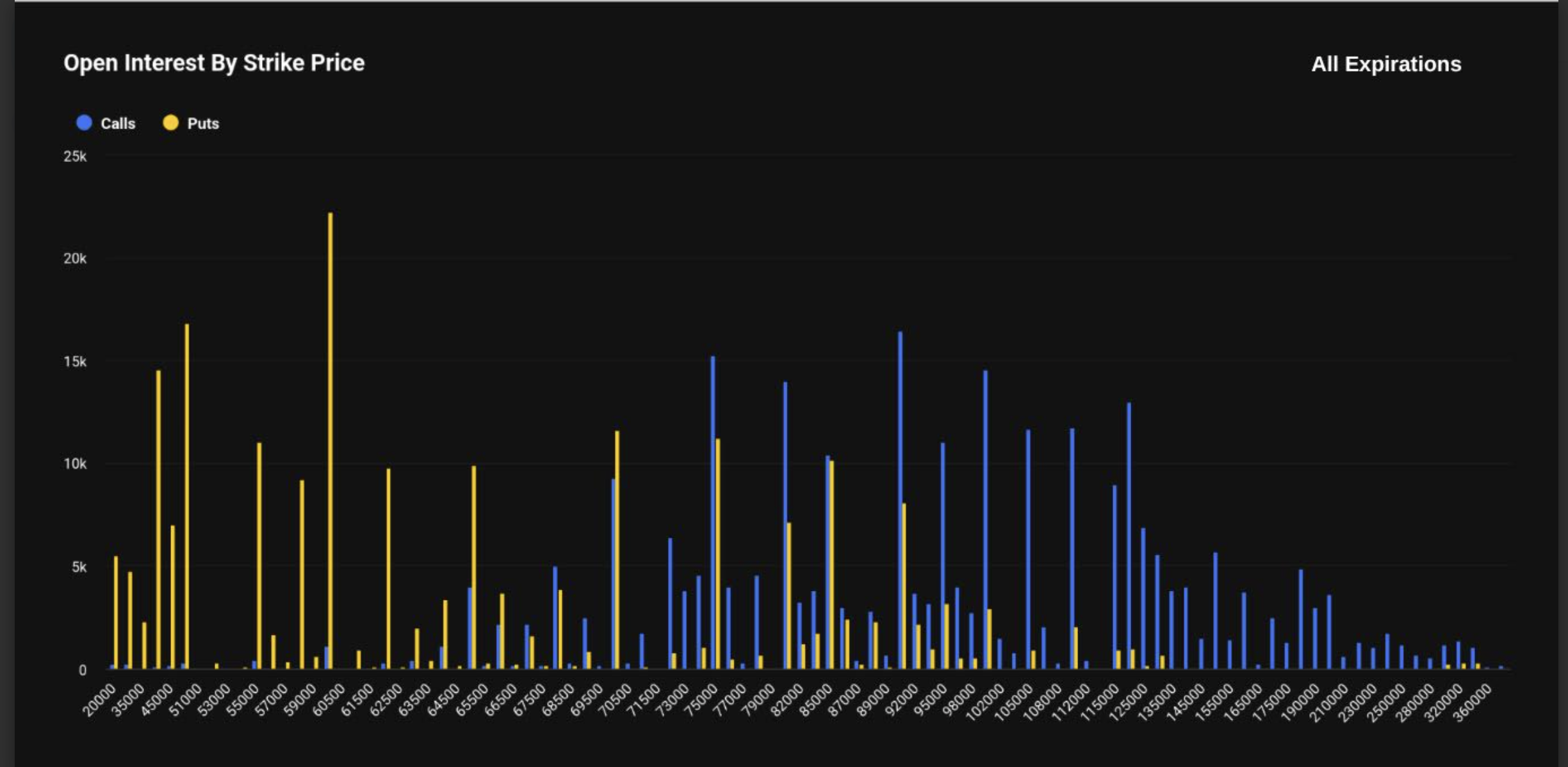
Péquignot said that across all expirations, the $60,000 put represents the single largest open interest (OI) concentration on the board, dwarfing all other strikes, “acting as a kind of gravitational well.”

“OI has built significantly in the $50K–$60K put range, showing fresh demand for protection. If BTC were to break through $63K and approach $61K, the negative gamma effects from this OI cluster would likely accelerate the move, turning a pullback into a high-velocity liquidity sweep,” he said, adding that ETF holders and corporate treasuries are buying six-month and one-year puts at $60,000 or below as portfolio insurance.
Open interest
(Deribit)

“For these players, $60K could be the maximum pain threshold — the level below which their investment mandate or macro thesis begins to break down,” Péquignot said.

Looking ahead, Péquignot said that lacking sufficient momentum to go higher, the market still seems to take the path of least resistance down into the pockets of stop-losses at $62,000 to $65,000 to find the liquidity needed to fuel a move resolutely higher.

“And losing the more critical psychological level at $60K would open the door to the $55K–$50K region,” he said.

A convincing daily close above $68,000 would go a long way toward neutralizing the prevailing bearish sentiment and shift attention toward the $70,000 to $71,000 resistance band, he added.
max pain
(Deribit)

Several experts are looking at March with skepticism, as macro drivers and geopolitical flare-ups continue to weigh on bitcoin.

Nic Puckrin, cofounder of Coin Bureau, told Sherwood that it’s a 50-50 toss-up whether bitcoin will rebound from current levels or move lower.

He said that in the short term, the direction of travel will depend on the macro backdrop and news flow. Catalysts include a compromise finally reached on the CLARITY Act on March 1, while risks include escalating geopolitical tensions, he said.

“Realistically, we could be stuck in the range between $60,000 and around $71,000 for some time. Even if there is a relief rally in March, this momentum is unlikely to last,” Puckrin said.

Matt Hougan, CIO of Bitwise, told Sherwood that crypto has never staged a V-shaped recovery after a crypto winter; instead, it’s usually a “tortured process of bottoming slowly.” 

“That’s my base case here: that we chop sideways, maybe even testing the previous lows, and that the real recovery takes place in Q2 or Q3 dependent on news flow,” he said.

“In the depths of the winter, crypto was so depressed that it didn’t care about anything; not even very good news,” Hougan said. “When BlackRock announced it was investing in UNI tokens a little while ago, the market barely shrugged. If you can’t get excited that the world’s largest asset manager is endorsing the world’s largest DeFi protocol, you know things are bad.”

Hougan said that now the deep freeze has broken, and that “if we get the right series of news flow lining up, there’s a chance that we rally.”

Finally, Mike Marshall, head of research at Amberdata, predicts March will look a lot like February, as the macro environment is hostile.

What makes this interesting, rather than simply bearish, is the accumulation happening underneath: leverage is washed out, stablecoins are minting $4.3 billion per month, and whales have been quietly adding more than 230,000 BTC, Marshall said.

“The correction has done its job, cleaning out excess. Think we need a catalyst, and the calendar (CLARITY Act deadline, Fed chair nomination, tariff resolution) could deliver one, just probably not on a predictable timeline,” he said.

More Crypto

See all Crypto
crypto

Hyperliquid reclaims all-time high

HYPE, the native token powering perpetuals exchange Hyperliquid and its underlying blockchain, rebounded to reclaim its all-time high previously set at the start of the month.

Treasury firms Hyperliquid Strategies and Hyperion DeFi have also rallied as the token increased double digits in the last 24 hours to trade as high as $76.70, rising past its record price set nearly two weeks ago, according to CoinGecko. In the interim between all-time highs, HYPE pulled back to around $53.

The token has several tailwinds, the first coming from ETF flows. Since their inception in May, HYPE ETFs have yet to record negative weekly outflows, posting a cumulative total net inflow of $171.8 million, per SoSoValue.

The second comes from Hyperliquid spending basically everything it earns in fees to buy HYPE, a mechanism embedded into the protocol’s codebase.

The venue’s buyback funding mechanism is set to add a new source of yield. Validators of the network activated “AQAv2,” which means stablecoin deployers will share about 90% of reserve yield revenue on their supply within the protocol.

Around $6.1 billion of Circle’s USDC resides in Hyperliquid, per DefiLlama. Accrual begins on August 26 and the first payment is made on October 3, the network announced in its Discord channel last week.

A substantial amount of capital is riding on different positions of HYPE. In total, a move down to under $53 would result in the liquidation nearly 1.8 million HYPE worth of leveraged long positions on the on-chain perps venue, or $131.7 million, data from CoinGlass shows. For the upside, a climb above $100 results in the liquidation of more than 3 million worth of leveraged HYPE short positions, or $221.5 million.

HYPE’s rebound to all-time high comes after Michael Selig, chair of the Commodity Futures Trading Commission, defended his agency’s decision to approve regulated perpetuals, or futures contracts without expiration dates, CNBC reported on Monday.

Last month, the CFTC approved bitcoin perpetual futures trading in the US through regulated prediction markets firm Kalshi and an affiliate of centralized exchange Coinbase.

“Perps are highly likely to become lightly regulated and thus approved in the US,” said David Pakman, head of venture investments at CoinFund.

“We expect to see perps for many different types of assets, from commodities to equities,” Pakman told Sherwood News.

crypto

Crypto market snaps back as sentiment lifts, with altcoins from ethereum to XRP soaring

The market capitalization of the crypto industry has jumped around $83.2 billion in the last 24 hours, with privacy-focused token Zcash and worldcoin, the native cryptocurrency of the network backed by OpenAI CEO Sam Altman, leading market gains, jumping over 22%.

But the last 24 hours have been good across the board:

Investors have been eager to see some positive signs around the Iranian conflict ending, coupled with hopeful outlooks around the CLARITY act, both breathing some life into assets, Kairos Research cofounder Ian Unsworth told Sherwood News.

Simon Shockey, a crypto strategist at crypto wallet infrastructure firm Privy, said the upswing stems from several things converging. He pointed to how alt markets broadly were very oversold following the bug found in Zcash that shook confidence.

Friday, Zcash founder Zooko Wilcox said Anthropic didn’t find any more serious bugs with the Zcash protocol after Shielded Labs requested the AI firm run a security audit of the network with Mythos.

Shockey added that the pool of willing sellers has dwindled. Even if structurally, AI is a much more compelling and asymmetric bet in the eyes of allocators, many of these crypto assets have simply run out of marginal sellers despite some shorter-term narrative-driven pumps. The only people left to sell at this point are the teams themselves and VCs.

Net-net: oversold conditions plus exhausted seller bases plus a macro backdrop thats stabilized equals a snapback, especially in names that have real usage or community conviction behind them,” Shockey told Sherwood.

Latest Stories

Sherwood Media, LLC and Chartr Limited produce fresh and unique perspectives on topical financial news and are fully owned subsidiaries of Robinhood Markets, Inc., and any views expressed here do not necessarily reflect the views of any other Robinhood affiliate, including Robinhood Markets, Inc., Robinhood Financial LLC, Robinhood Securities, LLC, Robinhood Crypto, LLC, Robinhood Money, LLC, Robinhood U.K. Ltd, Robinhood Derivatives, LLC, Robinhood Gold, LLC, Robinhood Asset Management, LLC, Robinhood Credit, Inc., Robinhood Ventures DE, LLC and, where applicable, its managed investment vehicles.