
Culture
American flag design pillow. USA Flag Throw Pillow. Patriotic concept
Getty Images
50 winks

Americans that live in colder states are more likely to sleep longer

But most US adults still aren’t getting enough shut-eye.

Millie Giles

As we slouch toward the end of a sticky summer, Americans will be looking forward to finally turning off their AC and getting out their comforters with the approach of autumn (though by Starbucks’ seasonal standards, we’re already a week in).

Pumpkin spice notwithstanding, one of the best things that colder temperatures signal for many is a better night’s sleep.

The cool side of the pillow

Last month, updates were published from an ongoing research project, funded by Apple in collaboration with the American Heart Association and Brigham and Womens Hospital, that uses Apple Watch data from over 61,000 adults to provide insights on factors that affect heart health, including sleep.

Overall, the study showed that most Americans aren’t getting enough shut-eye: the average sleep duration for US adults worked out to be 6 hours and 40 minutes, per Axios, short of the recommended seven to nine hours. It also found that the average bedtime for Americans (or at least when they get off their devices) was about 11:37 p.m.

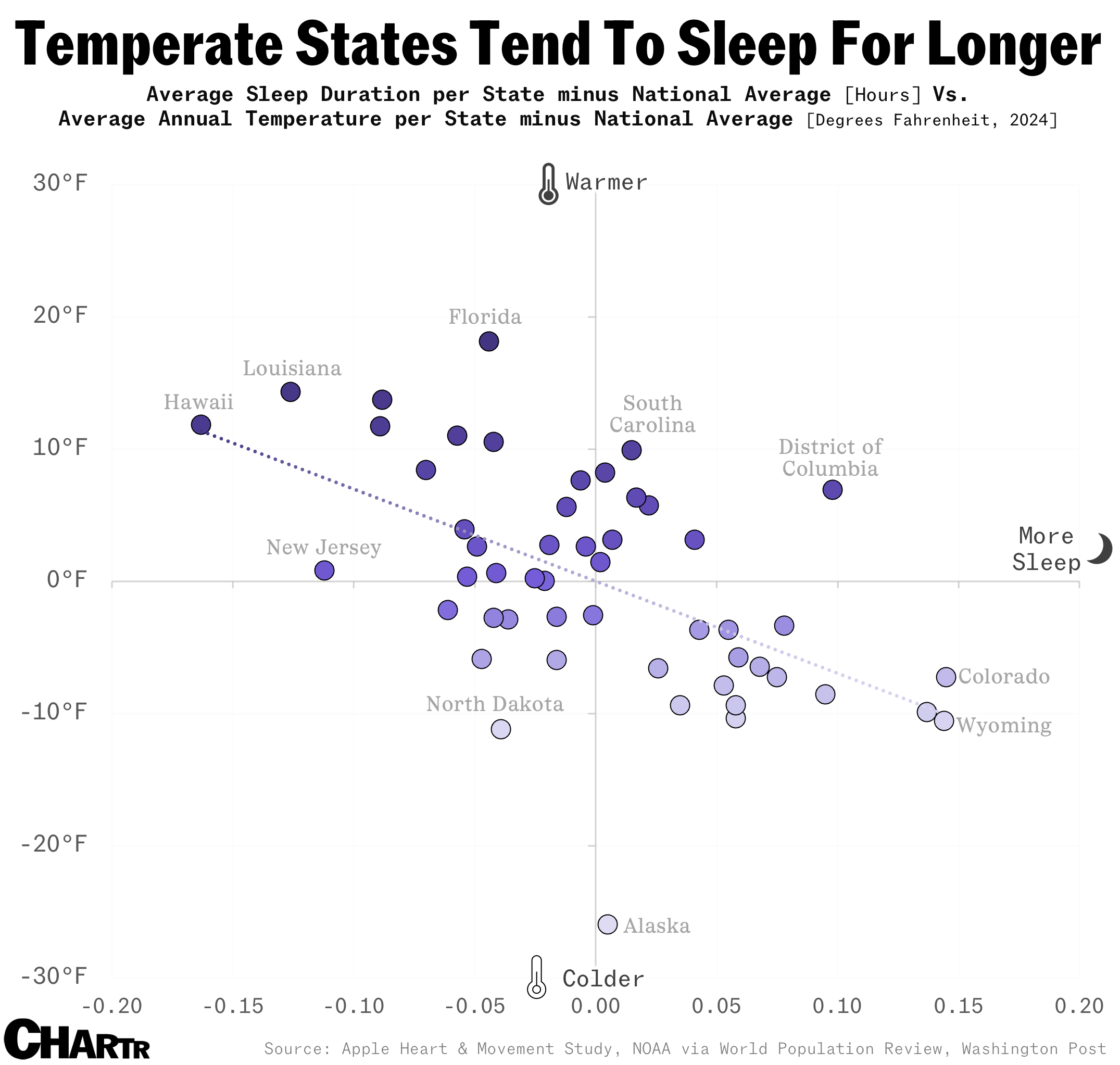
However, overlaying the results with the average annual temperatures in each US state last year presented a clear correlation: residents in colder states tended to sleep more.
Sleep temperature states
Sherwood News

Plotting average sleep duration with each state’s deviation from the national mean temperature showed that warmer states — such as Louisiana, Texas, and Florida — trended with having shorter sleep lengths. Hawaii, known for its tropical climate, saw participants get the least sleep of any state at 6 hours and 31 minutes, despite having the earliest bedtime (11:06 p.m.).

Generally, states with below-average temperatures, like Colorado and Wyoming, reported the longest slumbers — bar notable exceptions like extremely cold Alaska and unusually sleepy D.C. In fact, while D.C. residents had the third-longest average sleep duration in the country, at 6 hours and 47 minutes, they also went to bed the latest (11:56 p.m.).


More Culture

See all Culture
culture

OpenAI set to air a minute-long Super Bowl ad for a second consecutive year, per WSJ

OpenAI is expected to broadcast a lengthy commercial at Super Bowl LX, The Wall Street Journal reported Monday.

Having aired its first-ever paid ad at last year’s Big Game, the ChatGPT maker is set to take another 60-second ad slot during NBC’s broadcast on February 8, according to people familiar with the matter.

culture

Tamagotchis are making a comeback, 3 decades after first becoming a global toy craze

If you were a ’90s kid, you might remember the craze around little egg-shaped toys with an 8-bit digital screen, displaying an ambiguous pet-thing that demanded food and attention.

Now, on the brand’s 30th anniversary, the Tamagotchi the Japanese pocket-sized virtual pet that launched a thousand cute and needy tech companions, from Nintendogs to fluffy AI robots — is making a minor comeback.

Tamagotchi Google Search Trends
Sherwood News

Looking at Google Trends data, searches for “tamagotchi” spiked in December in the US, up around 80% from just six months prior, with the most search volume in almost two decades.

While the toys are popular Christmas gifts, with interest volumes often seen ticking up in December each year, the sudden interest might also have something to do with the birthday celebrations that creator and manufacturer Bandai Namco are putting on, including a Tokyo exhibition that opened on Wednesday.

Game, set, hatch

More broadly, modern consumers appear to have a growing obsession with collectibles (see: Labubu mania), as well as a taste for nostalgia (see: the iPod revival, among many other trends).

But, having finally hit 100 million sales in September last year, the brand itself is probably just glad to exist, giving a whole new generation the chance to experience the profound grief of an unexpected Tamagotchi death.

$5.6B

Disney could be well on its way to its third billion-dollar film of the year following a $345 million opening weekend for “Avatar: Fire and Ash.” The film’s opening gross puts the “Avatar” franchise’s total box office earnings at $5.6 billion — and counting.

The latest film, the second “Avatar” entry under Disney’s tent, earned about 75% of its total box office gross internationally — in line with previous movies in the (as of now) trilogy. Domestically, this one earned $88 million, falling short of expectations.

“Fire and Ash” was the widest Imax release ever, debuting on 1,703 screens globally and earning $43.6 million through the format. The $345 million “Fire and Ash” opening weekend was the second-highest of 2025, behind Disney’s “Zootopia 2,” which recently passed the $1 billion mark, globally.

Year to date, Disney has earned $5.8 billion globally at the box office.

Latest Stories

Sherwood Media, LLC produces fresh and unique perspectives on topical financial news and is a fully owned subsidiary of Robinhood Markets, Inc., and any views expressed here do not necessarily reflect the views of any other Robinhood affiliate, including Robinhood Markets, Inc., Robinhood Financial LLC, Robinhood Securities, LLC, Robinhood Crypto, LLC, or Robinhood Money, LLC.