


Making Hollywood great again will be hard
Film production in LA has fallen by 40% from prepandemic levels. Can tariffs turn the cameras back on?
Another week, another tariff threat — this time, in the name of making Hollywood great again.
In a Truth Social post Sunday, President Trump called for a 100% tariff on foreign-made movies, calling them a “national security threat” and warning that the US film industry faces a “very fast death.”
Shares of Netflix and Disney dipped on the news before recovering in trading earlier this week.
Trump’s announcement followed a meeting with actor Jon Voight, appointed “Special Ambassador to Hollywood” in January, who reportedly pitched a plan for federal tax incentives to bring production work back to the US, which has increasingly moved to countries like the UK, Canada, and Australia for lower costs and tax perks.
But just how bad are things in Hollywood?
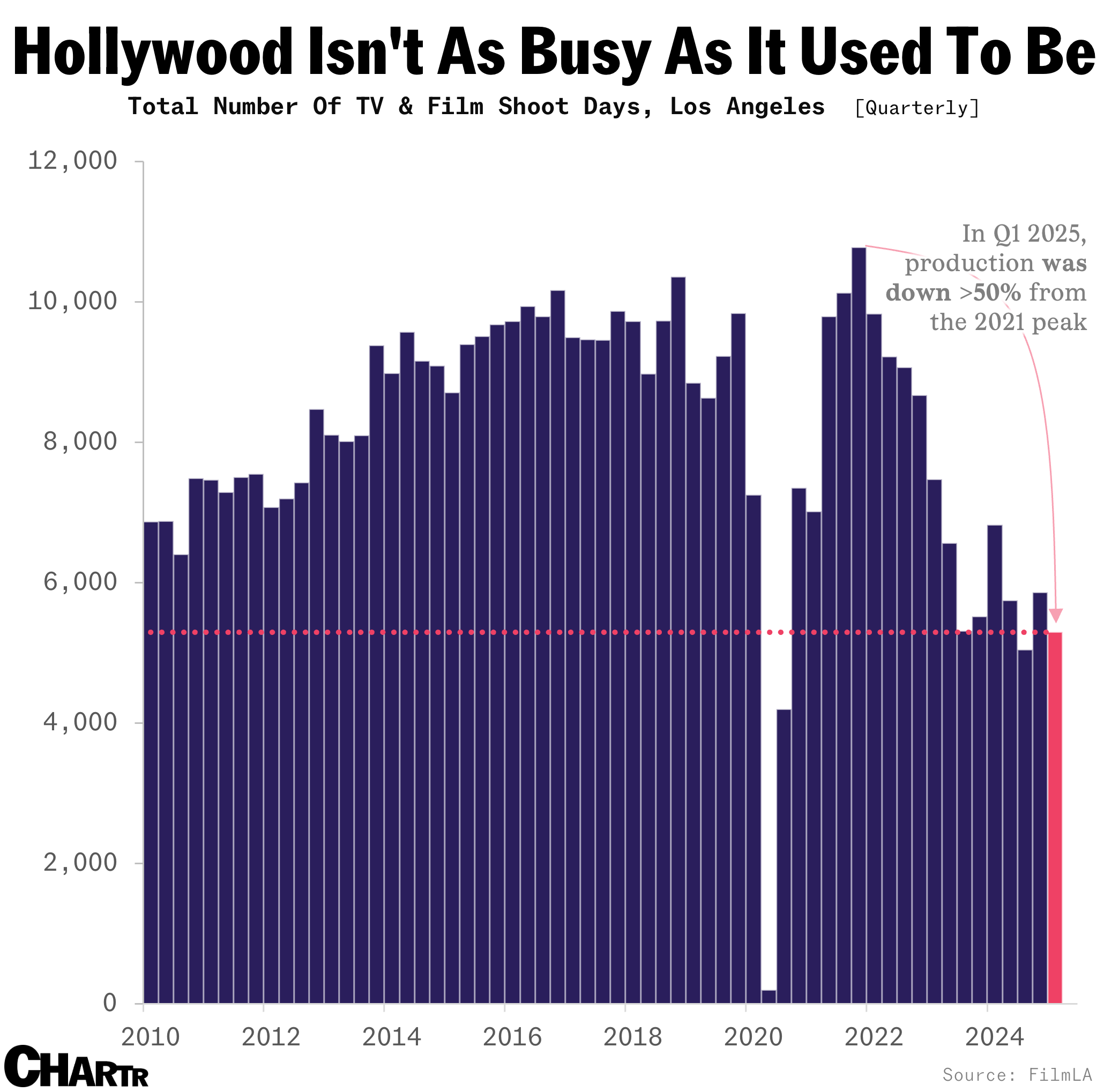
In the first quarter of this year, shoot days in LA were 22% lower than last year and down more than 50% from their 2021 peak, per FilmLA.
While America still leads in global film production, spending is down 28% in the US, according to research firm ProdPro, and jobs in the sector also remain below prepandemic levels, with the unemployment rate in motion picture and sound recording hitting 12.6% in April — the highest of any industry and more than triple the national average.
California’s dominance is slipping, too, with the state now accounting for just 30% of industry employment, down from 40% in the early 2010s, per the St. Louis Fed. With California’s role shrinking, Governor Gavin Newsom responded to Trump’s tariff threat yesterday by proposing a whopping $7.5 billion federal film tax credit — 10x the state’s current program.
So, what’s driving the decline in the US film and TV business? The gold rush brought about by the advent of the age of streaming is well and truly over, with studios slashing costs and scaling back investments as they chase profitability. At the same time, streamers are increasingly focusing on overseas content, where Netflix poured $7.1 billion last year, 7x more than in 2017.
Whether tariffs can revive the struggling industry is unclear. The White House said Monday that no final decisions have been made, while some key questions — such as how “foreign-made” will be defined — remain unanswered. Furthermore, US studios earn the bulk of their box office revenue abroad, Axios reports, raising the threat of retaliation from overseas.