Markets
markets
Luke Kawa

Accenture’s DOGE problem sends shares sliding

Accenture is the worst-performing S&P 500 stock in early trading, down 7% even after the consultancy reported quarterly results that were largely better than expected. The DOGE-shaped fly in the ointment: management warned that the Trump administration’s attempts to curb spending are weighing on its sales outlook.

Here’s CEO Julie Sweet from a conference call with analysts:

“As you know, the new administration has a clear goal to run the federal government more efficiently. During this process, many new procurement actions have slowed, which is negatively impacting our sales and revenue. In addition, recently, the General Service Administration has instructed all federal agencies to review their contracts with the top 10 highest-paid consulting firms contracting with the US government, which includes Accenture Federal Services.”

It’s a relatively basic accounting identity that the government’s deficit spending has to end up somewhere else. Either US households are getting more money, US corporations are booking bigger profits, or those greenbacks are going to the rest of the world.

Postpandemic outsized profit growth was, in narrative terms, a tale of base effects and “revenge” spending, but in practical terms, it’s the story of the flow of funds from the government’s debt issuance to household stimmies to Corporate America’s bottom line.

What Accenture is warning of now is just a micro example of this dynamic running in reverse.

More Markets

See all Markets
markets

Micron gains after breaking ground on new facility in decade-long, $24 billion investment plan

Micron sees an AI boom and wants to sell more chips into it.

On Monday evening, the company announced that it broke ground on an additional wafer fabrication facility at its complex in Singapore, kicking off a decade-long, $24 billion project.

Shares are up more than 3.5% as of 4:05 a.m. ET.

Of note: this is an expansion of NAND capacity, rather than DRAM. The latter contains high-bandwidth memory and makes up the lion’s share of Micron’s revenues.

“Wafer output is scheduled to begin in the second half of calendar 2028, helping Micron address growing market demand for NAND technology driven by the rapid expansion of AI and data-centric applications,” per the press release.

Micron’s rivals in South Korea enjoyed strong sessions on Tuesday despite President Donald Trump threatening to raise tariffs on the nation’s exports to the US to 25%, from 15%. The KOSPI Index rebounded from early losses with SK Hynix and Samsung soaring. SK Hynix’s outsized gains appeared to be fueled by a report from local media that it will be the sole supplier of HBM3E for Microsoft’s new Maia 200 chip, which was unveiled on Monday.

As we’ve discussed before, the supply crunch in memory and storage is the shortage that traders have wanted exposure to for much of the past five months.

The beneficiaries of memory chip giants’ quest to increase capacity include semicap stocks like ASML, Lam Research, KLA Corp, and Applied Materials, which provide the equipment used in new fabs.

markets

UnitedHealth, CVS, Humana drop after WSJ reports Trump admin will propose flat rates for Medicare insurers

Major health insurers dropped after The Wall Street Journal reported Monday that the Trump administration will propose roughly flat rates for Medicare insurers next year.

The Centers for Medicare and Medicaid Services is expected to announce an average 0.09% increase in payments to the plans in 2027, less than the 4% to 6% analysts expected, the Journal reported Monday after the bell.

markets

GameStop surges after Michael Burry reveals he owns the stock

Shares of GameStop are surging after Michael Burry, former hedge fund manager of “The Big Short” fame and current Substacker, announced that he’s been buying the video game and collectibles retailer recently.

The revelation came in Burry’s long-anticipated follow-up post on GameStop. The stock initially jumped when Burry tweeted about his history of being long the stock in November, and again in December as he teased a more thorough write-up of the experience.

Per CNBC, Burry wrote in a Substack post on Monday:

“I own GME. I have been buying recently. I expect I am buying at what may soon be 1x tangible book value / 1x net asset value. And getting a young Ryan Cohen investing and deploying the company’s capital and cash flows. Perhaps for the next 50 years.”

Trading volumes in GameStop went parabolic after the news crossed the wires. As of noon ET, 11.9 million shares have changed hands, more than 6x the average by this time of day.

And while Burry said he’s “willing to hold long-term,” his ownership is spurring a big rush into short-term call options on GameStop. As of 12:20 p.m., call volumes are more than double their 20-day moving average. The four most active contracts are calls that expire this Friday with strike prices of $25, $24, $20, and $23.

GameStop is a stock that has traded off of nostalgia, its exposure to things that are cool or entertaining, and leaders with big main character energy. And Burry’s the first injection of main character energy into the shares since Keith Gill, aka Roaring Kitty, came back to spur another meme stock rally in GameStop in the second quarter of 2024 and then disappeared almost as quickly as he’d arrived.

Gill and Burry have a lot in common: both like GameStop because they think it’s cheap and they’re willing to make “a bet on the management, in particular, of course, Ryan fucking Cohen.”

markets

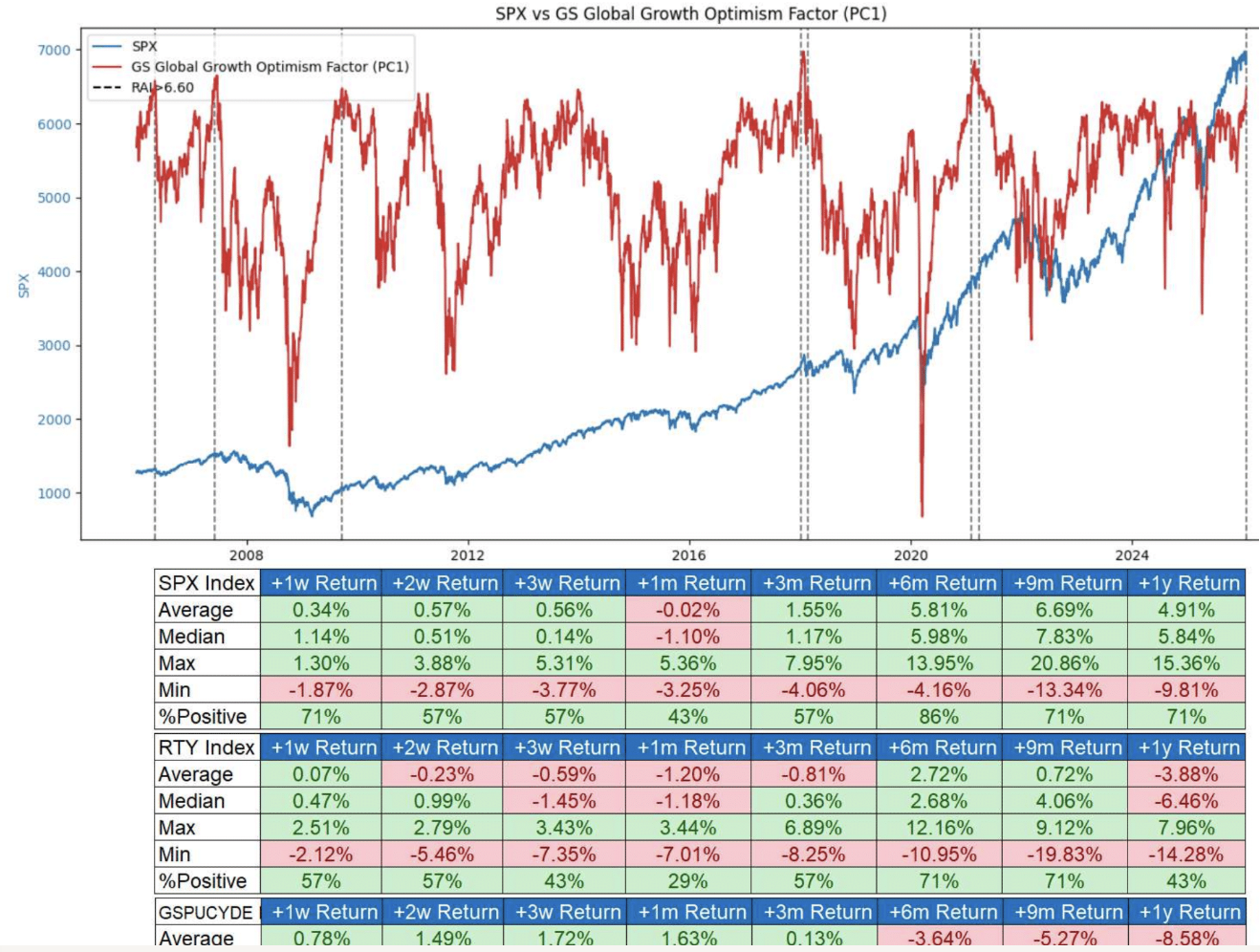
Extreme optimism on global growth is a bad omen for cyclically sensitive trades

By mid-December, it became pretty clear that investors were pricing in an acceleration in global growth for 2026, and price action since then has only calcified that narrative.

“The equity market has rapidly priced a positive expected growth outlook for this year,” Goldman Sachs’ Cullen Morgan wrote. “Similar has been seen in other asset classes as well, leading to our Global Growth Optimism Factor (RAI PC1) hitting a level seen only a handful of times over the last two decades.”

RAI stands for “risk appetite indicator,” the bank’s proprietary metric for investor sentiment.

One problem with all this optimism embedded in asset prices, Morgan noted, is that it can serve as a high-water mark for trades perceived to be sensitive to the ebbs and flows of the economy — in particular, small-caps and cyclicals versus defensives.

Goldman Growth Optimism
Source: Goldman Sachs

“To be clear, we continue to recommend select cyclicals as beneficiaries of the economic acceleration in early 2026 given the market does not yet appear to be fully pricing our economists’ above-consensus growth forecasts, but we are growing wary of a limited runway,” he concluded.

RAI stands for “risk appetite indicator,” the bank’s proprietary metric for investor sentiment.

One problem with all this optimism embedded in asset prices, Morgan noted, is that it can serve as a high-water mark for trades perceived to be sensitive to the ebbs and flows of the economy — in particular, small-caps and cyclicals versus defensives.

Goldman Growth Optimism
Source: Goldman Sachs

“To be clear, we continue to recommend select cyclicals as beneficiaries of the economic acceleration in early 2026 given the market does not yet appear to be fully pricing our economists’ above-consensus growth forecasts, but we are growing wary of a limited runway,” he concluded.

Latest Stories

Sherwood Media, LLC produces fresh and unique perspectives on topical financial news and is a fully owned subsidiary of Robinhood Markets, Inc., and any views expressed here do not necessarily reflect the views of any other Robinhood affiliate, including Robinhood Markets, Inc., Robinhood Financial LLC, Robinhood Securities, LLC, Robinhood Crypto, LLC, or Robinhood Money, LLC.