

Markets
Primary school stock
A primary school teacher marking a pupil’s math homework (Victoria Jones/Getty Images)

Americans have thoughts about tariffs that don’t make any sense

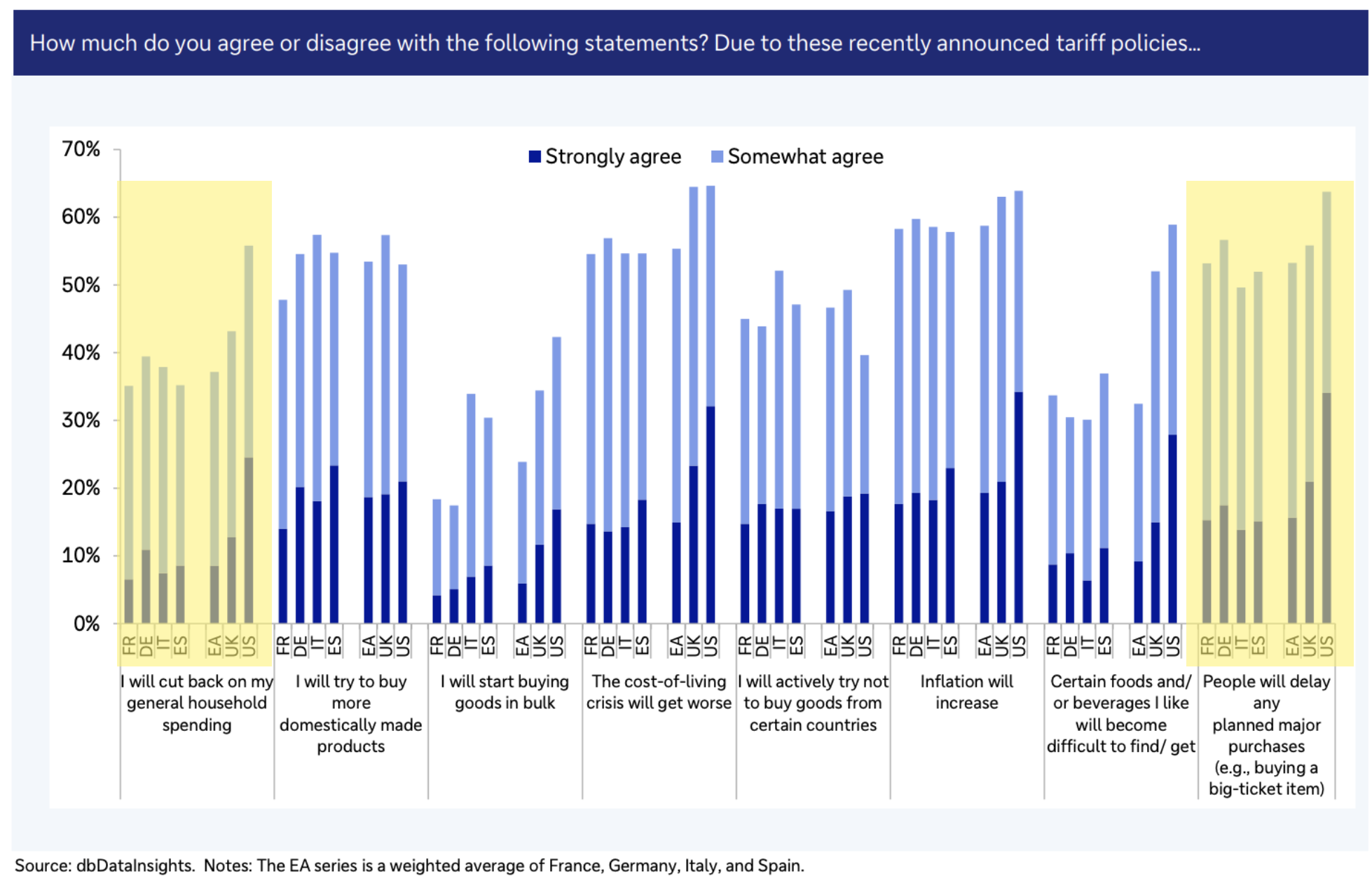
Sure, they said they’re slashing spending, think people are going to delay major purchases, and believe the cost of living will get worse, inflation will increase, and the trade war is having a net negative impact on the economy. But maybe it’ll work!

Luke Kawa

They’re our tariffs and (mainly) your problem.

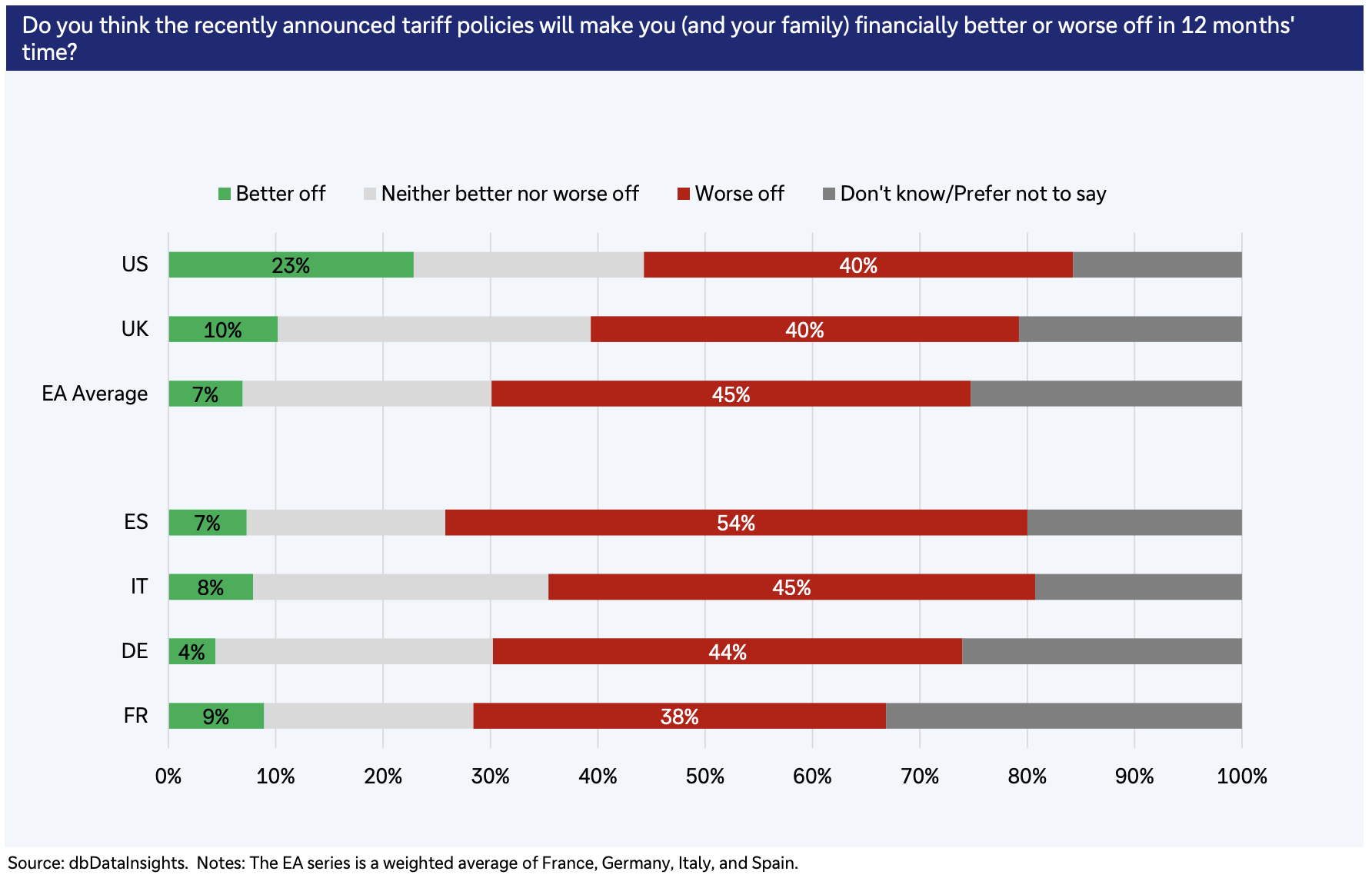
That’s one of the many different conclusions one could reach about Americans’ views on trade levies from a Deutsche Bank survey of 650 US households and 550 households each in Germany, France, Italy, Spain, and the UK from April 17 to 28.

Americans were more than three times as likely as Europeans to say that tariffs could be good for their financial situation over the coming year...
DBTariffSurvey1

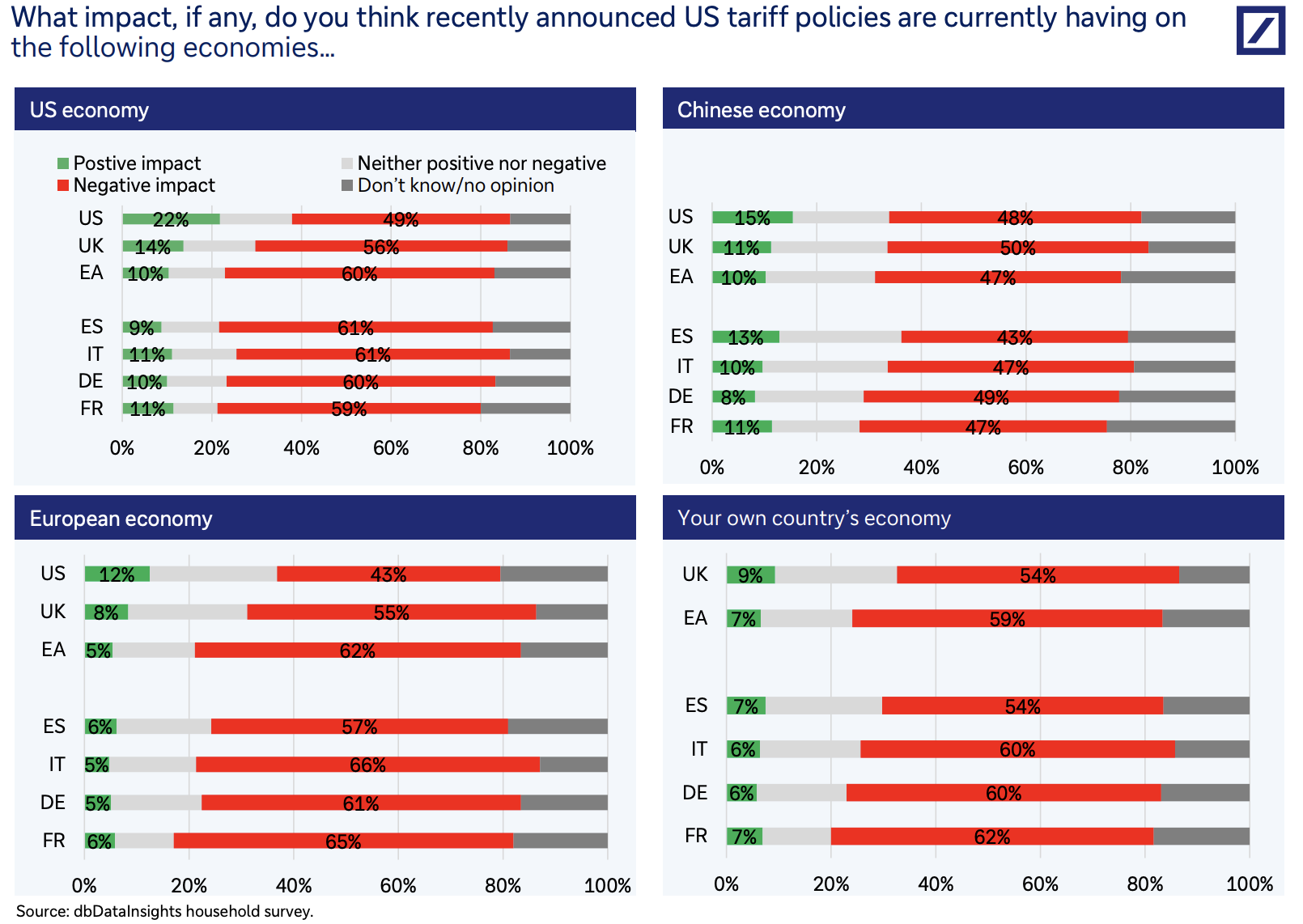
...and by a ratio of about 2.3 to 1, Americans think the trade war is having a net negative impact on the economy, compared to nearly 9 to 1 across European economies:
Screenshot 2025-04-30 at 3.08.31 PM

But when it comes to one clear negative economic consequence of tariffs — cutting or delaying spending in light of higher prices — Americans stand out as an outlier to the upside!
Chart
(Click to enlarge)

Obviously, tariffs are a hot-button issue with political overtones, and US survey data is littered with massive divides along those lines. It also probably matters that tariffs are something thats happening to other nations rather than being done by them, allowing for a much more coherent, unified level of thought for European countries compared to the US.

Because Americans’ thoughts on tariffs don’t really add up.

More Markets

See all Markets
markets

Traders are pricing in a big swing in AI chip market share to Broadcom from Nvidia

The story within the AI trade lately has been: Google’s a winner, and OpenAI is a... well, to be kind, non-winner.

Companies closely tied to the former, like Broadcom, which codesigns the TPUs that Gemini 3 was trained on, have benefited from their relationship with the hyperscaling search giant. Conversely, Nvidia, which sells to both Google and OpenAI but is besieged with worries about how custom chips might impact its AI market share (and profitability), has been selling off.

“NVDA stock is now trading at its widest ever ~40% discount to AVGO’s current 42x forward PE versus historical -10%/+7% discount/premium over the past 1/2 yrs, respectively,” Bank of America analyst Vivek Arya wrote. “In other words, consensus has already implicitly shifted at least 10+ points of (2H26E/27E) AI market share towards AVGO, conceptually.”

The abrupt shift in valuation amid this divergent price action is reversing course on Monday: Nvidia’s up about 1.5% as of 10:55 a.m. ET, while Broadcom is off 2.6%.

Air taxi companies are in the red as Goldman initiates coverage on Archer, Joby, and Beta

Goldman Sachs initiated coverage of the major US air taxi companies on Monday, including Joby Aviation, Archer Aviation, and Beta Technologies. All three are trading down as the bank’s first notes hit investor inboxes.

Though Joby “appears to be in pole position” on certification, analyst Anthony Valentini gave the stock a “sell” rating and a $10 price target — 30% below the value of Joby’s stock at Friday’s close. Valentini wrote that it’s unclear where competitors stand in the process.

Goldman gave Archer a “neutral” rating and an $11 price target, highlighting the company’s ability to cut spending. Beta Technologies, which went public last month, received a “buy” rating and a $47 price target.

markets

Crypto-adjacent stocks drop to start the week

Crypto-adjacent shares slid in early trading along with unprofitable tech company shares, as animal spirits ebbed to start the US trading week.

Goldman Sachs’ basket of bitcoin-sensitive stocks — heavily weighted toward Coinbase and treasury companies like MARA Holdings and Strategy — was down more than 3% early, reflecting another tumble in bitcoin overnight, though bitcoin prices stabilized a bit in early US trading. Robinhood Markets — shares of which have at times taken cues from the price of crypto, which is traded on the brokerage app — was also down.

(Robinhood Markets Inc. is the parent company of Sherwood Media, an independently operated media company.)

It would take a talented druid and a flock’s worth of bird entrails to the divine precisely what’s driving the downdraft. But S&P’s recent assessment of the vulnerability of Tether’s stablecoin, USDT — the world’s largest of these supposedly safer forms of crypto — to the bitcoin sell-off might be playing a role.

Latest Stories

Sherwood Media, LLC produces fresh and unique perspectives on topical financial news and is a fully owned subsidiary of Robinhood Markets, Inc., and any views expressed here do not necessarily reflect the views of any other Robinhood affiliate, including Robinhood Markets, Inc., Robinhood Financial LLC, Robinhood Securities, LLC, Robinhood Crypto, LLC, or Robinhood Money, LLC.
