Markets
Bitcoin ETF outflows
Sherwood News

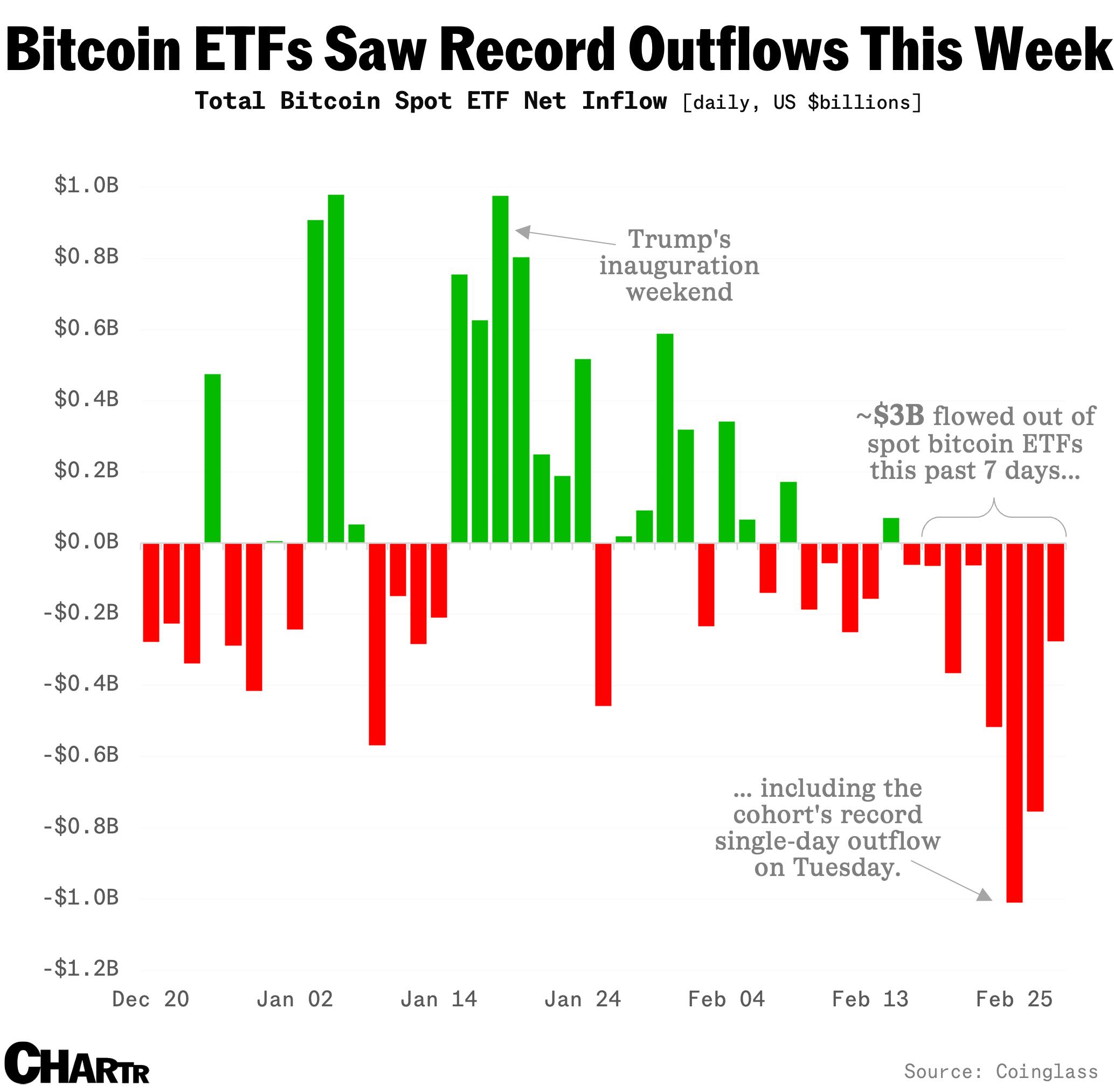
Investors yanked more than $3 billion from bitcoin ETFs in the past week

Some have rotated into gold ETFs.

Cryptocurrencies, growth stocks, and risk-on assets have been getting hammered in the last week, as investors blame a combination of tariffs, Nvidia, and good old-fashioned profit taking for this week’s sell-off.

In the crypto world, investors have been rushing to pull their money out of the very same exchange-traded funds they were piling into earlier this year, with spot bitcoin ETFs seeing a more than $1 billion outflow on Tuesday — the biggest one-day exodus since the cohort’s launch early last year.

Altogether some ~$3 billion has been pulled across the last seven trading days, per Coinglass data, with the world’s largest cryptocurrency trudging through one of its biggest declines, as bitcoin dipped briefly under $80,000 in the past 24 hours. That means much of the postelection gains have now been wiped out, with Bitcoin currently 24% below its all-time high of ~$109,000.

While bitcoin funds continue to struggle, seeing only four days of inflows so far this month, gold ETFs, seen as a safe haven asset by some, have raked in the largest amount of investment since Russia’s invasion of Ukraine.

More Markets

See all Markets
Business And Economy In Washington D.C.

Live Nation beats Q4 revenue estimates

The company reported earnings results on Thursday.

markets

AMD to “effectively guarantee” a loan to AI startup Crusoe that will be used to purchase its chips, The Information reports

Advanced Micro Devices will “effectively guarantee” a $300 million loan to data center company Crusoe from Goldman Sachs, according to The Information.

That is, Crusoe is taking out a loan to purchase AMD’s chips, and the chips that it’s purchasing are being used as collateral for that loan.

You’d be forgiven for thinking that this sounds an awful lot like a very common form of borrowing done by American families: borrowing money to buy a house, and having the home be collateral for the mortgage.

One big difference, of course, is that your home is expected to appreciate in value, while AI chips are expected to depreciate in value as they’re used. (The silver lining, however, is that so far these processors haven’t lost value too quickly.)

Another difference is that AMD, per the report, has agreed to rent these chips from Crusoe if it can’t find customers for this compute, which helped reduced the interest rate Crusoe will pay on this loan.

Similarly, in September, Nvidia agreed to buy any of CoreWeave’s unused cloud computing capacity through April 13, 2032, for $6.3 billion.

Rather than get overly hung up on “circular financing” elements, I’d probably frame the issue here like this: everyone wants AI chips. AMD sells AI chips. And yet, in both this deal and the most high-profile one we know about (AMD’s pact with OpenAI), the chip designer seems to be having to go the extra mile to get companies to use its AI chips. You might recall that as part of the OpenAI agreement, AMD issued warrants that enable the ChatGPT developer to receive 160 million shares, or about 10% of the company, if certain operational and stock price targets are hit over time.

Why is it so tough to get buyers on normal terms? My guess would be that this either says something negative about the financing environment for AI startups or the perception of AMD’s AI chips.

markets

Rental car companies drop amid volatile demand following an “unacceptable” Q4 from Avis

Rental car company Avis shed roughly $1 billion in market cap on Thursday as its stock fell more than 23% following the company’s Q4 results, which CEO Brian Choi called “unacceptable.”

Avis’ adjusted earnings before interest, taxes, depreciation, and amortization came in at $5 million on the quarter, a massive miss compared to the $145.4 million expected by Wall Street analysts polled by FactSet.

Avis said commercial rental days fell 11% in November, as thousands of flights were canceled amid the government shutdown. That led Avis to reduce its fleet size in Q4, “the most difficult period to sell used vehicles.” The company also took a $500 million write-down on its EV fleet at year-end.

“When operational performance speaks for itself, we earn the right to focus on the bigger picture. This quarter, we didn’t earn that right. We fell significantly short of guidance. That’s unacceptable, and I have no excuses to offer,” Choi said on the company’s earnings call.

Avis said it expects lower earnings in the first quarter of 2026, as January was also impacted by weather-related flight cancellations. Rival Hertz was dragged down in the sell-off, dropping more than 14%.

Latest Stories

Sherwood Media, LLC produces fresh and unique perspectives on topical financial news and is a fully owned subsidiary of Robinhood Markets, Inc., and any views expressed here do not necessarily reflect the views of any other Robinhood affiliate, including Robinhood Markets, Inc., Robinhood Financial LLC, Robinhood Securities, LLC, Robinhood Crypto, LLC, or Robinhood Money, LLC.