
Markets
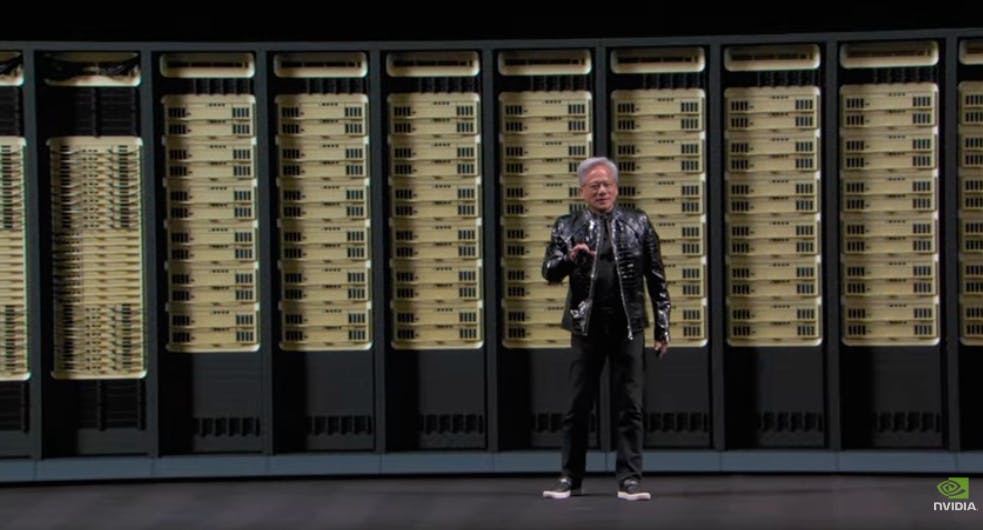
Jensen Huang in front of Vera Rubin at CES 2026
(Nvidia)

What Wall Street’s saying about Nvidia’s Q1 results

A makeover beautifies the growth outlook; so does the CPU opportunity.

Shares of Nvidia are lower for the fourth straight time after releasing quarterly results (despite another tidy top- and bottom-line beat). The good news for bulls is that the day-after reaction hasn’t been a good guide to what the stock does after that.

“We ignore this noise,” wrote Bank of America analyst Vivek Arya, who raised his price target on the stock to $350 from $320, and most of his peers agreed.

Zooming out, Wall Street analysts liked what they saw and heard from CEO Jensen Huang and CFO Colette Kress on Wednesday, with many boosting their view on how the shares will climb.

Here’s what they highlighted:

Corporate makeover

One of the most interesting things to come out of Nvidia’s quarterly results wasn’t just the numbers, but the new way in which they’re being arranged.

In particular, Nvidia is subdividing its “data center” revenues between hyperscale customers and everything else (formally, AI Clouds, Industrial, and Enterprise, or ACIE) in a bid to highlight its competitive advantage in the latter.

Revenues from each of these segments were roughly equal in Q1, though hyperscale sales are growing far faster than ACIE (74% versus 11%).

Megacap tech companies might have specific demands for the components going into their data centers (and in the case of many, custom chips), but Nvidia believes where its offerings really stand out is for the other cohort of clients who just want AI compute to be delivered to them (a full-stack solution, or off-the-rack racks, if you prefer).

“There’s a whole category of data centers that semi-custom chips just don’t apply because these data centers want to buy systems, they want to operate systems — they don’t want to design, they don’t want to build it themselves,” Huang said on the conference call. “We’re fairly unique in our ability to be able to serve this industry.”

These customers are all individually way smaller than the hyperscalers, but all these little wins would add up big over time, he argued.

“Jensen mentioned he expects ACIE to grow faster in the longer-term given that there are more potential customers in the segment and these customers do not want to design their own compute but rather have an off the shelf solution (where NVDA’s share is very high),” wrote Needham & Co. analyst Quinn Bolton, who hiked his price target to $270 from $240.

“NVDA has a near-monopoly here via AI factories and full-platform support — areas which custom ASICs cannot address,” BofA’s Arya added.

However, this shift toward data center growth dominated by non-hyperscale opportunities seems more like the beginning of a story that’ll be written in 2028 than beyond, mainly because...

$1 trillion and counting

When asked about incremental top-line drivers beyond the $1 trillion revenue target for Blackwell and Vera Rubin sales through the end of next year, Huang pointed to three things:

  1. More sales to frontier AI models (namely, Anthropic)

  2. Stand-alone Vera CPU sales

  3. LPX (an AI inference accelerator developed with Groq)

Conspicuous by omission here is any reference to that non-hyperscale ACIE category.

Analysts primarily keyed in on door No. 2 here, with Huang saying that he expects to deliver $20 billion in “stand-alone” Vera CPU revenues this year.

“The company seems set to potentially become the CPU king with a possible business as big or even bigger than their more traditional competitors in an overall new (incremental) TAM they size at $200 billion,” wrote Bernstein analyst Stacy Rasgon, who lifted his price target to $315 from $300.

Semi stocks with a high CPU footprint like Advanced Micro Devices, Intel, and Arm Holdings have outperformed in 2026 as the “orchestration” demands of AI agents boost the prominence of these older-school offerings in running models.

“We are excited for this opportunity and think that NVIDIA’s strong procurement will put them in a very strong position in a supply constrained environment,” said Morgan Stanley’s Joseph Moore, who nudged up his price target to $288 from $285.

More Markets

See all Markets
markets

SoftBank rallies on OpenAI and SB Energy IPO plans; its Japanese-traded stock notches best day since 2000

SoftBank shares skyrocketed in Tokyo trading, notching their biggest daily gain since 2000, boosted by news about planned IPOs at OpenAI, in which SoftBank has a sizable stake, and SoftBank’s own SB Energy unit. ADRs of SoftBank traded in the US rallied, too.

OpenAI is accelerating the timeline to its public debut, preparing to confidentially file its IPO prospectus with regulators as early as Friday, according to The Wall Street Journal. That could set the stage for a highly anticipated public listing as early as September.

SoftBank has systematically expanded its financial exposure to OpenAI, securing a highly valuable stake in the company. As of the fiscal year-end, SoftBank’s cumulative investment in OpenAI totaled $34.6 billion, with a fair value of $79.6 billion, and cumulative investment gains totaled $45 billion, according to a SoftBank filing.

For SoftBank, a successful public debut is critical to demonstrating that OpenAI can protect its market position amid intense industry pressure. Investors have grown increasingly anxious that OpenAI is losing ground to competitors like Anthropic, which is currently in talks for a funding round that could push its own valuation past that of OpenAI.

Adding to the upward momentum, SB Energy, the digital infrastructure and clean energy development firm co-owned by SoftBank and Ares Management, confirmed its own confidential draft registration filing for a major US public listing.

This multipronged IPO pipeline has boosted investors’ confidence in billionaire founder Masayoshi Son’s high-conviction AI thesis, showcasing a road map for SoftBank to transition its paper gains into potential liquidity. SoftBank’s stock is up 37% so far this year.

markets

Nio posts better-than-expected first-quarter earnings and forecasts strong Q2 sales

Chinese EV maker Nio posted Q1 results before markets opened on Thursday, reporting earnings that beat expectations and strong sales guidance for the second quarter. Shares of the company climbed more than 4% in premarket trading.

For the first quarter, Nio reported:

  • Adjusted earnings of $0.00 per share, compared to the $0.05 loss per share that Wall Street analysts polled by FactSet had expected.

  • $3.7 billion in revenue, compared to the $3.74 billion consensus estimate.

  • 83,465 vehicle deliveries, slightly exceeding its own forecast of between 80,000 and 83,000.

For Q2, Nio guided for deliveries of between 110,000 and 115,000, compared to estimates of 113,807. The company expects second-quarter revenues to come in between $4.75 billion and $4.99 billion, while analysts are forecasting $4.6 billion.

The Chinese auto industry has seen a surge in exports so far this year, as companies make efforts to combat declining domestic sales. Nio, which is still relatively new to overseas operations, has plans to ship “several thousand” EVs overseas this year.

markets

Quantum stocks soar after Trump administration awards $2 billion in grants, in deals that include government equity stakes

Quantum computing stocks are soaring in early trading on Thursday after the Trump administration signed a number of letters of intent (LOIs) to award a total of $2 billion in grants to nine quantum companies, in deals that also include equity stakes. In press releases published by IBM, GlobalFoundries, D-Wave Quantum, Infleqtion, and Rigetti, LOIs have been signed with the US Department of Commerce’s CHIPS Research and Development Office.

First reported by The Wall Street Journal, the following companies are part of the overall package, with respective amounts of funding reported:

For IBM, the largest recipient, the funds will be used to build an American quantum chip foundry, supporting the research and development efforts of a new IBM company: Anderon, set to be America’s first pure-play quantum foundry, according to IBM, which will match the federal funding dollar for dollar, plowing $1 billion into Anderon.

The agreements, which will be funded under the 2022 CHIPS and Science Act, will be made in exchange for the government taking an unspecified minority equity stake in each of the quantum companies — an unusual federal move that has become common under President Trump, with investments in the rare earth space and chips (most notably Intel).

The process of reaching these deals with the government included “a very rigorous technical evaluation over many, many months,” Infleqtion CEO Matthew Kinsella told Sherwood News. “Every quantum company I have spoken with throughout the supply chain applied and put in a proposal for this CHIPS Act money. So I view this as the US government having done a very, very broad overview of the quantum industry and selected the partners that they believe can execute.”

Rumors and reports of potential government support buoyed quantum computing stocks during September and October of last year, contributing to frenzied, options-fueled gains for many of its most well-known constituents.

Other quantum names not booking government deals today are also ticking up in sympathy, including pure-play IonQ, Quantum Computing, Arqit Quantum, and Honeywell (which backs Quantinuum), following the administration’s show of confidence in the nascent technology. The government is also reportedly working on an executive order focused on the quantum industry, the Journal reported, citing people familiar with the matter.

Latest Stories

Sherwood Media, LLC and Chartr Limited produce fresh and unique perspectives on topical financial news and are fully owned subsidiaries of Robinhood Markets, Inc., and any views expressed here do not necessarily reflect the views of any other Robinhood affiliate, including Robinhood Markets, Inc., Robinhood Financial LLC, Robinhood Securities, LLC, Robinhood Crypto, LLC, Robinhood Money, LLC, Robinhood U.K. Ltd, Robinhood Derivatives, LLC, Robinhood Gold, LLC, Robinhood Asset Management, LLC, Robinhood Credit, Inc., Robinhood Ventures DE, LLC and, where applicable, its managed investment vehicles.

