
Markets
US-TECHNOLOGY-LIFESTYLE-ELECTRONICS
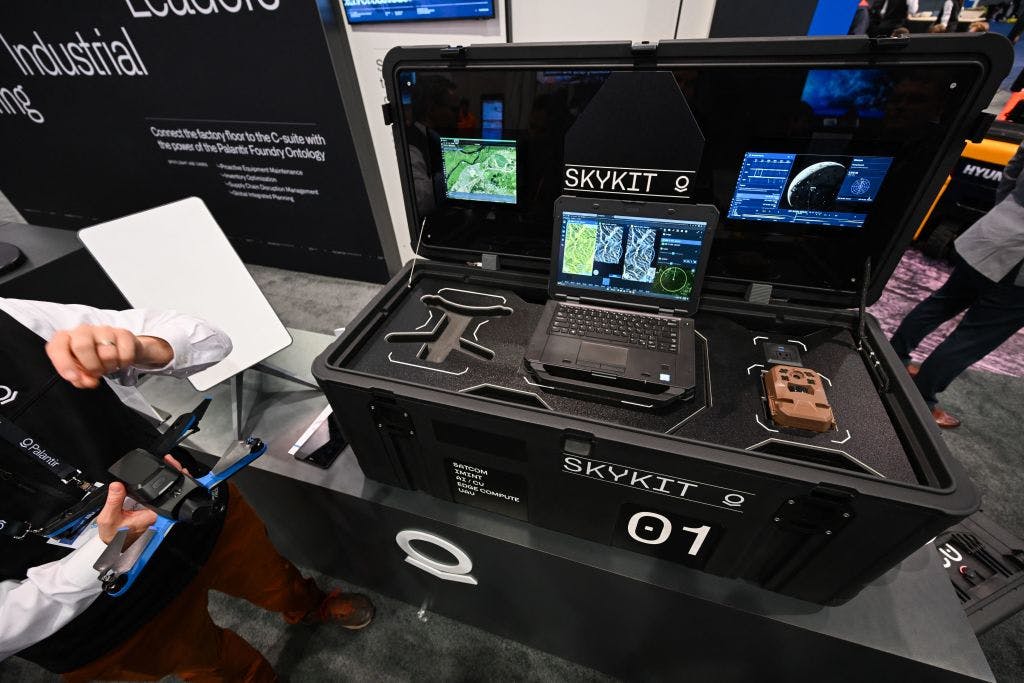
A Palantir Technologies Skykit (Patrick T. Fallon/Getty Images)

Retail traders’ zest for Palantir put to the test as earnings await

High multiples usually mean high expectations, but Palantir’s profits are expected to nearly halve year on year.

It’s earnings day for Palantir, arguably the hottest retail stock of the moment.

That steadfast retail shareholder base came in handy after Palantir endured a pretty gnarly 19% drop between January 3 and January 13 amid a wobble in confidence around the highest flyers of the AI era.

Retail traders swooped in to buy the dip and for weeks they’ve been laughing, as the stock recovered its loss and then some. Shares recently hit record highs. Nice trade.

Still, the nagging question posed by Palantir’s insane valuation multiples — forward PE (173x), trailing PE (418x), price-to-forward sales (53x) — remains: is there a snowball’s chance in hell of Palantir’s sales, profits, and margins ever reaching a level that would come anywhere near justifying the company’s nearly $190 billion market valuation?

For what it’s worth, that level of market cap puts Palantir, which has been public for less than five years and in the black for just two, ahead of perennially profitable icons of corporate America like AT&T, Verizon, and Pfizer, to name a few.

Of course, there’s no way that today’s numbers — due around 5 p.m. ET — will answer that question conclusively. Even if Palantir blew the doors off the hinges and posted sales well above the consensus expectation of $771 million and a far fatter profit than the somewhat piddling $48 million that’s projected, the stock would still be laughably overvalued by any traditional metric.

As far as the details, analysts and traders are going to be especially interested in whether Palantir sees a Q4 fillip in sales to corporate clients rather than its larger business of selling defense and intelligence software to governments and militaries. Palantir has been talking up the demand for its AI software products from private-sector buyers recently.

But if the numbers fall far short, it stands to reason it could take some wind out of the stock’s sails.

Shareholders may rightly wonder whether the superheated rhetoric emanating from Palantir executives might actually be an attempt to sex up a fairly standard software business. A bad quarter could also prompt shareholders to take a second look at the fact that the CEO has picked up the pace of his share sales (albeit through a prearranged stock sale program) and has dumped over $2 billion worth of Palantir stock in the last six months, according to one analyst.

Or maybe not. In many ways, we’re in something of a LOL-nothing-matters market.

Case in point: traditional business metrics like sales and profits have proven a remarkably poor guide predictor for Tesla’s share price recently, so much so that flummoxed Wall Street analysts are going public with the fact that they’re at a loss to explain the stock’s rise in the face of obviously ugly earnings last week.

Tesla is an interesting comp for Palantir. Both companies are wealth vehicles of right-wing oligarchs with close ties to the Trump administration. Both have rabid contingents of retail shareholder and outspoken, charismatic CEOs. And both have crucial business issues that hinge on federal government policies, whether it’s in the form of the federal EV tax credits that incentivize sales of electric offerings like Teslas or the fact that Palantir’s single largest customer is the US government. (Oh and there’s also Musk’s other venture, SpaceX, which is a major government contractor.)

Oddly enough, these two companies also happen to be the top two stocks in the S&P 500 (closely followed by Taser maker Axon) since President Trump won the election in November, suggesting that at least some investors are betting on benefits for Tesla and Palantir under the new administration that traditional business metrics don’t quite capture.

Ain’t the free market grand.

More Markets

See all Markets
markets

Hardware stocks jump thanks to server demand and record Lenovo revenue

Server stocks are rallying as Dell, Super Micro Computer, and Hewlett Packard Enterprise ride the momentum of Hong Kong-based Lenovo. The PC makers stock rose 19% on Friday, hitting an all-time high, on record Q4 earnings.

Powering the positive earnings report was the companys AI-related revenue, which grew 84% in the fourth quarter and now makes up over a third of total revenue. Investors seem to think the increased demand for servers could have trickle-down effects for other companies.

The companys results and commentary reinforced the outlook for strong AI-infrastructure demand while indicating resilient broader traditional server and storage spending, wrote Woo Jin Ho, a senior technology analyst at Bloomberg Intelligence. Lenovos $21 billion AI-server pipeline and remarks that demand is outpacing supply support Dells AI-demand momentum and point to robust orders.

AIs insatiable computing demand is reshaping the hardware industry and driving up server demand.

Dell will report first-quarter earnings on Thursday, May 28.

Policeman with Piercing Eyes

Take-Two’s “GTA 6” forecast feels absurdly conservative

Take-Two issued a 2027 net bookings forecast about $1 billion below Wall Street’s estimates. The stock is falling on Friday.

The D-Wave 2X quantum system, is operated at the NASA Advanced Supercomputing facility's Quantum Artificial Intelligence Laboratory at NASA's Ames Research Center in Mountain View, Calif., as seen on Tuesday December 8, 2015.

Quantum computing CEOs hope “validating” government backing proves their technology is no longer speculative

The government funding is a push to boost the foundational elements of quantum computing to get the industry ready for prime time. The CEOs of Infleqtion and D-Wave give us their thoughts.

Luke Kawa5/22/26
markets

Ross Stores surges as Q1 results beat expectations, full-year guidance raised

Ross shares are rising after the company delivered strong Q1 results, with sales topping Wall Street’s projections.

The stock soared 6.3% just after the open.

Key numbers:

  • Earnings per share of $2.02 vs. $1.47 year over year (estimate: $1.72).

  • Sales of $6.01 billion, up 21% year over year (estimate: $5.61 billion).

  • Comparable sales growth of 17% (estimate: 8.58%).

CEO Jim Conroy attributed the results to better traffic in stores. “Customer traffic was the primary driver of the strong sales trend as compelling merchandise assortments, higher customer acquisition and engagement from our ongoing marketing initiatives, and an improved in‑store experience are resonating with shoppers.”

The company also noted that transaction volume grew across all key demographics, including “income levels, ethnicities, and age groups, including younger customers.” Sales were also likely buoyed by standard seasonal tailwinds, including consumer spending from tax refunds.

Backed by the strong quarter, the company lifted its full-year targets. Ross now projects same-store sales growth of 6% to 7%, up from the prior forecast of 3% to 4%, topping Wall Street’s estimate of 4.64%. It boosted its annual EPS guidance to a range of $7.50 to $7.74, versus the prior outlook of $7.02 to $7.36.

Ross Stores has been one of the retail sector’s standout performers this year, rising around 20% year to date as of Thursday’s close.

Latest Stories

Sherwood Media, LLC and Chartr Limited produce fresh and unique perspectives on topical financial news and are fully owned subsidiaries of Robinhood Markets, Inc., and any views expressed here do not necessarily reflect the views of any other Robinhood affiliate, including Robinhood Markets, Inc., Robinhood Financial LLC, Robinhood Securities, LLC, Robinhood Crypto, LLC, Robinhood Money, LLC, Robinhood U.K. Ltd, Robinhood Derivatives, LLC, Robinhood Gold, LLC, Robinhood Asset Management, LLC, Robinhood Credit, Inc., Robinhood Ventures DE, LLC and, where applicable, its managed investment vehicles.

