

Markets
US Trade down Trade bargains discounters
(CSA Archive/Getty Images)

The trade-down trade is a market theme worth watching

Annoyingly high costs of living are driving bargain hunting and big gains for discounters.

Earnings season came to its usual, consumer-oriented conclusion over the last couple weeks, with a flurry of quarterly reports from retailers peppering the tape.

The market was clearly taken aback by some superstrong numbers from a few unsexy off-price retailers. Kohl’s mooned 24% Wednesday after posting its numbers. Burlington Stores rose a more muted 5% Thursday for the same reason, as did Five Below, which gained about 4%. Others like Dollar General and TJX Maxx parent TJX Cos. also did much better than expected, even if the stock reaction wasn’t so dramatic.

The upside wasn’t uniform — Ross Stores posted slightly disappointing sales last week, for instance — but in the aggregate, the news seemed to reinforce the message of an interesting chart published in a note by Bank of America analysts.
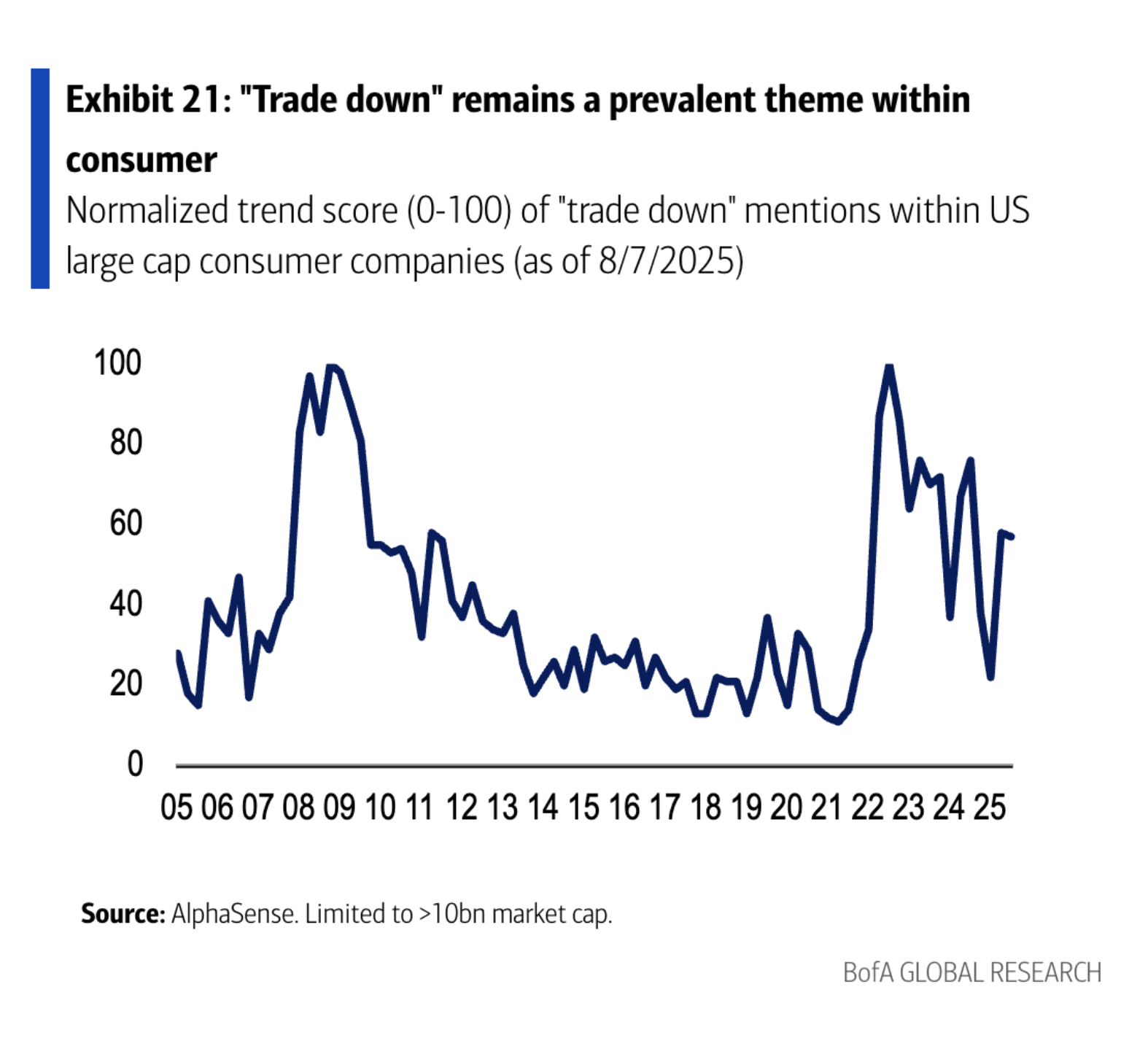
Trade Down Stock Market Theme
(Bank of America Global Research)

This trend line charts the change in mentions of “trading down” — that is, consumers shopping for lower-priced options rather than paying premium prices — on conference calls hosted by large US companies over the last 20 years.

Mentions of such behavior spiked during great financial crisis of 2008-09, and then again a decade or so later during the post-Covid inflation, as consumers saw their buying power weaken either because of job losses during the recession or because their pay didn’t keep up with price increases after the pandemic.

After a brief respite, this chart says (and the recent numbers from discounters confirm) that trading down is back.

This makes sense, as inflation remains stubbornly high. Actually it’s a bit worse than that, as inflation is actually accelerating.

The Fed’s preferred measure of underlying inflationary pressures, core PCE, hit an annual rate of nearly 3% last month, up from 2.6% back in April, according to data released Friday. It was the third straight monthly increase.

At the same time, the job market, while more or less stable, seems to be softening a bit on the margin, with the number of those receiving continued unemployment benefits rising and net employment growth decelerating, both of which make it harder to switch jobs or push for higher pay.

That might sound like an uncomfortable world for workers.

But it’s a solid backdrop for stocks of bargain retailers. Such stocks might be a decent place for risk-averse investors — if such a breed still exists — to hunt for relatively safe trades that could perform well in the high-inflation, soft-growth economy we might be looking at for a while.

More Markets

See all Markets
markets

Report: US senators plan to introduce bill blocking Nvidia from selling advanced chips to China for 30 months

US senators are on the verge of introducing a bill that would block Nvidia from selling its H200 or Blackwell chips to China for 30 months, the Financial Times reports. The H200 is Nvidia’s best chip from the Hopper generation, while the Blackwell line is its current flagship offering.

Shares of the chip designer are little changed in the wake of this report, still up more than 1% on the session. The reaction makes sense, seeing as previous positive indications on Nvidia’s ability to sell advanced chips to China failed to inspire much positive momentum in its shares.

The stock got a short-lived jolt higher (that didn’t last the day!) on November 21 after Bloomberg reported that the Trump administration had discussed the possibility of selling its H200 chips to China.

Nvidia has effectively been shut out of China’s AI market in 2025. First, export restrictions meant it could no longer sell the H20, a nerfed version of its Hopper chip, to the world’s second-largest economy. After that export ban was lifted, demand from China “never materialized,” per Nvidia CFO Colette Kress. Reports indicate that China banned its leading technology giants from purchasing these semiconductors, instead pushing them toward domestic alternatives.

President Donald Trump had mused about allowing Nvidia to sell Blackwell chips to China prior to his meeting with Chinese President Xi in late October, but failed to do so. The two leaders did not discuss the topic at that time.

Per the FT, this upcoming bill would be a bipartisan effort, being cosponsored by the leading Republican and Democrat members of the Senate Foreign Relations East Asia subcommittee.

markets

AI energy plays soar on an explosion of call buying

Like their quantum computing counterparts, AI-linked energy plays are benefiting from an explosion of bullish options activity on Thursday.

  • Oklo is up double digits with call volumes above 106,000 as of 2:46 p.m. ET, more than double its 20-day average for a full session, with a put/call ratio of about 0.6. Call options with a strike price of $110 that expire this Friday (which are now in-the-money thanks to today’s surge) are seeing the most activity.

  • Nuscale, another nuclear energy play, has seen nearly 140,000 call options change hands versus a 20-day average of 51,073.

  • And fuel cell company Bloom Energy has traded nearly 80,000 calls, roughly twice its 20-day average, with a put/call ratio of about 0.3.

During his appearance on Joe Rogan’s podcast released on Wednesday, Nvidia CEO Jensen Huang talked up the potential for nuclear energy, saying, “In the next six to seven years I think you are going to see a whole bunch of small nuclear reactors.”

This adds to the evidence that the speculative bid is back in a big way after smaller stocks tied to the AI boom and quantum computing cratered from mid-October through most of November as credit risk began to seep into the AI trade.

Old electronic items tossed on ground for disposal, Hudson

Technology giants don’t look like they used to, as the asset-light era fades

Oracle and Meta are now some of the most capital-intensive businesses in the S&P 500, spending more than energy giants. I guess data really is the new oil?

markets

Space stocks rip amid speculation on Altman joining race

Space stocks AST SpaceMobile, Planet Labs, and Rocket Lab all soared Thursday amid a recovery in the high-beta momentum class of shares coveted by some retail traders.

(High-beta momo stocks are basically shares that have been on a winning streak for a while, and tend to go up a lot more than the overall market on positive days. Goldman Sachs includes all three of the aforementioned space stocks in its themed basket of such shares.)

There’s little other fundamental news out there on the companies themselves.

But a Wall Street Journal report that OpenAI impresario Sam Altman has been toying with the idea of entering the space industry, potentially standing up a rival to Tesla CEO Elon Musk’s Starlink satellite service, may also be contributing.

As we’ve mentioned elsewhere, sometimes these stocks seem to trade on a what’s-bad-for-the-Musk-empire-is-good-for-us-and-vice-versa vibe.

Latest Stories

Sherwood Media, LLC produces fresh and unique perspectives on topical financial news and is a fully owned subsidiary of Robinhood Markets, Inc., and any views expressed here do not necessarily reflect the views of any other Robinhood affiliate, including Robinhood Markets, Inc., Robinhood Financial LLC, Robinhood Securities, LLC, Robinhood Crypto, LLC, or Robinhood Money, LLC.
