Markets
ITALY-FRANCE-CULTURE-BRIDGE
A view shows “The Farnese Bridge,” a participatory monumental cardboard installation by French artist Olivier Grossetete, over the Tiber river (Filippo Monteforte/Getty Images)

There’s a record disconnect between rising stocks and skittish volatility markets

The S&P 500’s streak of seven straight sessions in the green while the front of the VIX futures curve stays inverted is the longest such run on record.

Luke Kawa

The raucous recovery in US stock markets has yet to be validated by volatility markets.

In fact, the signals being sent between these two asset classes have never conflicted for as long as they have recently.

The S&P 500 has gained for seven straight sessions, its longest streak since September. Meanwhile, the front of the VIX futures curve has remained inverted — that is, the front-month future has been trading above the second-month future.

The front of the VIX futures curve has been in that term structure for the past 23 sessions, suggesting (loosely) that the S&P 500 is expected to be more volatile over the coming month than the month after that. VIX futures are tied to the VIX Index, which tracks the 30-day implied volatility of the S&P 500 using out-of-the-money options prices.

Typically, the VIX futures curve slopes upward. That’s because markets are usually going up, and the time that we should be concerned about stocks falling is at some undetermined time in the future.

An inverted VIX curve is a signal that the time for worry is now. Stocks going up are, in part, a signal that the worst of the momentum breakdown and tariff-enhanced recession fears are in the rearview mirror. In other words, the volatility markets are telling traders to stay on guard while the price action in the stock market is suggesting that worry is steadily melting away.

The seven consecutive sessions of the S&P 500 rising while the front of the VIX curve stays inverted is the longest such streak on record going back to the introduction of VIX futures in 2004.

“Some like to anthropomorphize the VIX by referring to it as the fear index, but what it really captures is the current health of the market,” said Dave Roberts, an independent trader of volatility and vol products. “Despite a lot of recent stock gains, the inverted curve is still signaling we are in a bear market environment where stocks are susceptible to sharp drops.”

The next-longest streak of this nature came in February 2018, after the blowup of two exchange-traded products that allowed traders to bet on market calm had a scarring effect on volatility markets that outlived the impact on the stock market.

Of course, volatility is, in theory, direction agnostic. A high VIX means stocks are being priced to move a lot — up or down. But in practice, pricing high implied volatility along with an inverted VIX curve has tended to coincide with markets going down, not up.

Hence why this combination, for this long, has never happened before!

More Markets

See all Markets
markets

Stock futures slide on Trump's 25% European tariff threat over Greenland, as gold and silver push higher

With US exchanges closed for MLK Day, European and Asian stock markets have been the main release valve for reaction to President Trump’s fresh tariff threats to Europe, which followed sharp pushback from European allies around America’s ongoing Greenland pursuit.

In a Truth Social post on Saturday, Trump warned that the US would impose tariffs on several European countries — Denmark, Norway, Sweden, France, Germany, the UK, the Netherlands, and Finland — unless a deal is reached for the “Complete and Total purchase of Greenland.” A 10% tariffs on “any and all goods” shipped to the US from the eight countries would take effect February 1, rising to 25% by the start of June if an agreement isn’t reached.

European stock markets opened lower, with the broad STOXX Europe 600 down 1.2%. France's CAC 40 index, Germany's DAX, and the UK's FTSE 100 fell 1.5%, 1.3%, and 0.5%, respectively, as of 5:12 a.m. ET. Asian markets also closed lower on global trade fears, with Tokyo's Nikkei 225 down 0.6%.

Although liquidity is thin, US risk assets weren’t entirely shielded, with S&P 500 Futures (Mar ‘26 E-Mini contract) down a little over 1% as of 5:45 a.m. ET. Bitcoin also dropped sharply, down ~2.5% from its undisturbed price.

Meanwhile, precious metals (again) hit all-time highs, with spot gold up more than 2% to a record $4,690 per ounce and silver hitting a record $94.08 per ounce, extending its rally this year.

TACO vs. TART?

A popular market narrative over the last year has been that President Trump often employs tariffs as threat, using them as a bargaining tool for other goals. But the “Trump Always Chickens Out” argument isn’t really borne out by the data. As Luke Kawa pointed out last year, the reality is that the US has raised its levies rate on both occasions that Trump has been in the White House, suggesting that the more accurate acronym is really: “Trump Always Raises Tariffs.” For now, this latest reactive threat to America’s allies looks more like a bargaining tool than a high-priority bit of trade policy.

markets
Luke Kawa

Nvidia’s H200 suppliers reportedly pause production after China blocks imports

The saga of Nvidia’s H200s has more confounding twists and turns than a house of mirrors.

On Friday evening, the Financial Times reported that suppliers for Nvidia’s H200 chips have halted production amid reports that Beijing has banned these processors from entering the country. Bloomberg had previously reported that China would begin to allow H200 imports for commercial use “as soon as this quarter.”

Nvidia called upon suppliers to boost output of components for these H200 chips after reportedly receiving more than 2 million orders from Chinese customers while only having roughly 700,000 in inventory.

Chinese policymakers have been keen on boosting their domestic semiconductor industry, with Nvidia’s H20 chips (a nerfed version of the H200) not breaking through into the market in a meaningful way even after export restrictions were lifted last year. Even though the H200 is considerably more powerful than the H20, recent reporting by both the FT and The Information suggests that regulators are similarly intent on limiting access.

That’s creating a more robust black market for Nvidia’s flagship Blackwell chips, per the FT:

One Chinese seller of Nvidia AI servers said many local customers had cancelled orders for the H200. Instead, they have switched to the more advanced B200 and B300, which are banned for export into China by Washington, leading to an active black market for the chips.

The Department of Commerce had recently revised its export review policy to lay the foundation for Nvidia to begin to ship these chips to the world’s second-largest economy, while US President Donald Trump imposed a 25% levy on H200 imports into the US that will not be used domestically (that is, will be brought in then re-exported to China). These announcements also cover AMD’s MI325X chips.

markets
Luke Kawa

How Claude Code “is the ChatGPT moment repeated” — and why that’s awful news for software stocks

The relentless slide in software stocks continues, with the iShares Expanded Tech Software ETF trading to the downside and lagging the market on Friday.

The growing adoption of Claude Code, and more recently, the launch of Claude Cowork by Anthropic, has been an attention-grabbing moment as to the power of AI agents and how they can be housed and operated solely under one highly integrated user interface.

To say that software stocks have fallen out of favor would be an understatement, as having this much industry-specific market pain is incredibly rare. Based on data going back to 2001, if IGV has fallen at least 5% over the past month, the SPDR S&P 500 ETF is typically also down between 5% to 6% over the same period. Less than 3% of the time does SPY rise at least 1% while software stocks have gotten slammed — 28 instances in total, going back to August 2001 — and three of those are the past three sessions. Their valuation compression has also been intense.

Doug O’Laughlin, president of SemiAnalysis, authored a thought-provoking piece on just how momentous this recent technological progress is, along with his views on how AI agents will displace software and what disrupted companies can do adapt. A couple excerpts:

Assuming it improves, has harnesses, and can continue to scale large context windows and only become marginally more intelligent, I believe this is enough to really take us to the next state of AI. I cannot stress enough that Claude Code is the ChatGPT moment repeated. You must try it to understand.

One day, the successor to Claude Code will make a superhuman interface available to everyone. And if Tokens were TCP/IP, Claude Code is the first genuine website built in the age of AI. And this is going to hurt a large part of the software industry.

I believe that all software must leave information work as soon as possible. I believe that the future role of software will not have much information processing’, i.e., analysis. Claude Code or Agent-Next will be doing the information synthesis, the GUI, and the workflow. That will be ephemeral and generated for the use at hand. Anyone should be able to access the information they want in the format they want and reference the underlying data.

What I’m trying to say is that the traditional differentiation metrics will change. Faster workflows, better UIs, and smoother integrations will all become worthless, while persistent information, a la an API, will become extremely valuable.

The growing adoption of Claude Code, and more recently, the launch of Claude Cowork by Anthropic, has been an attention-grabbing moment as to the power of AI agents and how they can be housed and operated solely under one highly integrated user interface.

To say that software stocks have fallen out of favor would be an understatement, as having this much industry-specific market pain is incredibly rare. Based on data going back to 2001, if IGV has fallen at least 5% over the past month, the SPDR S&P 500 ETF is typically also down between 5% to 6% over the same period. Less than 3% of the time does SPY rise at least 1% while software stocks have gotten slammed — 28 instances in total, going back to August 2001 — and three of those are the past three sessions. Their valuation compression has also been intense.

Doug O’Laughlin, president of SemiAnalysis, authored a thought-provoking piece on just how momentous this recent technological progress is, along with his views on how AI agents will displace software and what disrupted companies can do adapt. A couple excerpts:

Assuming it improves, has harnesses, and can continue to scale large context windows and only become marginally more intelligent, I believe this is enough to really take us to the next state of AI. I cannot stress enough that Claude Code is the ChatGPT moment repeated. You must try it to understand.

One day, the successor to Claude Code will make a superhuman interface available to everyone. And if Tokens were TCP/IP, Claude Code is the first genuine website built in the age of AI. And this is going to hurt a large part of the software industry.

I believe that all software must leave information work as soon as possible. I believe that the future role of software will not have much information processing’, i.e., analysis. Claude Code or Agent-Next will be doing the information synthesis, the GUI, and the workflow. That will be ephemeral and generated for the use at hand. Anyone should be able to access the information they want in the format they want and reference the underlying data.

What I’m trying to say is that the traditional differentiation metrics will change. Faster workflows, better UIs, and smoother integrations will all become worthless, while persistent information, a la an API, will become extremely valuable.

markets
Luke Kawa

Strategists sound alarm over silver’s rally, recommend options trades for potential violent reversal

Silver’s ridiculous romp higher in 2025 and at the start of this year is showing some signs of fraying around the edges.

And with just how fierce the move higher has been, strategists are warning of the potential for intense downside as some of the key parts of the fundamental and technical theses for silver are starting to look less solid.

Michael Purves, CEO of Tallbacken Capital Advisors, who’s been bullish on the shiny metal, thinks it’s once again time to hedge long exposure.

On Thursday, he recommended selling $95 strike calls on the iShares Silver Trust that expire in February to purchase $75 strike puts.

Purves previously recommended that clients hedge their silver exposure on December 26 (its 2025 peak) before declaring that the coast was once again clear for longs on December 30.

“It might be surprising to know that speculative long silver futures positions are at 20 month lows, or that Open Interest is at five year lows,” he wrote. “Once again, hedging long positions is in order — particularly given the distorted put-call skew which allows [investors] to sell calls to finance long put positions.”

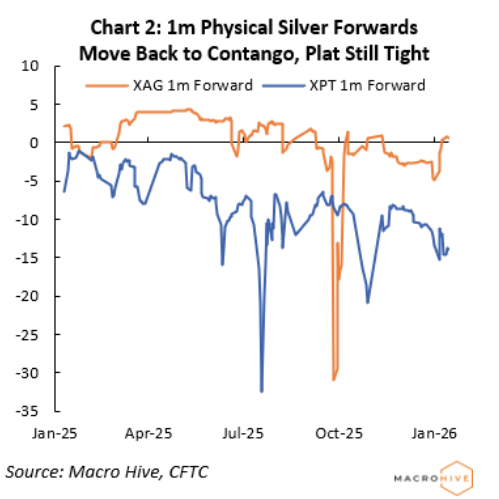
Viresh Kanabar, an investment strategist at Macro Hive, followed this up on Friday by flagging one of several key changes in the market structure for silver. The physical market tightness, cited by bulls as an important driver behind silver’s skyward ascent, is showing signs of reversing.

“1m forwards on physical silver have flipped back to contango,” he wrote. “This lines up with physical ETF outflows and evidence that high prices are weighing on industrial demand.”

Silver contango

“In short, we are not bullish on silver at these levels, instead, see increasing signs of risks skewing to the downside,” Kanabar added.

David Cervantes, founder of Pinebrook Capital Management, told clients on Thursday that he’s taken a short position in silver by owning put options on SLV with three months to expiry, noting that its outperformance of the stock market over the past 100 and 252 days has reached unprecedented levels.

“THIS IS HIGHLY SPECULATIVE AND A SMALL GAMBLE-SIZED WAGER WILL BE MADE OVER WHICH SLEEP WILL NOT BE LOST,” he emphasized.

Latest Stories

Sherwood Media, LLC produces fresh and unique perspectives on topical financial news and is a fully owned subsidiary of Robinhood Markets, Inc., and any views expressed here do not necessarily reflect the views of any other Robinhood affiliate, including Robinhood Markets, Inc., Robinhood Financial LLC, Robinhood Securities, LLC, Robinhood Crypto, LLC, or Robinhood Money, LLC.