Tech
Spotify's CEO & Co-Founder Daniel Ek Joins Author & Comedian Trevor Noah To Discuss The Future Of Storytelling At Spotify Beach
Spotify CEO Daniel Ek has had a lot to smile about since chatting to Trevor Noah in June 2023 (Spotify/Getty Images)

1 in 12 people on Earth is now a Spotify monthly active user

Spotify stock surges after the streaming giant beat expectations and reported its first-ever annual profit.

After spending years struggling to turn a profit, Spotify’s financial 2024 Wrapped was music to the ears of investors. 

Off the back of better-than-expected Q4 earnings this morning — with soaring subscriber numbers and bumper cash flows that helped the company post its first-ever full year of profitability — Spotify shares are soaring 10%, reaching all-time highs that are up ~150% from a year prior.

Track record

The audio streaming giant reported record user numbers, adding a total of 35 million monthly active users (up 12%) to hit 675 million in total, beating analyst expectations and marking the largest Q4 in Spotify's history. (With Earth’s population at about 8 billion, that means about 1 in 12 people in the world is a user.) The share of ad-supported users on the platform remained close to ~60%, and Premium subscribers grew some 11% year over year to 263 million.
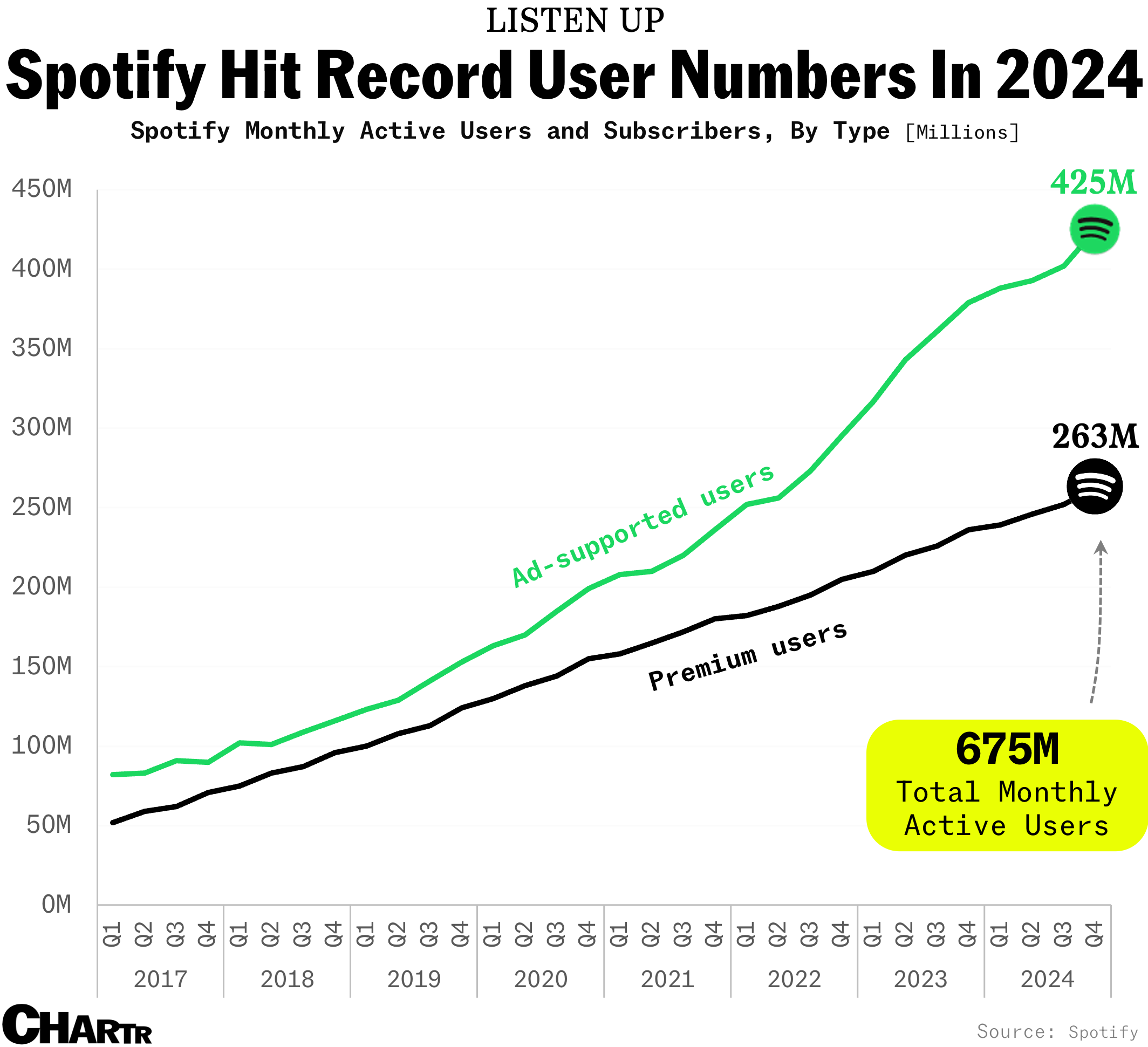
Spotify User Numbers
Sherwood News

Despite multiple rounds of price hikes, the latest of which saw the cost of Spotify Premium rise to $11.99 a month, the company is succeeding in keeping users locked in, with churn rates staying low and the tally of free listeners continuing to tick up. It seems that an emphasis on product features is working to make the service more appealing to audiophiles: the report outlined that Spotify’s 10th annual Wrapped last year was its biggest ever, reaching 184 global markets and driving user engagement up 10% year over year.

Fine tune

Amped-up user numbers contributed in no small part to the first full-year profit in Spotify’s history. The company reported that quarterly operating income rose to €477 million ($485 million) — a U-turn from the prior year’s €42 million loss — bumping net income to a total of €1.14 billion ($1.2 billion) for 2024. 

Beyond listening power, the “efficiency strategy” championed by founder and CEO Daniel Ek is also paying off: in Q4, gross profit margins climbed to a record 32.2%, free cash flow generation reached an all-time high of €877 million, and operating expenses declined 16% year on year. Indeed, the company has honed in on finally achieving profitability in recent years, overseeing a series of company-wide layoffs and cutting some marketing spend.

Play on, pay out

Looking forward, Ek has said that Spotify will “continue to place bets that will drive long-term impact,” including maintaining these levels of efficiency while focusing on diversifying content, prioritizing new partnerships — including, most recently, with Universal Music, the biggest music company in the world — and doubling down on creator monetization programs.

On top of the hot-button issue of audience-driven payouts for artists (Spotify was keen to tell everyone that it forked out over a record $10 billion to the music industry in 2024), the company also outlined plans to enhance business offerings for increasingly important podcast creators and authors with new, tailored payout schemes.


More Tech

See all Tech
tech

Anthropic launches “Claude Design,” sending shares of Figma and Adobe down

Anthropic has been slowly and steadily gaining a leading share in the enterprise AI market by focusing on coding, spreadsheets, and other common productivity and workplace apps.

Now it’s going after design apps.

Today Anthropic launched Claude Design, a dedicated app powered by its latest model, Claude Opus 4.7, that lets users use text prompts to build website designs, user interface prototypes, presentations, and marketing materials.

Shares of Figma and Adobe sank on the news.

While Claude has previously had the ability to create designs and user interfaces, breaking it out into a dedicated app signals a major new piece of its enterprise strategy alongside its popular Claude Code product.

Today Anthropic launched Claude Design, a dedicated app powered by its latest model, Claude Opus 4.7, that lets users use text prompts to build website designs, user interface prototypes, presentations, and marketing materials.

Shares of Figma and Adobe sank on the news.

While Claude has previously had the ability to create designs and user interfaces, breaking it out into a dedicated app signals a major new piece of its enterprise strategy alongside its popular Claude Code product.

tech

Apple’s China iPhone shipments surged 20% in Q1 even as overall smartphone shipments fell

Apple’s iPhone shipments in China jumped 20% last quarter, even as the country’s overall smartphone market fell 4%, according to new data from Counterpoint Research. Rising memory costs have pushed prices higher across the industry, weighing on demand.

Apple appears poised to ride out the broader smartphone slump. Its strength at the less price-sensitive high end of the market and its unusual leverage over suppliers, which helps keep costs in check, give it an edge over rivals.

Greater China remains a critical region for Apple, making up about 18% of its total revenue in the fourth quarter. The company accounted for 19% of China’s smartphone market in the first quarter, up from 15% a year earlier, per Counterpoint.

tech
Rani Molla

Anthropic has surged past OpenAI in capturing business spending on generative-AI software

Last quarter, Anthropic attracted the lion’s share of trackable business spending on generative-AI software, according to new data from Ramp, a fintech company that provides corporate cards and expense management software for small firms and Fortune 500 companies alike.

The data showed that in the first quarter, Anthropic saw 37% of spending, its biggest share yet, versus 33% for OpenAI. Notably, the dataset doesn’t capture spending by Google or Microsoft.

OpenAI, which makes ChatGPT, still leads in overall adoption at 81% of AI buyers, but Anthropic is catching up, at nearly 63% in March. Overall, more than half of Ramp’s customers currently pay for AI, up from just 18% two years ago.

Anthropic’s enterprise tools, including Claude Code and Cowork, have been making waves among the business class, sending its revenue soaring.

Anthropic’s revenue share is even higher among companies spending on AI for the first time.

“Anthropic has definitely been on a tear,” Ara Kharazian, Ramp’s economist, told Sherwood News. “Its increase in adoption rates has been driven by its ability to sell to less technical users and smaller contracts than it typically has.”

It’s notable that midway through the first quarter, Anthropic had a falling-out with one of its biggest customers, the US government, which near the end of February decided to shun Anthropic’s products and lean into working with OpenAI.

tech
Jon Keegan

Report: Google ditches its objection to defense work, pitches Gemini to Pentagon

In 2018, Google employees protested against the company’s tech being used for the US military’s Project Maven — a drone targeting program — reminding the company of its “don’t be evil” motto.

After the controversy, the company declined to renew the contract with the Pentagon, drawing a bright line between Big Tech and the national security establishment.

What a difference a few years makes.

Google is now actively working to get its Gemini AI model to be used in classified national security settings, according to a new report from The Information. Seeking a similar deal to the one OpenAI hashed out with the Pentagon, Google reportedly wants a contract that allows use of Gemini in classified work, but with a prohibition on mass domestic surveillance and autonomous lethal weapons.

But Google is playing catch-up in a major way. Amazon and Microsoft both have been widely used for classified defense work, and contractors are already experienced in working with their cloud systems, while Google’s services have never been used in classified work.

What a difference a few years makes.

Google is now actively working to get its Gemini AI model to be used in classified national security settings, according to a new report from The Information. Seeking a similar deal to the one OpenAI hashed out with the Pentagon, Google reportedly wants a contract that allows use of Gemini in classified work, but with a prohibition on mass domestic surveillance and autonomous lethal weapons.

But Google is playing catch-up in a major way. Amazon and Microsoft both have been widely used for classified defense work, and contractors are already experienced in working with their cloud systems, while Google’s services have never been used in classified work.

Latest Stories

Sherwood Media, LLC produces fresh and unique perspectives on topical financial news and is a fully owned subsidiary of Robinhood Markets, Inc., and any views expressed here do not necessarily reflect the views of any other Robinhood affiliate, including Robinhood Markets, Inc., Robinhood Financial LLC, Robinhood Securities, LLC, Robinhood Crypto, LLC, Robinhood Derivatives, LLC, or Robinhood Money, LLC. Futures and event contracts are offered through Robinhood Derivatives, LLC.