Business
Spotify’s profits are driven by premium users

Spotify reported record profits after price hikes

Spotify’s free tier is just the icing on a very large, increasingly profitable, premium cake

Stairway to heaven

Spotify is singing a tune that investors are thoroughly enjoying this morning, with shares in the world’s largest music streaming platform up more than 10% after the company reported a record quarterly profit, continued subscriber growth, and strong guidance for the rest of the year.

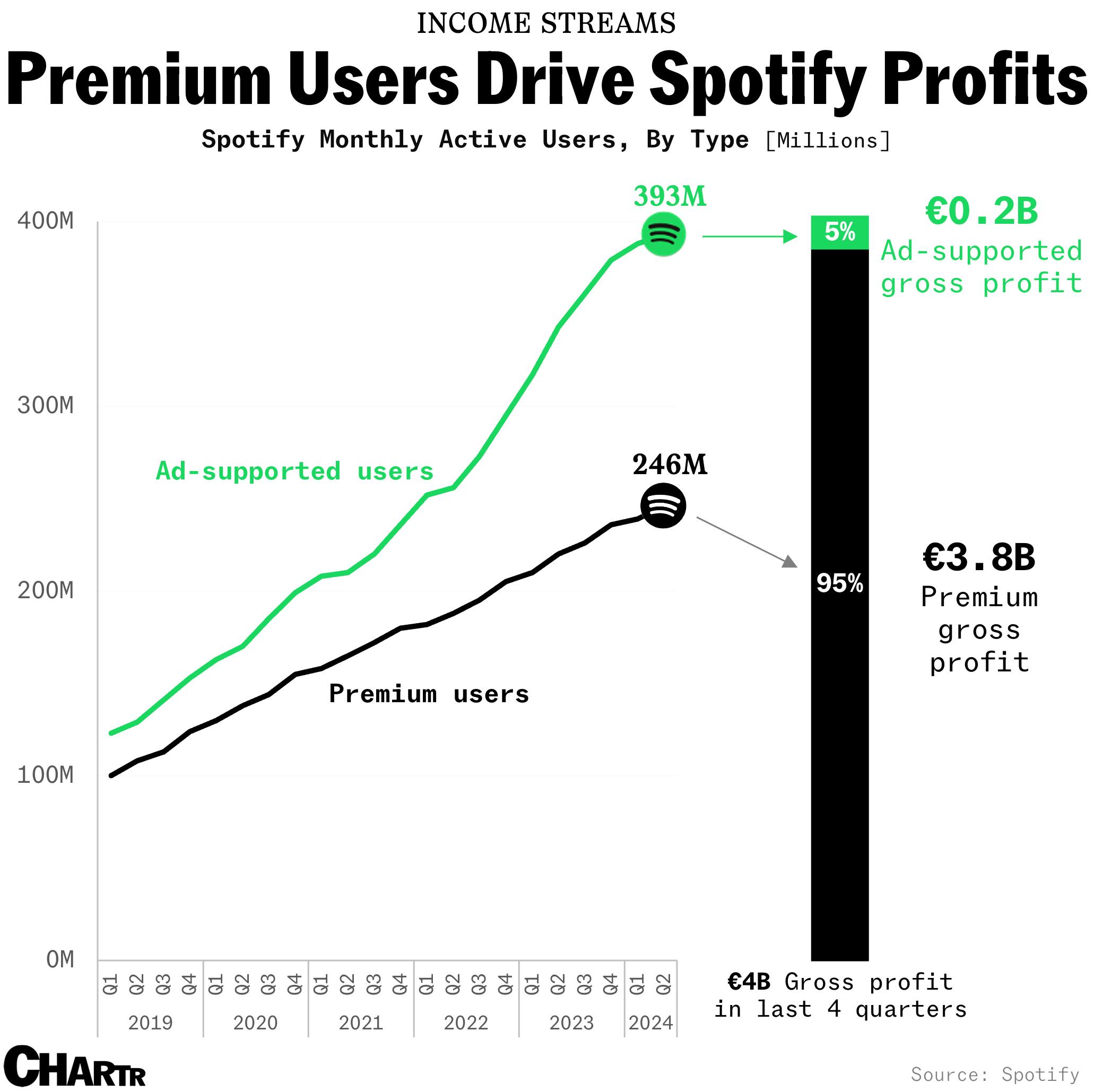
While there was a lot of noise around Spotify increasing prices for the first time ever last summer, and then again earlier this year, premium users weren’t perturbed. Indeed, despite having to cough up more for their music, Spotify’s subscriber numbers were up 12% year-on-year to a record 246 million. The combined effect of higher prices and more subs? Revenue from premium users that was up 21%.

That’s of course carried over to the company’s bottom line too, where it’s also still all about music fans who are forking out a monthly fee: per our calculations, Spotify’s premium users accounted for 95% of the company’s gross profit over the last 12 months.

Oops!... I did it again

Given that this quarter only accounts for up until the end of last month (June 30th), it’s reasonable to assume that the figures mostly reflect just the price hike from last year, while the US price hike in June 2024 has yet to fully wash through for an entire quarter.

Many people seem increasingly willing to live with constant advertising interruptions when sitting down to watch something from their favorite streamers (especially if it means the platforms get considerably cheaper). Indeed, streamers like Netflix are finding success cutting prices for inflation-weary consumers by offering ad-supported tiers.

Music might be different. So far, it seems like watchers might be more price sensitive than music fans: Disney+ actually lost users after its price hike, while Spotify has continued to grow. I guess the question boils down to what is more annoying? An ad interruption during your nightly TV binge, or an ad that breaks up your favorite album?

More Business

See all Business
business
Tom Jones

Demis Hassabis, Google DeepMind’s CEO and founder, was also an early Anthropic investor

A chess prodigy and an actual a knight of the realm in the UK, it’s perhaps no surprise that Demis Hassabis has made some strategic moves about his exposure to AI upside. According to people familiar with the matter, the influential AI architect became an angel investor in Anthropic, currently behind many of the leading AI models, per Arena AI leaderboards.

The Nobel Prize winner’s position in the Claude creator was previously undisclosed and, per the Financial Times, highlights Hassabis’ “growing influence across the AI industry.”

Google, which bought DeepMind, the company that Hassabis cofounded and heads to this day, for a reported ~$400 million in 2014, is also a key Anthropic investor. The tech giant reportedly plans to invest up to $40 billion in the AI company as part of the mutually beneficial relationship the pair have forged, with reports that Anthropic has committed to spending $200 billion in the other direction on Google’s cloud services over the next five years.

Im playing all sides, so I always come out on top

In addition to his financial support for Anthropic, Hassabis has also invested in a range of AI startups launched by colleagues, such as Inflection AI, a company set up by DeepMind cofounder Mustafa Suleyman (who is now CEO of Microsoft AI), as well as efforts from other collaborators, like David Silver’s Ineffable Intelligence.

Hassabis also emerged as a recurring figure on the fringes of the recent Elon Musk v. Sam Altman trial, cropping up repeatedly in testimonies and court documents and appearing to live, as The Verge put it, “rent-free” in Musk’s head.

Founded in 2021, Anthropic has recently raised funding at a reported $900 billion valuation, sending it soaring ahead of competitor OpenAI.

The Nobel Prize winner’s position in the Claude creator was previously undisclosed and, per the Financial Times, highlights Hassabis’ “growing influence across the AI industry.”

Google, which bought DeepMind, the company that Hassabis cofounded and heads to this day, for a reported ~$400 million in 2014, is also a key Anthropic investor. The tech giant reportedly plans to invest up to $40 billion in the AI company as part of the mutually beneficial relationship the pair have forged, with reports that Anthropic has committed to spending $200 billion in the other direction on Google’s cloud services over the next five years.

Im playing all sides, so I always come out on top

In addition to his financial support for Anthropic, Hassabis has also invested in a range of AI startups launched by colleagues, such as Inflection AI, a company set up by DeepMind cofounder Mustafa Suleyman (who is now CEO of Microsoft AI), as well as efforts from other collaborators, like David Silver’s Ineffable Intelligence.

Hassabis also emerged as a recurring figure on the fringes of the recent Elon Musk v. Sam Altman trial, cropping up repeatedly in testimonies and court documents and appearing to live, as The Verge put it, “rent-free” in Musk’s head.

Founded in 2021, Anthropic has recently raised funding at a reported $900 billion valuation, sending it soaring ahead of competitor OpenAI.

Latest Stories

Sherwood Media, LLC and Chartr Limited produce fresh and unique perspectives on topical financial news and are fully owned subsidiaries of Robinhood Markets, Inc., and any views expressed here do not necessarily reflect the views of any other Robinhood affiliate, including Robinhood Markets, Inc., Robinhood Financial LLC, Robinhood Securities, LLC, Robinhood Crypto, LLC, Robinhood Money, LLC, Robinhood U.K. Ltd, Robinhood Derivatives, LLC, Robinhood Gold, LLC, Robinhood Asset Management, LLC, Robinhood Credit, Inc., Robinhood Ventures DE, LLC and, where applicable, its managed investment vehicles.