


Data shows most new apps don’t just fail — they completely bomb
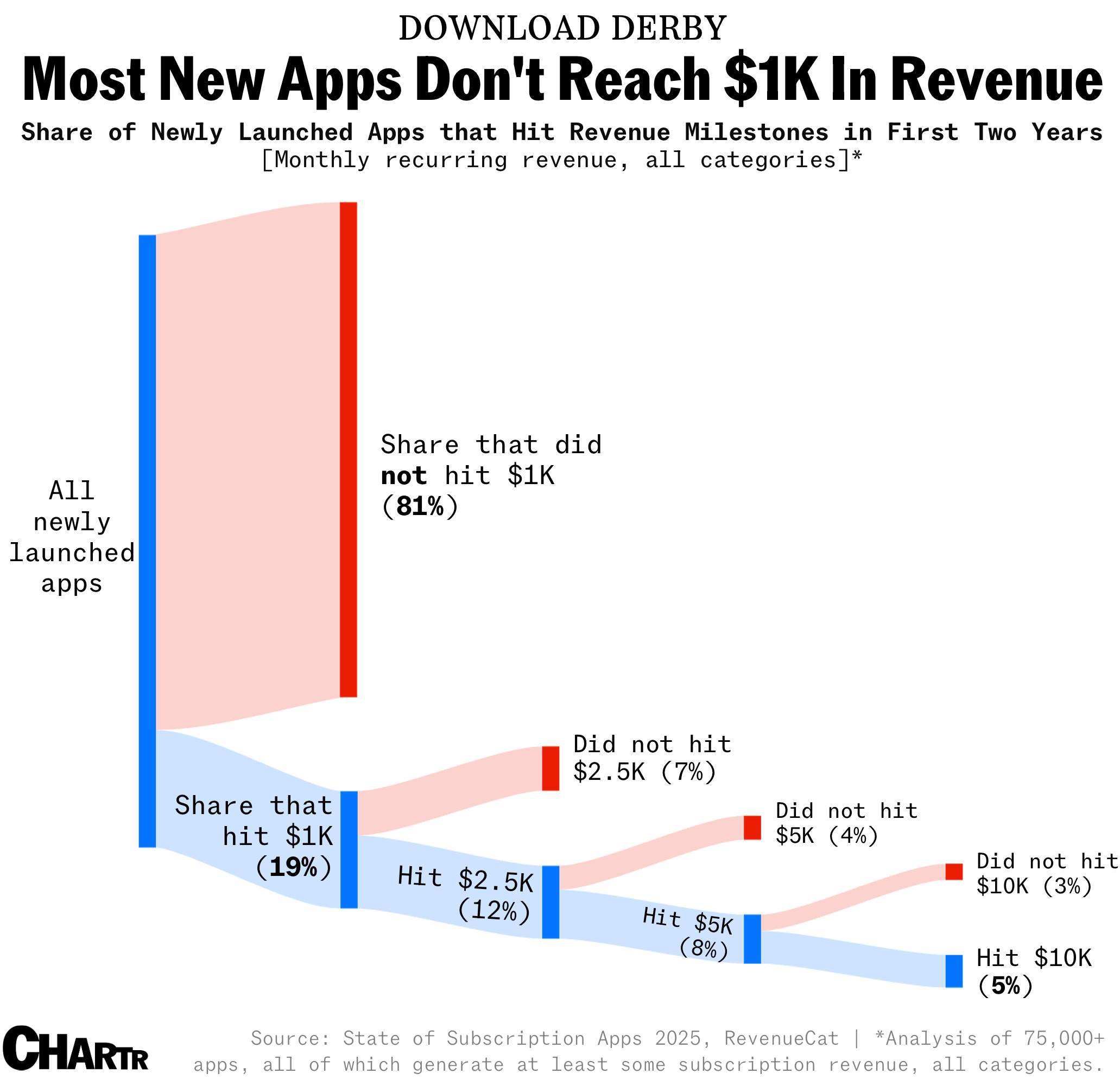
A new report shows that more than 80% of apps never reach $1,000 in monthly revenue in the first two years after launching.
These days, you can’t do anything without signing up for something — with everything from (naturally) streaming services, to news sites, to chatbots, to airlines, to pet suppliers now operating on subscription models.
Luckily for Apple and Google, which take a cut of in-app payments through their respective app stores, many of those subscriptions now start through our phones.
But in the increasingly competitive battle for space on our precious home screens, most apps never even come close to getting enough subscribers to cover their costs.
According to the 2025 State Of Subscription Apps report from RevenueCat, published last week, just a handful of apps now dominate a huge share of users’ screen time. According to the research, the top 5% of newly launched apps make over 400x more in their first two years (~$8,888) than the bottom 25% (~$19).
The report also outlined that only 19% of new apps across all categories generated $1,000 in monthly recurring revenue within two years of launch, implying that 81% failed to hit that threshold. After this, the drop-off is steep, with a large portion of apps failing to meet each consecutive monetary milestone. At the upper end, only 5% of all new apps reached $10,000 in revenue.
Clearly, subscriptions alone are no longer enough for many newly launched apps to survive on. Now, hybrid monetization structures are becoming more common, with 35% of apps overall mixing subscriptions with consumable or lifetime purchases — including ~62% of Gaming apps and ~40% of Social & Lifestyle apps — to fuel revenue growth from both new and loyal app users.
App-eat-app world
Different types of apps also have very different subscription strategies. Health & Fitness apps were uniquely focused on yearly plans, with 66.6% of app subscriptions sold on an annual basis. Clearly, developers in the health arena are hoping that users have enough motivation to instill good habits to commit to an entire year. Gaming apps were the opposite: just 5.7% of subscriptions sold were for an annual plan, while weekly plans dominated, comprising 78% of subscriptions sold in the category.
Overall, of the categories surveyed, Photo & Video apps were the most successful in generating revenue, with ~28% of these newly released apps reaching $1,000 and ~9% reaching $10,000 in their first two years.




